The dominant approach to machine intelligence scales one architecture, the autoregressive transformer. A transformer is a fixed matrix of learned weights that produces output by statistical continuation. Four of its limits are structural, and adding parameters does not remove them: it has no internal test for truth, it...
Ibrahim Vandenberg· Zenodo (CERN European Organi...· 0 citations
A hierarchical Graph Neural Network (GNN) framework for ROI-level breast cancer subtype classification that represents nuclei and tissue regions as linked graph structures is presented and shows that sequential hierarchical fusion is the most effective configuration in this setting.
A. M. Rinaldi, Cristiano Russo, Cristian Tommasino· Data mining and knowledge di...· 0 citations
A dynamic graph neural network classification method integrating machine vision mapping and spatiotemporal evolution that effectively improves the generalization accuracy and anti-interference capability of heterogeneous network entity classification models.
Jing-Yi Xu· International Conference on...· 0 citations
The dominant approach to machine intelligence scales one architecture, the autoregressive transformer. A transformer is a fixed matrix of learned weights that produces output by statistical continuation. Four of its limits are structural, and adding parameters does not remove them: it has no internal test for truth, it...
Ibrahim Vandenberg· Zenodo (CERN European Organi...· 0 citations
Reach audiences
Advertise in front of researchers, engineers, and readers.
This record provides supporting experimental data, source code, selected trained model weights, and reproducibility documentation for the manuscript “RART: A Resource-Aware Recursive Transformer for Stochastic Resource-Constrained Project Scheduling” by Cem Savas Aydin. The study evaluates RART on stochastic resource-c...
Cem Savas Aydin· Zenodo (CERN European Organi...· 0 citations
This record provides supporting experimental data, source code, selected trained model weights, and reproducibility documentation for the manuscript “RART: A Resource-Aware Recursive Transformer for Stochastic Resource-Constrained Project Scheduling” by Cem Savas Aydin. The study evaluates RART on stochastic resource-c...
Cem Savas Aydin· Zenodo (CERN European Organi...· 0 citations
Code, decontaminated data, and model weights for the manuscript "Chemical-space-aware routing enhances PFAS toxicity prediction: large-scale pretraining, conditional fine-tuning, and leakage control". The archive contains the complete pipeline for training and evaluating multi-task graph neural networks (Chemprop D-MPN...
Zhanting Yang· Zenodo (CERN European Organi...· 0 citations
Crystal graph neural networks predict materials properties by propagating information through local atomic environments. In conventional crystal graph convolutional neural networks (CGCNNs), this propagation depth is increased by stacking independently parameterized convolutional layers. This coupling between message-p...
In our earlier methodology paper, we introduced a hierarchical framework combining graph compression, Diffusion Convolutional Recurrent Neural Networks (DCRNNs), and Multi-Agent Reinforcement Learning (MARL) to approximate Bellman’s optimality principle for real-time energy system control, validated using Palm Springs,...
Wan-Gon Lee, Anthony George Constantinides· Electronics· 0 citations
Herbal medicines constitute a chemically diverse source of bioactive molecules and remain important components of traditional and complementary healthcare systems. However, the development of reproducible pharmaceutical formulations from herbal materials is complicated by variability in botanical identity, geographical...
Herbal medicines constitute a chemically diverse source of bioactive molecules and remain important components of traditional and complementary healthcare systems. However, the development of reproducible pharmaceutical formulations from herbal materials is complicated by variability in botanical identity, geographical...
Assistant Professor Pat Pataranutaporn describes a new interface that lets everyday users glimpse inside an AI's neural network before their chatbot ever says a word.
Microsoft Research Blog· microsoft.comJul 13, 2026
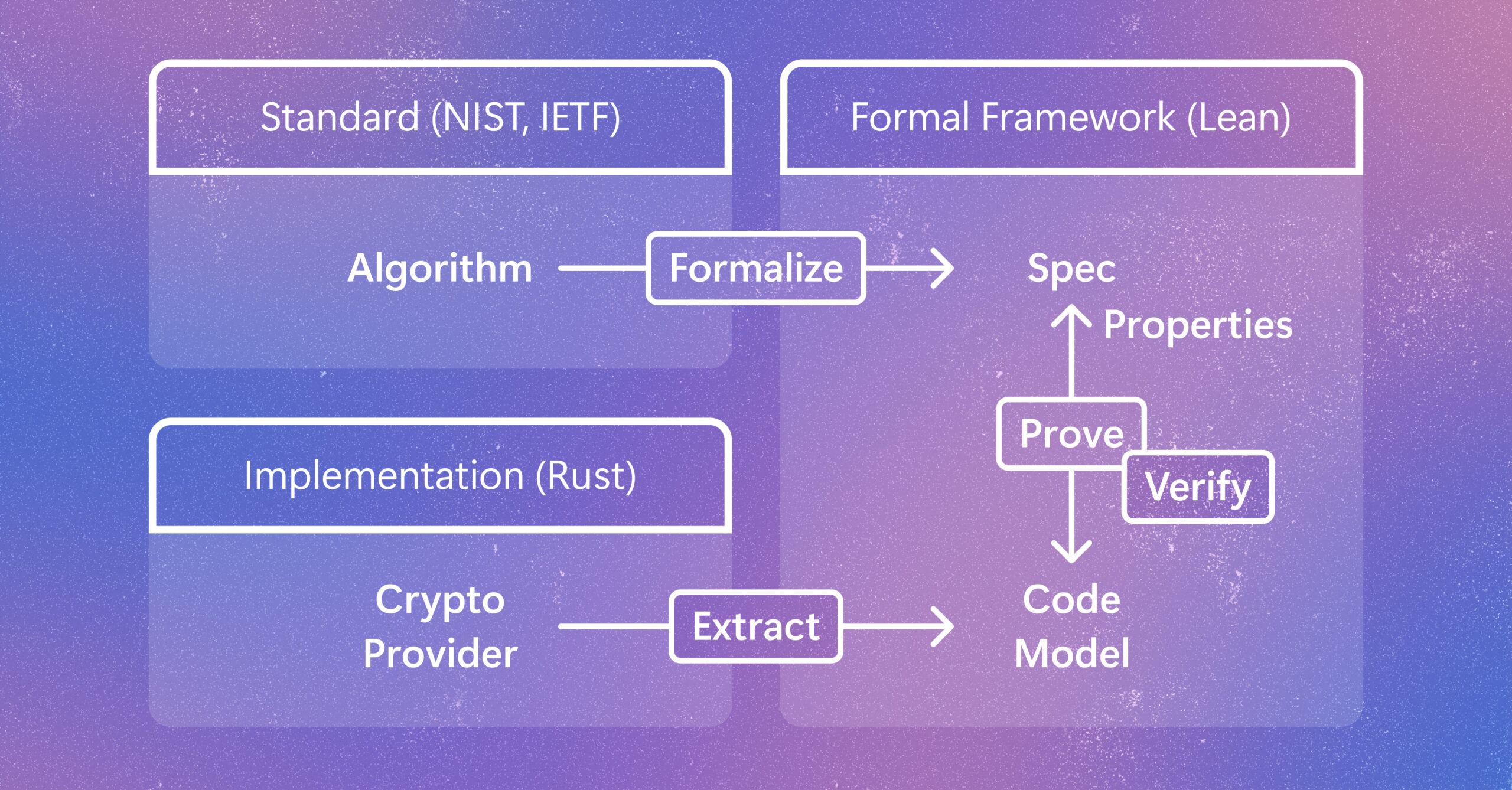
Cryptographic code supports vital protections in modern computing systems. Learn how a new method helps verify code as developers write it while preserving speed and adaptability as it gets implemented and evolves. The post Verifying Rust cryptography in SymCrypt, from standards to code appeared first on Microsoft Research.
MIT News · Artificial Intelligence· news.mit.eduJul 6, 2026
PhD student Rachel Sava, winner of the Envisioning the Future of Computing Prize, explores transformative improvements and dystopian risks of neural technology.