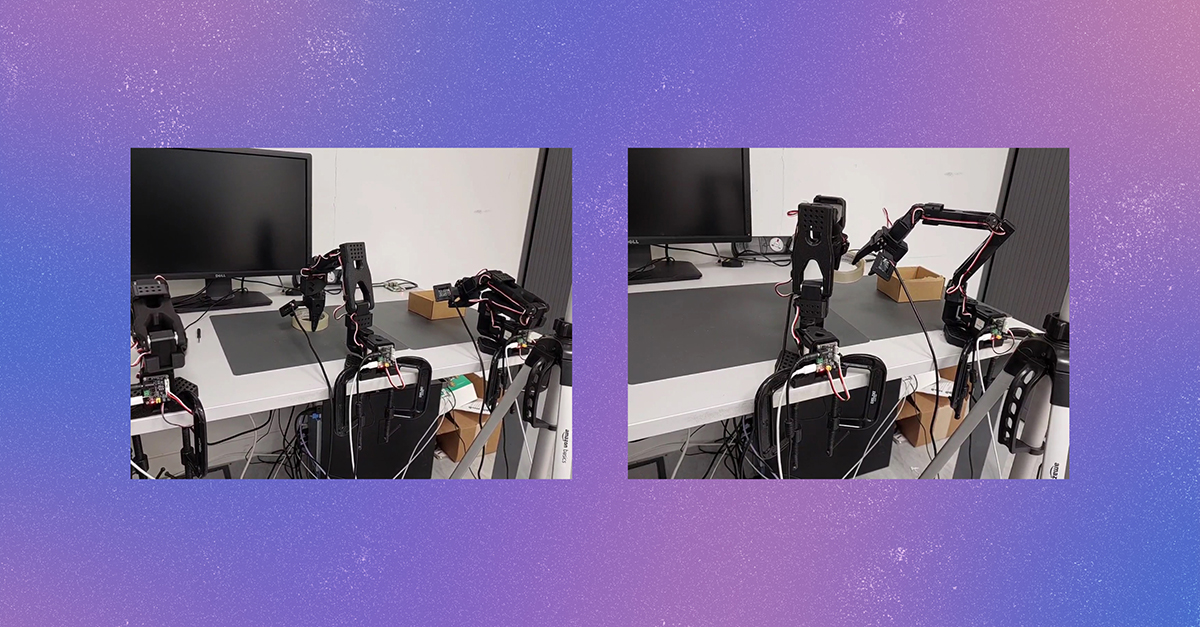
Cloud robotics is an innovative field that leverages cloud technologies-including cloud computing (CC), cloud storage, deep learning, big data, and the Internet of Things to augment the capabilities of robotics. This integration facilitates the execution of robotic functions through a converged infrastructure and share...
Shahnawaz Ahmad, Shahadat Hussain, Khalid Anwar et al.· International Conference on...· 2 citations
We present PAC-MAN, a perception-aware CBF-RL framework that couples control-barrier safety with deployment-realistic onboard sensing for whole-body humanoid dodgeball. The deployed policy sees the ball only as segmentation-masked depth from a head-mounted camera, while training-time CBF guidance represents clearance t...
Lizhi Yang, Junheng Li, Aaron D. Ames· 0 citations
Long-horizon policies trained with reinforcement learning can still achieve high return through inefficient interactions, while rare efficient behaviors discovered during training may be forgotten. We argue that temporal efficiency itself provides a source of self-supervision for reinforcement learning. We introduce Te...
Humanoid loco-manipulation benefits from one controller to coordinate locomotion, arm movements, and fall recovery. These behaviors are difficult to learn together from scratch because they require different skills and objectives. We present HANDOFF, a training architecture that distills motion-tracking, locomotion, an...
Lizhi Yang, Junheng Li, Nehar Poddar et al.· 0 citations
Reach audiences
Advertise in front of researchers, engineers, and readers.
While household robots are often evaluated based on task completion, everyday domestic environments involve value-conflicting situations where robots are expected to choose actions that prioritize diverse values such as human autonomy, efficiency, or social appropriateness. Yet, there are no benchmarks for evaluating r...
Jongwook Han, Hyeongjin Kim, Yohan Jo· 0 citations
EvoScene-VLA is introduced, which uses compact scene tokens to unify within-chunk scene prediction, cross-chunk state propagation, and observation-based correction and shows that a recurrent scene state alone does not necessarily improve performance, whereas state propagation can improve control when combined with geom...
Vision-language-action policies map camera images and natural-language instructions to a robot's motor actions. Some of these policies are designed to reason in text before acting, generating a reasoning chain and decoding actions conditioned on that chain. The works introducing this design offer the reasoning chain as...
Tuan Duong Trinh, Basim Azam, Mohammed Ishaq Ansari et al.· 0 citations
Reinforcement learning explores effectively in domains such as Atari games, navigation, and locomotion, where novelty over states or dynamics is a sufficient signal. In contrast, dexterous manipulation requires rich physical hand--object interactions, but existing methods often suffer from unstable contact-based novelt...
Zixuan Liu, Ruoyi Qiao, Chenrui Tie et al.· 0 citations
A modular manipulation framework that separates high-level planning from low-level control and coupling grounded plan generation with a 3D-based execution policy, this framework achieves state-of-the-art performance on the challenging GemBench benchmark and demonstrates promising transfer to real robots.
Shi-Zhe Chen, Ricardo Garcia, Paul Pacaud et al.· 2 citations
Natural-language instance navigation becomes challenging when the initial user request does not uniquely specify the target instance. A practical agent should reduce the user's burden by actively asking only the information needed to distinguish the target from similar distractors, rather than requiring a detailed desc...
Junhyuk Kwon, Seungjoon Lee, Hyejin Park et al.· 0 citations
This work introduces skill-space shooting, which uses foundation model guidance to explore corrections through reusable skills and turn successful trials into policy improvement, and enables scalable and generalizable policy improvement within and across tasks.
Zi-Hang Rui, Ren-Hao Wang, Hao-Xu Huang et al.· 0 citations
Autonomous vehicles interacting with passengers through natural language must reason beyond immediate commands. Passenger intent may span multiple stages of behavior, depend on future events, refer to surrounding agents or landmarks, and remain relevant as driving conditions evolve. Existing language-enabled driving da...
Parthib Roy, Yashpal Tandon, Marcus Blennemann et al.· 0 citations
Robots are getting smarter, but how can their hardware match that growth? New Microsoft Research findings show that moving AI inference beyond the robot can improve task success, boost efficiency, and support more advanced physical AI workloads. The post Offloaded inference for real-world physical AI robotics appeared first on Microsoft Research.
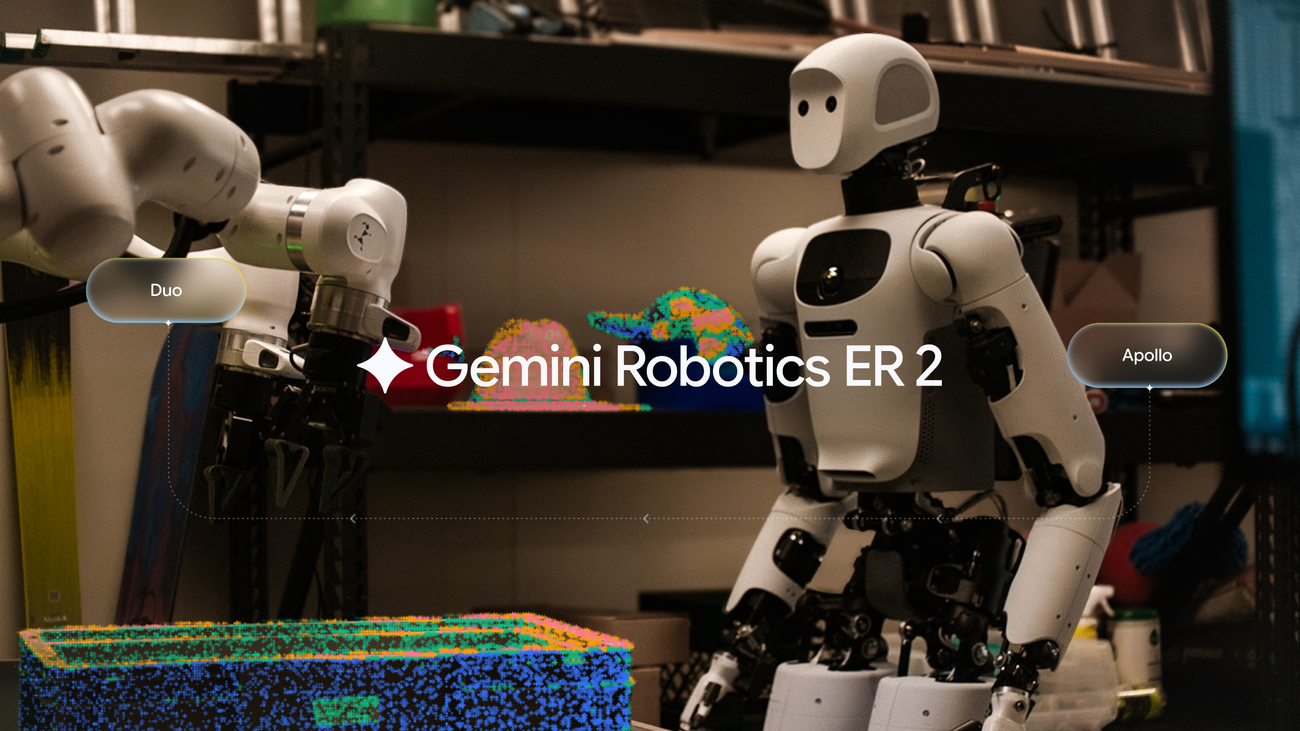
Gemini Robotics ER 2 helps robots reason, collaborate, and solve real-world tasks. It represents a step change in video understanding, tool orchestration, and multi-robot collaboration for robotic applications.
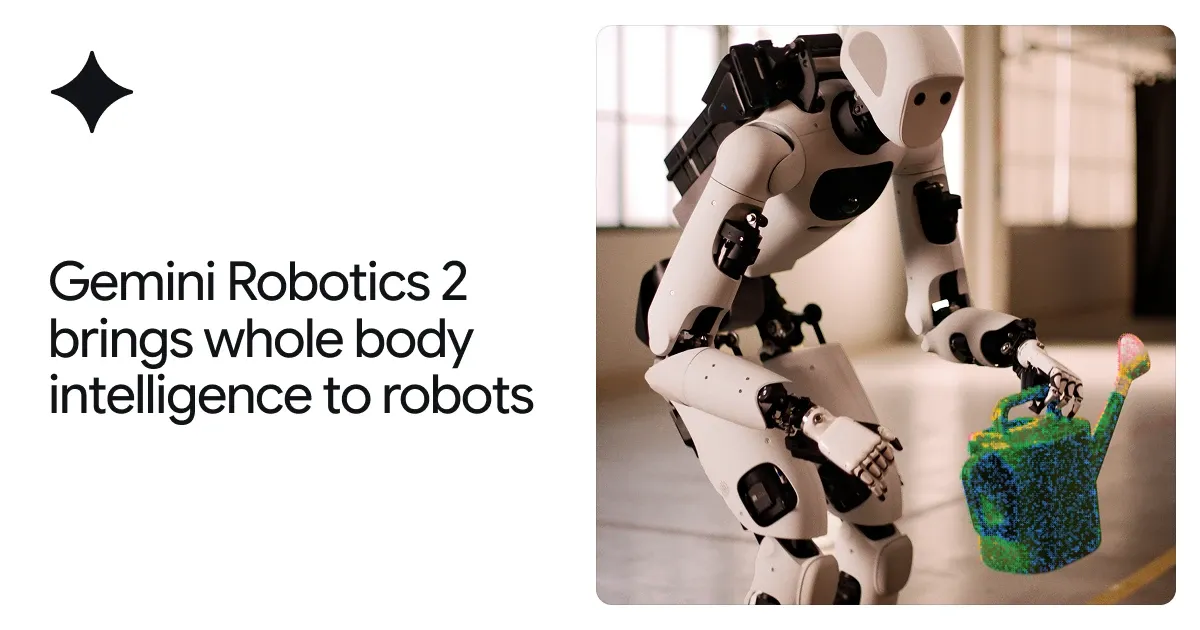
From feet to fingertips — we are teaching robots intelligent whole-body control, fine dexterity, and teamwork to complete a broad range of complex tasks.
We use cookies to run the site and, with your consent, for analytics and to show ads.
See our Cookie Policy.