Jun 2024· International Conference on Computing Communication and Networking Technologies· pp. 1-7· 2 citations· 46 references
Computer Science
Abstract
Cloud robotics is an innovative field that leverages cloud technologies-including cloud computing (CC), cloud storage, deep learning, big data, and the Internet of Things to augment the capabilities of robotics. This integration facilitates the execution of robotic functions through a converged infrastructure and shared services. The domain faces numerous challenges, such as the increasing demand for cloud security, ensuring performance accuracy, meeting the real-time requirements of diverse scenarios, ensuring rapid response, managing remoteness, and addressing network constraints. Although various studies have conducted systematic literature reviews (SLRs) on aspects like requirements elicitation, modeling, stakeholder analysis, and the selection and prioritization of robotics requirements, there has been limited focus on the technologies, research issues, and applications specific to cloud robotics. Addressing this gap, our paper presents an SLR on the achievements and challenges in cloud robotics, aiming to identify research gaps for future investigations in this field.
The rapid expansion of IoT devices has resulted in a paradigm shift from centralized cloud computing models to highly distributed computing continua that incorporate IoT devices, edge gateways, fog nodes, regional cloudlets, and hyperscale cloud data centers. In this survey, we provide an overview of Edge-Fog-Cloud-IoT...
Patrick Effraim, Micheal Mensah, Bismark Budu· Journal of King Saud Univers...· 0 citations
A comparative evaluation of four ROS 2 deployment patterns for cloud-edge robotic AI: monolithic containers, microservices, dynamic module loading and overlay workspaces reveals a clear trade-off between monolithic and microservices patterns, and shows that no pattern dominates.
M. A. Mateo-Casalí, Daniel González El Yachouti, A. Boza et al.· IEEE Access· 0 citations
A structured taxonomy is presented that classifies algorithms into traditional, heuristic, meta-heuristic, and modern learning-based approaches, with a particular emphasis on the increasing adoption of Reinforcement Learning (RL) and Deep Reinforcement Learning (DRL) for dynamic and adaptive scheduling.
This study critically examines the integration of nature-inspired optimization algorithms and deep learning techniques in autonomous mobile robotics, addressing key research gaps related to adaptability, real-time decision-making, and energy-efficient operations.
Ahmed N. Abdalla, J. K. S. Paw, Y. C. Tak et al.· Terra Joule Journal· 2 citations
Dronuum decomposes the wildfire detection pipeline into modular services, including image acquisition, preprocessing, inference, and alerting, and a lightweight YOLOv8n-based classifier is employed for fire detection.
A. Galletta, Auday Al-Dulaimy, M. Villari· 0 citations
The Internet of Robotic Things (IoRT) has introduced new possibilities for distributed and scalable robotic control by combining industrial manipulators with cloud-based computation and networked communication infrastructures. However, the deployment of cloud-assisted robotic systems requires accurate kinematic modelin...
Mohamed S. Elhadidy, Sarah M. Ayyad, Waleed Shaaban et al.· Scientific Reports· 0 citations
What does it take to trust AI-driven HVAC optimization? Our AI Model Factory combines agents, machine learning, reinforcement learning and deterministic checks in a governed workflow designed for messy, real-world building data. The post We built an AI factory for HVAC control appeared first on GPT-Lab.
MIT News · Artificial Intelligence· news.mit.eduAug 18, 2026
A new method for surgically removing training examples from a model reveals that as datasets grow, the link between what a model learns and what it produces dissolves.
MIT News · Artificial Intelligence· news.mit.eduAug 3, 2026
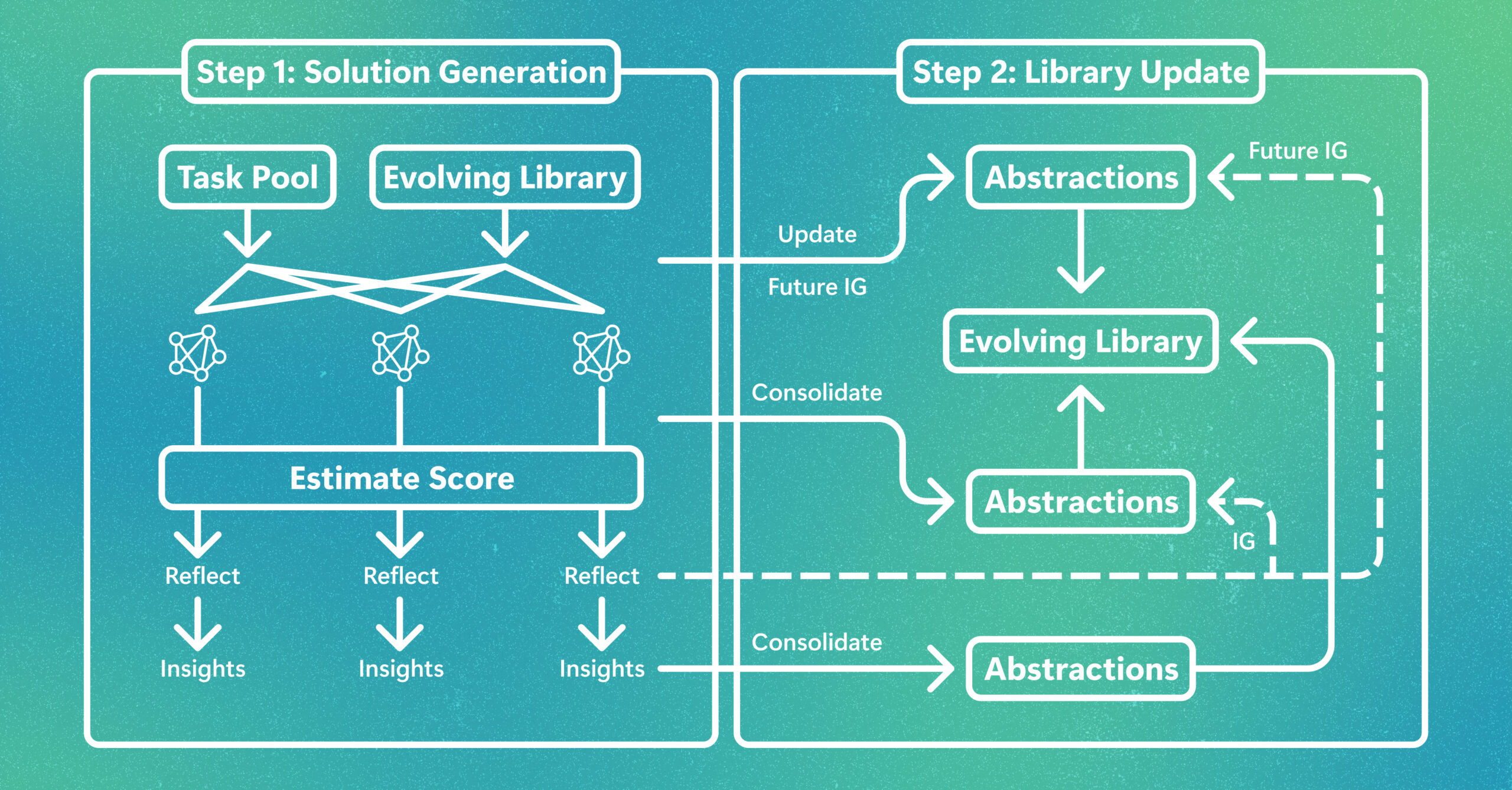
LLMs do not get smarter just by remembering more. EvoLib turns experience into evolving knowledge, taking reusable skills and insights that help models learn and adapt across tasks long after deployment. The post EvoLib: Turning experience into evolving knowledge appeared first on Microsoft Research.
We use cookies to run the site and, with your consent, for analytics and to show ads.
See our Cookie Policy.