Robotic systems routinely encounter conflicting objectives, modeling errors, and degenerate contact conditions that render quadratic programs (QPs) infeasible. Yet most optimization solvers and differentiable QP layers assume feasibility, leading to numerical failures, unstable gradients, or solver breakdown when const...
Aristotelis Papatheodorou, Jose Rojas, Ioannis Havoutis et al.· 0 citations
Developing navigation policies requires simulation scenarios that support repeatable training and evaluation. Despite the availability of numerous simulators, constructing diverse navigation scenarios often involves writing simulator-specific code, using complex graphical interfaces, performing substantial manual confi...
Ruihua Han, Shuai Wang, Chengyang Li et al.· 0 citations
Robotic foundation models offer a promising path toward general-purpose humanoid robot control, often through hierarchical architectures. However, their effectiveness depends on the command interface between the planner and the controller, which must support accurate execution while remaining easy to predict, and ideal...
Fei-Yang Wu, Chen-Xiao Gao, Chen Yang et al.· 0 citations
Robot policies are frequently trained from human corrections, yet teleoperating a robot to provide corrections is burdensome, and human demonstrators are not always optimal. We propose Blended DAgger (BlenDAgger), an approach for collecting data to train imitation learning policies by using shared control to blend the...
Cailyn Smith, Geoffrey Sun, Henny Admoni et al.· 0 citations
Reach audiences
Advertise in front of researchers, engineers, and readers.
Training robust social-navigation policies requires simulators with diverse scene layouts, terrain, and human motion, but constructing such environments and specifying pedestrian behavior is costly. We propose an efficient pipeline that converts ordinary monocular walking videos directly into closed-loop social-navigat...
Vision-Language-Action (VLA) models remain brittle under visual distribution shifts, often relying on spurious correlations tied to domain-specific factors rather than task-relevant structure. We propose Domain-Invariant Latent Lookahead (DILL), a representation-learning framework that mitigates shortcut learning in VL...
Junghyun Kim, Ngseo Kim, Chung-Woo Lee et al.· 0 citations
Generalist robot policies such as vision-language-action models (VLAs) have achieved remarkable generalization, but their inference delays can conflict with the demands of real-time control. Asynchronous execution avoids pauses between action chunks by predicting the next sequence of actions while the robot carries out...
Moritz Zoellner, Reece O'Mahoney, Ioannis Havoutis et al.· 0 citations
A detector pretrained on a broad corpus is fine-tuned on a narrow domain, its in-domain accuracy improves, and it ships. We ask what happens meanwhile to its coverage of objects the vocabulary never names, which in obstacle detection and inspection carry the risk. No in-domain test set holds an example of one. We give...
Trung Minh Bui, Jongsul Moon, YoungOuk Kim et al.· 0 citations
Vision-language-action (VLA) models perform well on shorter-horizon manipulation tasks but still struggle with long-horizon tasks that require multiple dependent manipulations from a single command. Online reinforcement learning (RL) can improve these policies through environment interaction, yet many existing methods...
Ziyi Yin, Sangmin Woo, Kang Zhou et al.· 0 citations
General-purpose robots must infer what a new task requires and translate that understanding into appropriate physical action. In-context learning (ICL) for robots supports this process by using demonstrations and interaction to direct existing competence with neural parameters held fixed during deployment. We organize...
Hao-Jian Huang, Ze-Xi Li, Ju-Hao Guo et al.· 1 citation
Generative modeling is widely used for producing diverse objects from complex, multimodal distributions. However, its expressivity does not, in general, come with formal guarantees that the generated objects satisfy hard constraints or requirements. In multi-agent generation, this problem becomes more challenging becau...
Ruoyu Lin, Magnus Egerstedt, Fabio Pasqualetti· 0 citations
Action chunking provides temporal abstraction in reinforcement learning by selecting short action sequences instead of individual actions, but many existing approaches face two limitations in high-dimensional robotic control. First, many rely on value functions over action chunks, which can be difficult to learn as act...
Robots are getting smarter, but how can their hardware match that growth? New Microsoft Research findings show that moving AI inference beyond the robot can improve task success, boost efficiency, and support more advanced physical AI workloads. The post Offloaded inference for real-world physical AI robotics appeared first on Microsoft Research.
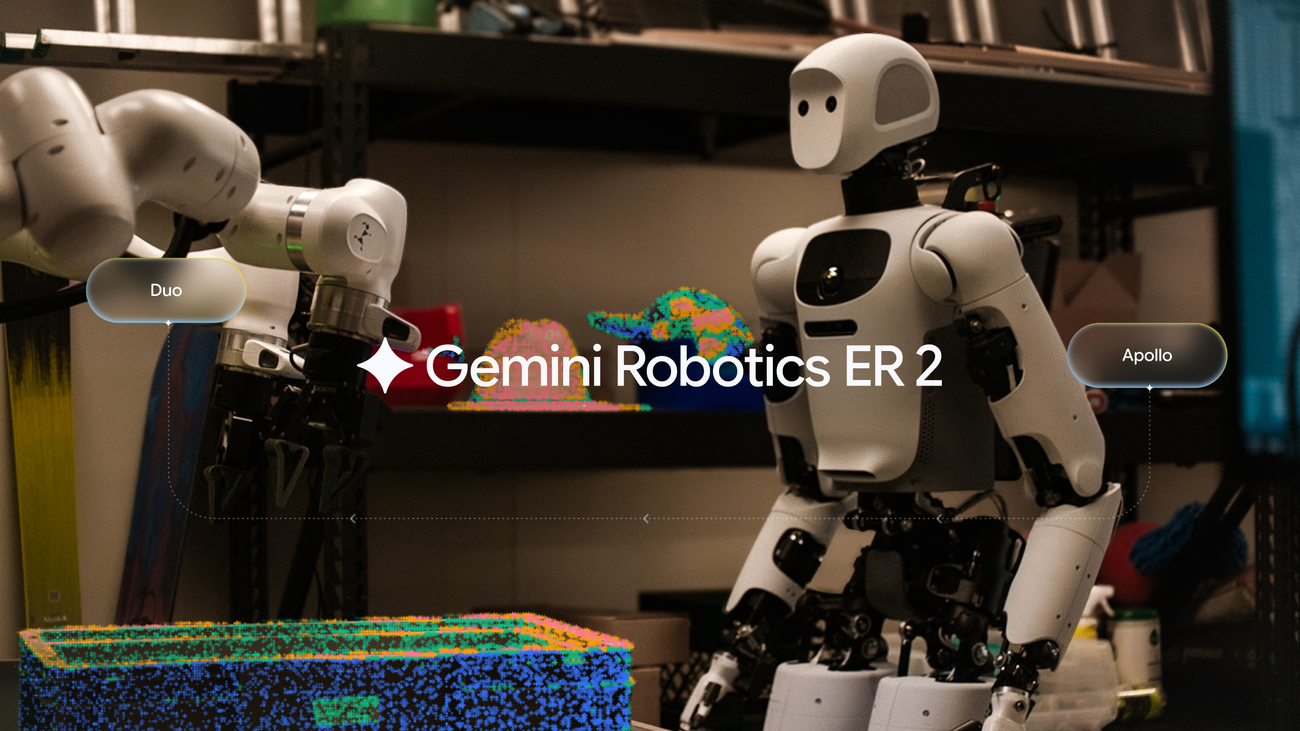
Gemini Robotics ER 2 helps robots reason, collaborate, and solve real-world tasks. It represents a step change in video understanding, tool orchestration, and multi-robot collaboration for robotic applications.
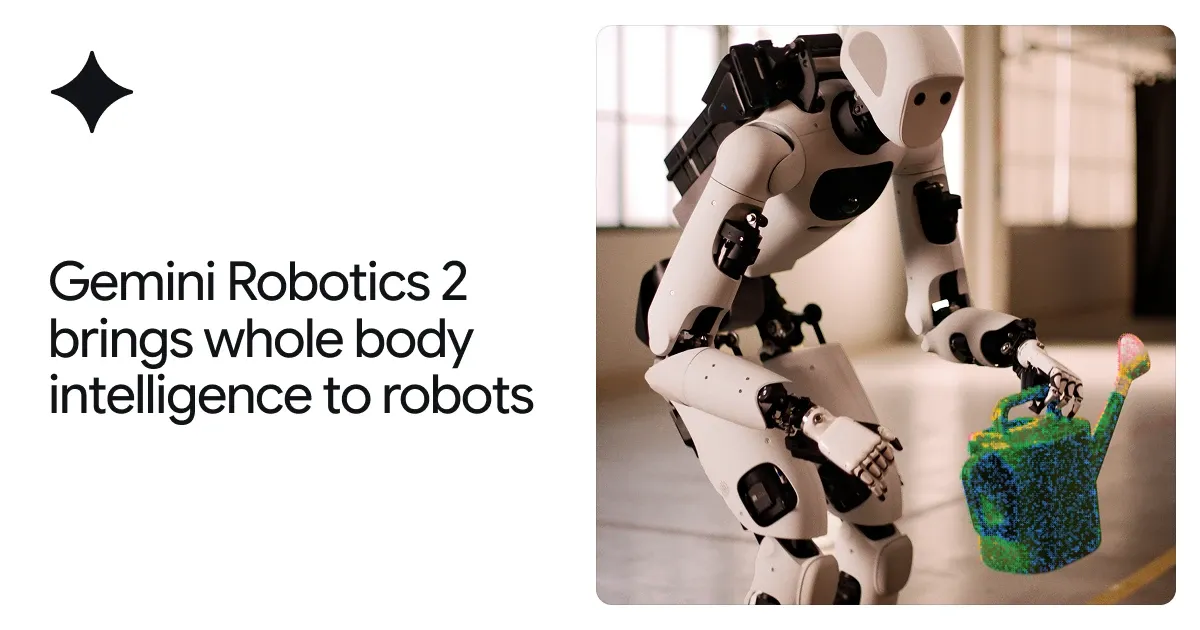
From feet to fingertips — we are teaching robots intelligent whole-body control, fine dexterity, and teamwork to complete a broad range of complex tasks.
We use cookies to run the site and, with your consent, for analytics and to show ads.
See our Cookie Policy.