Embodied systems must make knowledge acquired during one encounter usable in another despite changes in viewpoint, motion, and illumination. Yet aggregate cross-video accuracy conflates failures of local perception with failures to preserve observation identity, establish correspondence, and compose evidence, obscuring...
Yue-Dong Tan, Lei-Tao Qi, Yu Liu et al.· 0 citations
Average performance on routine driving benchmarks does not establish planner reliability under rare, safety-critical hazards. We proposed ExceptionDrive, a counterfactual planning benchmark that uses VLM-assisted screening, localized multi-view editing, and quality auditing to insert hazards into real nuScenes scenes w...
Vision-language-action and world-action models have demonstrated impressive capabilities in robotics, yet generalization to unseen tasks remains challenging. More recently, general-purpose multimodal agents have shown great potential for zero-shot robotic task solving. However, they often incur high execution costs by...
Si-Cheng Xie, Yi-Tong Chen, Hai-Dong Cao et al.· 0 citations
Search and Rescue (SAR) operations increasingly deploy heterogeneous teams of aerial and ground robots. However, conventional coverage methods typically do not translate perceived terrain into platform-specific reachability, while continuous image exchange imposes a high communication cost. We propose an edge-centric,...
Abdulqader Dhafer, Qi Wang, Z. Hao· 0 citations
Reach audiences
Advertise in front of researchers, engineers, and readers.
Test-time adaptation for vision-language navigation (TTA-VLN) enables pretrained policies to adapt online to unseen environments using only test-time observations and interaction history. However, distribution shifts can distort local action preferences and lead to off-course decisions. Existing methods rely on predict...
Yang Li, Sijia Zhang, Yihan Li et al.· 0 citations
Large language models (LLMs) are increasingly used as high-level planners in robot navigation, but their outputs may become unreliable when instructions are ambiguous, unsupported by the environment, or semantically inconsistent. This paper presents a Risk-Aware Semantic Grounding framework for trustworthy LLM-based ro...
Łukasz Sobczak, Nur Keleşoğlu, S. Nowak· 0 citations
Video-based policy learning is particularly promising, as it illustrates target behaviors without requiring action annotations or embodiment-matched demonstrations. A central challenge is deciding what information should be transferred from the video to the robot. Existing approaches commonly convert visual observation...
Merve Atasever, Keyan Azbijari, Cagan Bakirci et al.· 0 citations
Coding agents can now write, run, and debug programs with little human help. Robot tasks, however, are usually specified by a sentence that leaves out how to grasp, in what order to make contact, and what the result should look like, and an agent given only the sentence must find these details by trial and error. We in...
Yi-Fan Kang, Zihan Wang, Zhi-Wen Fan et al.· 0 citations
P predictive visual latents are established as a foundation for effective WAM learning from task-specific demonstrations and for transferring future-modeling knowledge acquired from broader in-the-wild videos.
Yang Zhang, Jiang-Yuan Zhao, Chen-You Fan et al.· 0 citations
Human demonstrations capture diverse scenes and rich whole-body skills without requiring robot teleoperation. Prior work on egocentric transfer has emphasized scene generalization in loco-manipulation under decoupled control, leaving direct transfer of coordinated whole-body skills less explored. We present EgoHumanoid...
Jin Chen, Yi-Ming Jiang, Chong-Yang Xu et al.· 0 citations
Rare but consequential failures can persist in learned locomotion policies for legged robots even when average task performance is high, in part because standard curricula primarily adapt task difficulty rather than the distribution of safety-critical experience. We introduce Predictive Safety Curricula (PSC), a framew...
Ivan Ovinnikov, Pascal Sutter, Christian Gehring et al.· 0 citations
Visually plausible articulated assets may still fail during contact interactions or exhibit inaccurate motion. We present FACT (Fidelity-Aware Construction of Articulated Twins), an agentic framework that progressively constructs articulated twins to improve geometry, contact, and dynamic fidelity. The agent drives an...
Kui-Xiang Shao, Chuan-Sen Nie, Yi-Nuo Bai et al.· 0 citations
Robots are getting smarter, but how can their hardware match that growth? New Microsoft Research findings show that moving AI inference beyond the robot can improve task success, boost efficiency, and support more advanced physical AI workloads. The post Offloaded inference for real-world physical AI robotics appeared first on Microsoft Research.
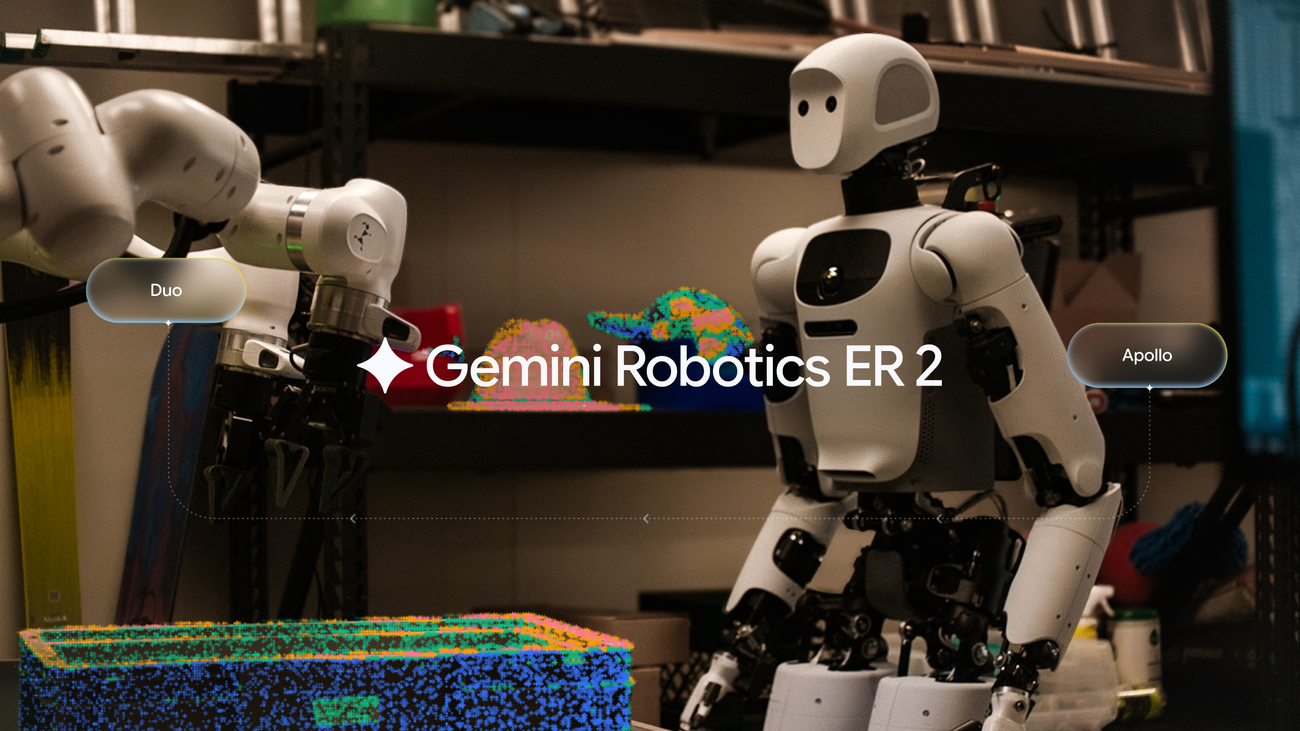
Gemini Robotics ER 2 helps robots reason, collaborate, and solve real-world tasks. It represents a step change in video understanding, tool orchestration, and multi-robot collaboration for robotic applications.
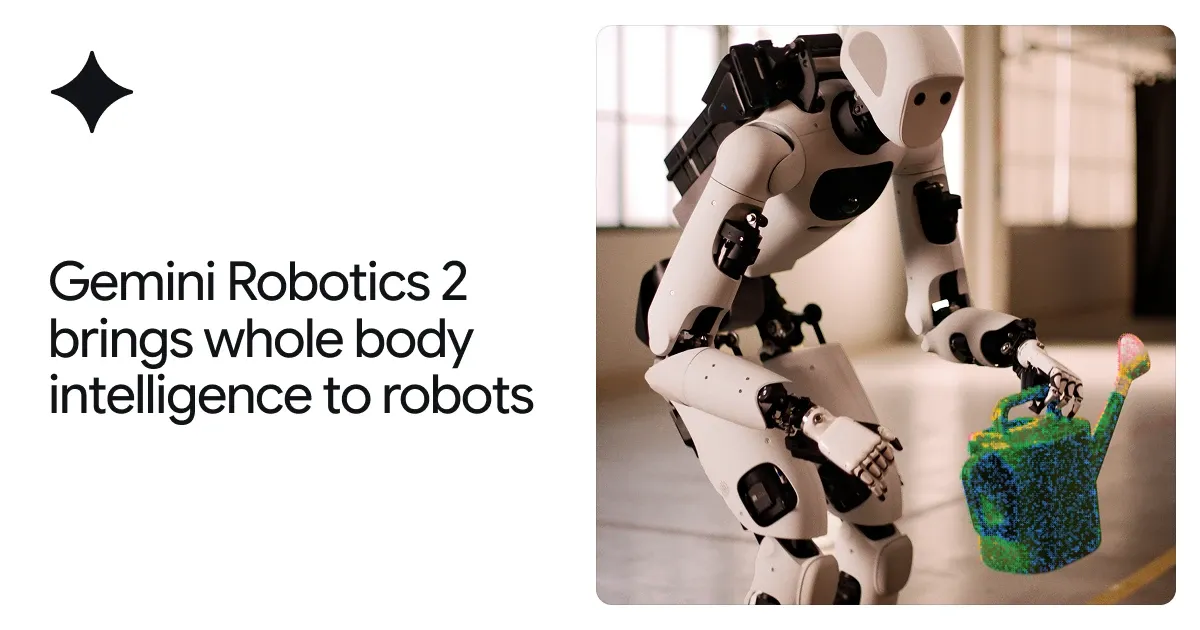
From feet to fingertips — we are teaching robots intelligent whole-body control, fine dexterity, and teamwork to complete a broad range of complex tasks.
We use cookies to run the site and, with your consent, for analytics and to show ads.
See our Cookie Policy.