Grow with the Flow: Scalable Graph Neural Networks for Energy Grid Reliability
Charlotte Cambier van Nooten
· Zenodo (CERN European Organi... · 0 citations
Category
1,828 papers
Computational fluid dynamics (CFD) discretizes the Navier-Stokes equations on computational meshes to obtain flow-field quantities like velocity, pressure, and density through numerical iteration, but traditional solvers, though reliable in accuracy, are computationally expensive and time-consuming for high-Reynolds-nu...
Abstract Low Earth Orbit (LEO) satellite augmentation can improve the availability and satellite geometry of Precise Point Positioning (PPP). However, most existing Global Navigation Satellite System (GNSS)/LEO PPP methods rely on fixed stochastic models and do not fully exploit the heterogeneous characteristics of GNS...
Graph-structured data is ubiquitous, yet labeled graph data remains scarce and expensive, limiting the effectiveness of supervised graph neural networks (GNNs). To address this, self-supervised learning (SSL) has emerged as a promising paradigm to pre-train GNNs on unlabeled graphs. However, existing SSL methods typica...
Reach audiences
Advertise in front of researchers, engineers, and readers.
<jats:p> Graph neural networks and spectral embeddings aggregate local neighbourhoods and so miss the global metric properties—growth rate, hyperbolicity, boundary at infinity—that govern large-scale structure in hierarchical, networked, and negatively curved data. We propose a fr...
Abstract Personalized training path planning has emerged as an active concern in intelligent sports education, yet many existing approaches struggle to capture the dependencies that link diverse movement features. This study develops a graph convolutional neural network (GCN) approach that models learner movement featu...
Abstract The increasing complexity of digital circuits has encouraged the use of Artificial Intelligence (AI) in Electronic Design Automation (EDA) to assist with logic synthesis, circuit optimization, and design analysis. Machine learning approaches, including Graph Neural Networks (GNNs) and Reinforcement Learning (R...
GOLDWALK A Marked-Walk Engine for Cyclic Groups Author: C. J. Tully ORCID: 0009-0007-5661-7332 https://doi.org/10.5281/zenodo.23021217 Version: 0.1 Date: 29 September 2026 License: CC BY 4.0 Resource type: Technical note / Software documentation --- Abstract GOLDWALK is a software and theorem-card package for enumerati...
Abstract Hybrid-Vlasov simulations resolve ion-kinetic effects in the solar wind–magnetosphere interaction, but even 5D (2D + 3V) configurations are computationally expensive. We show that graph-based machine learning emulators can learn the spatiotemporal evolution of electromagnetic fields and lower-order moments of...
The Lifshitz-Petrich (LP) model is a classical model for describing complex spatial patterns such as quasicrystals and multiphase structures. Solving and classifying the solutions of the LP model is challenging due to the presence of high-order gradient terms and the long-range orientational order characteristic of the...
Assistant Professor Pat Pataranutaporn describes a new interface that lets everyday users glimpse inside an AI's neural network before their chatbot ever says a word.
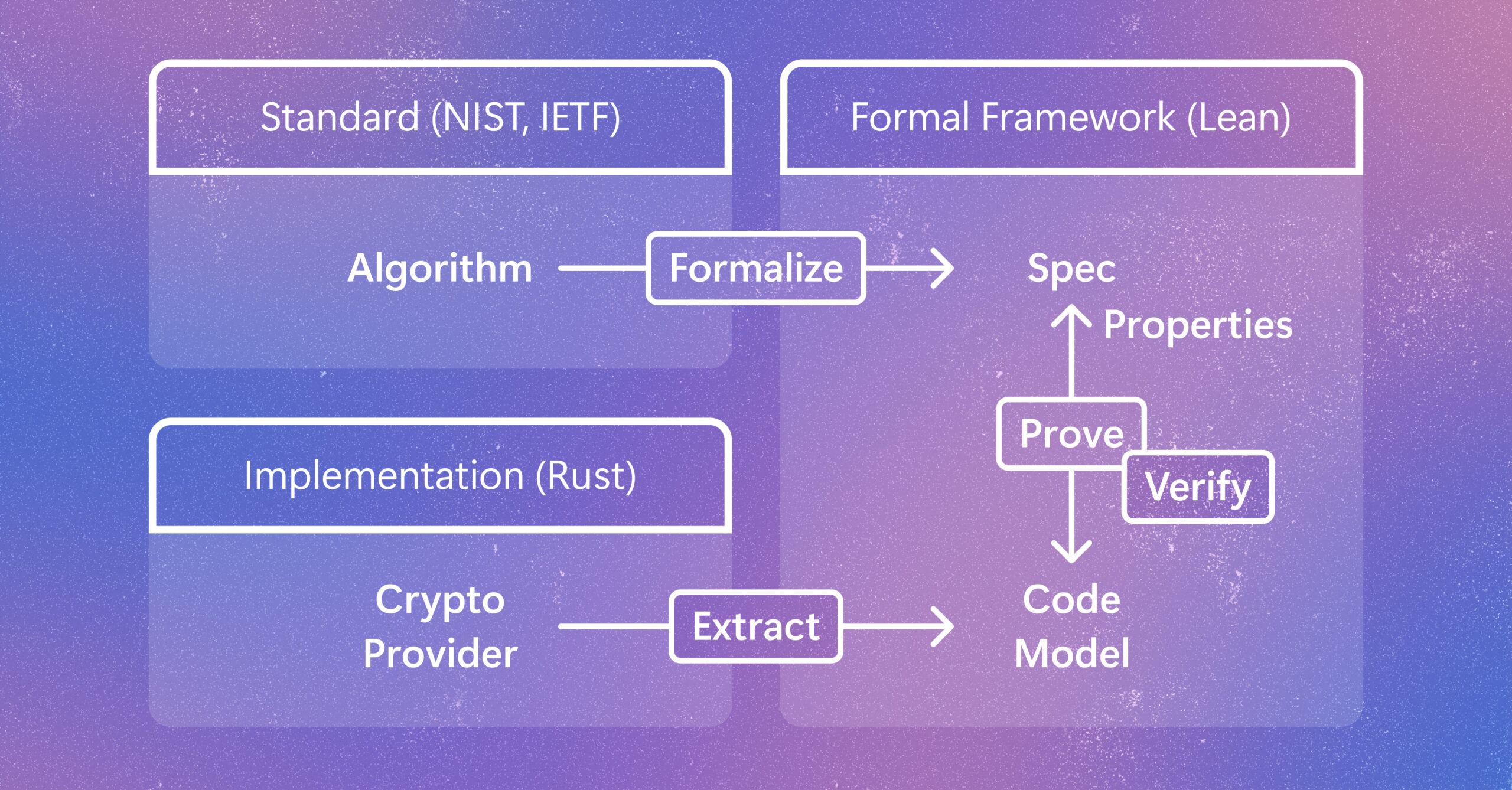
Cryptographic code supports vital protections in modern computing systems. Learn how a new method helps verify code as developers write it while preserving speed and adaptability as it gets implemented and evolves. The post Verifying Rust cryptography in SymCrypt, from standards to code appeared first on Microsoft Research.
PhD student Rachel Sava, winner of the Envisioning the Future of Computing Prize, explores transformative improvements and dystopian risks of neural technology.
Climate & Sustainability
We use cookies to run the site and, with your consent, for analytics and to show ads. See our Cookie Policy.