Path finding and multi-robot motion planning require trajectories that are smooth, goal-directed, and collision-free in environments with complex geometric constraints. Recent diffusion-based planners have shown that trajectory generation can be cast as iterative denoising which has opened the doors to learning-based a...
Michael Y. Fatemi, Jin-Hao Liang, Ferdinando Fioretto· 0 citations
Autonomous driving systems have become a central focus of intelligent transportation research, with End-to-End Learning and Modular Architectures offering two prominent design paradigms for their implementation. E2E Learning uses deep learning algorithms to map raw sensory inputs directly to driving actuators, providin...
Most current grasp synthesis systems are trained offline and remain fixed during deployment. While this works well when deployment conditions resemble the training data, performance can degrade when robots encounter conditions they have not seen before, such as unfamiliar objects. In this work, we present a continual-l...
Giulio Schiavi, Andrei Cramariuc, Michael Pantic et al.· 0 citations
Coordinated multi-humanoid loco-manipulation is promising yet challenging due to high-dimensional whole-body control, decentralized decision making, and scalability. While recent reinforcement learning methods have improved single-humanoid whole-body control, extending them to the multi-humanoid setting remains nontriv...
Yi-Fan Hu, Lu-Hang Hong, Ming-Kang Long et al.· 0 citations
Reach audiences
Advertise in front of researchers, engineers, and readers.
A Data-Strategy-Platform taxonomy is introduced that conceptualizes training as an interdependent system and surveys recent advances across data-centric pipelines, learning paradigms, and training infrastructures, and analyze their interplay in shaping model performance, robustness, and deployability.
Cheng-Kai Xu, Yi-Ming Cui, Jia-Qi Liu et al.· IEEE transactions on intelli...· 5 citations
Controlling an agent with vision requires being able to separate useful information from irrelevant background information. JEPA-style latent world models seem like a natural approach for this, as they do not perform pixel-level reconstruction; however, they are still sensitive to these distractor signals and experienc...
Morgan Byrd, Robert Wright, Sehoon Ha· 0 citations
Vision-language-action (VLA) models often struggle to generalize to skill combinations absent from their fine-tuning demonstrations, even when every constituent skill has been demonstrated. We focus on a vision shortcut as one failure mode: during fine-tuning, visual observations can serve as a proxy for the instructio...
Taegeun Yang, Youngju Na, Yoonki Cho et al.· 0 citations
Autonomously constructing physically realizable 3D structures remains a significant challenge due to combinatorial action spaces, interchangeable components, equifinal assembly sequences, and strict stability requirements during construction. State-of-the-art methods fine-tune large language models for text-based gener...
Gadiel Sznaier Camps, Cheng-Yang He, G. Sartoretti et al.· 0 citations
Latent world models plan by scoring candidate action sequences with distances in latent space. However, task success is judged by physical quantities, which we call the success-criterion quantities. In all four latent world models we examine, the end-effector position is encoded in the latent state with an error larger...
The cross-entropy method (CEM) uses world-model scores to select action sequences and fit the distribution sampled in its next iteration. A scoring error can therefore change both the present decision and the candidates considered later. We evaluate these two roles separately. Four types of predictive model generate CE...
This paper explores a reward-based policy to achieve zero-shot transfer between source and target environments with completely different observation spaces. While humans can demonstrate impressive adaptation capabilities, deep neural network policies often struggle to adapt to a new environment and require a considerab...
Morgan Byrd, Jacob Blevins, Maks Sorokin et al.· 0 citations
While humans readily repurpose a book, a stone, or a shoe to drive a nail, robots trained on specific tools fail to transfer the same function to novel ones -- a gap we formalize as functional generalization. Functionally equivalent tools share visually recognizable functional intent, such as where contact can occur an...
Chuhao Zhou, Liquan Wang, Shuxin Cao et al.· 0 citations
Robots are getting smarter, but how can their hardware match that growth? New Microsoft Research findings show that moving AI inference beyond the robot can improve task success, boost efficiency, and support more advanced physical AI workloads. The post Offloaded inference for real-world physical AI robotics appeared first on Microsoft Research.
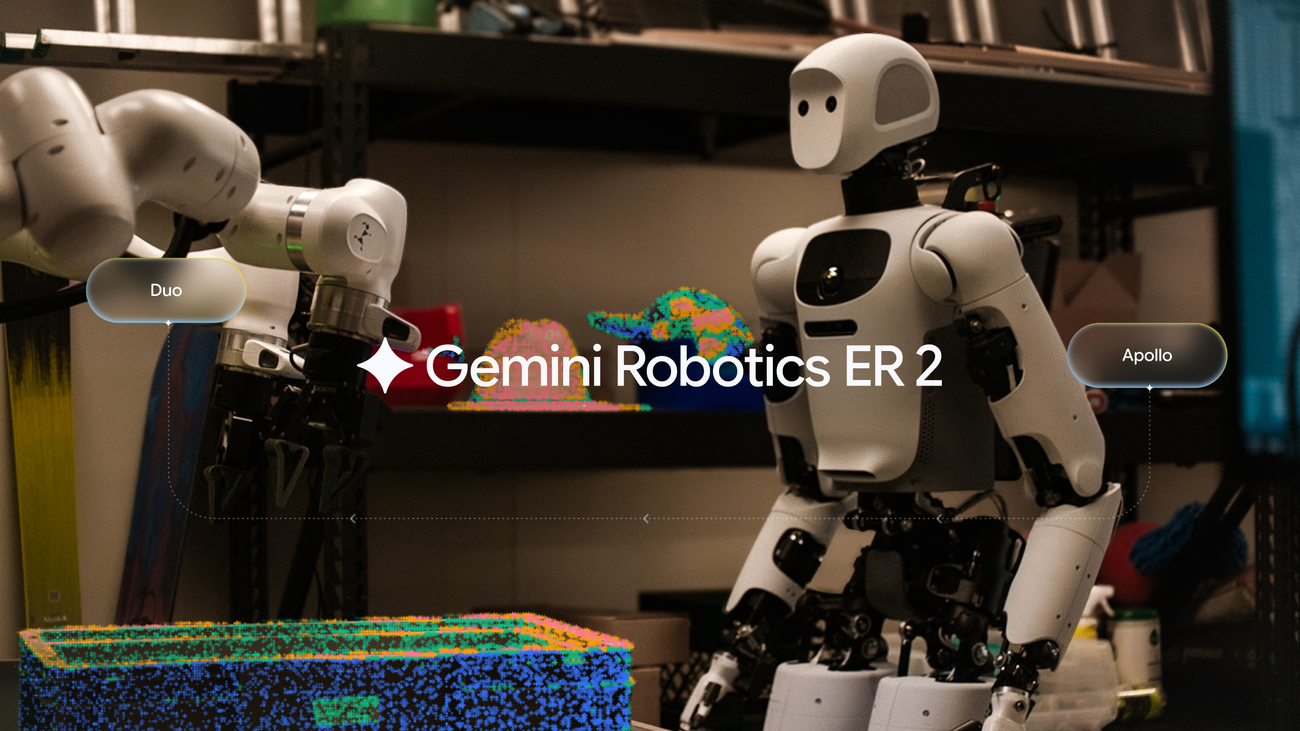
Gemini Robotics ER 2 helps robots reason, collaborate, and solve real-world tasks. It represents a step change in video understanding, tool orchestration, and multi-robot collaboration for robotic applications.
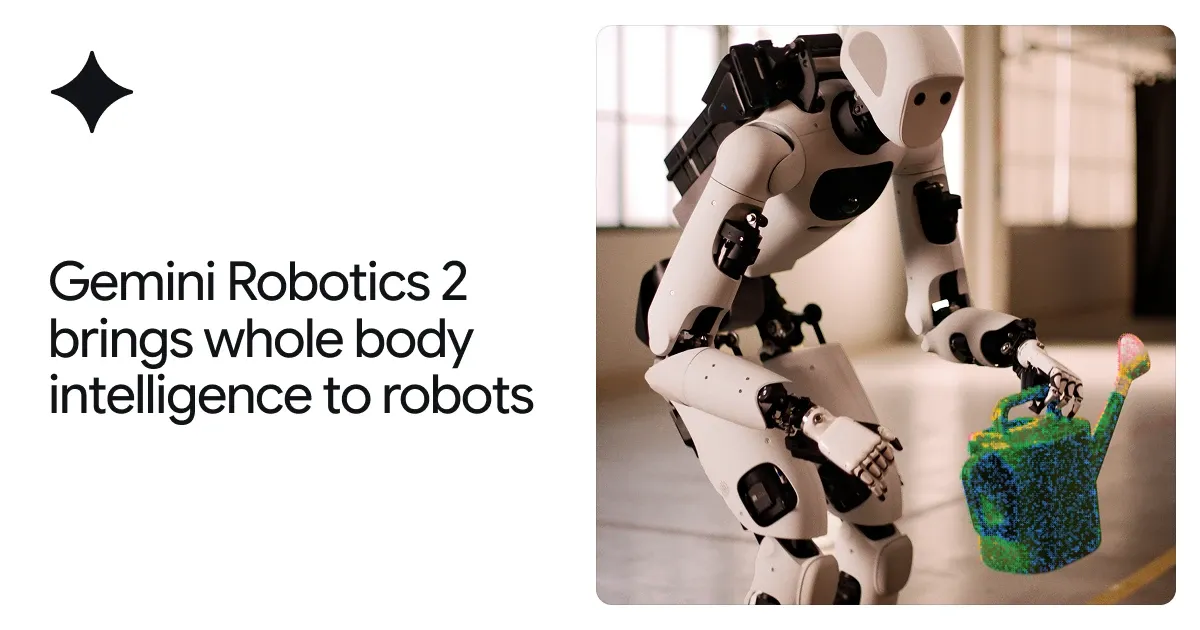
From feet to fingertips — we are teaching robots intelligent whole-body control, fine dexterity, and teamwork to complete a broad range of complex tasks.
We use cookies to run the site and, with your consent, for analytics and to show ads.
See our Cookie Policy.