Accurate 3D detection is essential for mobile embodied agents, while Vision Foundation Models (VFMs) offer transferable visual and geometric priors. Yet existing VFM-based 3D detectors rely on narrow-view monocular images or discrete perspective views, limiting coherent surround perception; equirectangular projection (...
Vision-Language-Action (VLA) foundation models have scaled rapidly to enhance manipulation performance and generalizability, but this scaling incurs high computational costs that render real-world deployment increasingly challenging. Existing approaches typically mitigate this issue by designing smaller architectures o...
Yoojin Oh, Jeongsol Kim, Yeonwoo Seo et al.· 0 citations
Learned visual reward models are increasingly used to optimize robot policies, yet a reward model can score an execution that acts on the wrong object as highly as one that completes the task. We show that optimizing such a reward can amplify these wrong-object failures while reward and task success both rise, so the s...
Jia-Xuan Luo, Xing-Guo Xu, Shan-Shan Wang et al.· 0 citations
Policy gradient methods for on-policy reinforcement learning (RL) can become unstable when expensive, scarce target-domain data yield noisy gradient estimates. We address this challenge by complementing limited high-fidelity (HF) target-domain data with abundant, cheap, but biased low-fidelity (LF) data, e.g., from a s...
Xinjie Liu, Ruihan Zhao, Anirban Chaudhuri et al.· 0 citations
Reach audiences
Advertise in front of researchers, engineers, and readers.
Massively parallel GPU simulators train multi-robot policies in thousands of environments, and many fleets use private Fifth-Generation (5G) networks, where each robot's delay depends on its teammates' traffic. Network-in-the-loop training places a simulated 5G network inside this loop. However, GPU robot simulators re...
Zifan Zhang, Mingzhe Han, Kannan Athreya et al.· 0 citations
Artificial intelligence increasingly serves as a natural-language interface to complex technical systems, letting people accomplish sophisticated tasks by describing what they want rather than specifying how to do it. Extending this interface to living systems is harder: unlike code or images, a biological intervention...
Nam H. Le, Douglas Blackiston, Michael Levin et al.· 0 citations
Model-based reinforcement learning (MBRL) achieves strong sample efficiency by planning within learned latent dynamics, yet its performance degrades substantially under unseen visual distractions such as background variations, lighting changes, or camera shifts. Unlike model-free RL, where encoder perturbations affect...
Mingyu Park, Samyeul Noh, Hyun Myung et al.· 0 citations
World action models (WAMs) have emerged as a promising paradigm for robotic control by jointly predicting future visual dynamics and actions from an initial observation and instruction. However, existing WAMs struggle with long-horizon prediction, as generating dense video rollouts is highly inefficient. Some recent WA...
Fei Zhang, Zhao-Chong An, Duncan P. Frost et al.· 0 citations
We present a teleoperation system that enables a single operator to perform construction tasks on a Unitree G1 humanoid, combining extended reality (XR) based upper body control with pedal-based locomotion to enable simultaneous manipulation and locomotion. Motivated by persistent labor shortages, hazardous working con...
Parastoo Ali Pour, David R. Martin, Chang Min Hur et al.· 0 citations
A Frequency-aware Decomposition Network (FDN) is proposed to estimate vibration-rich wrench in a sensorless, multi-step-ahead manner and requires neither an identified robot model nor an F/T sensor during estimation.
Multi-agent systems provide mature abstractions for role decomposition, coordination, and normative governance, but increasingly capable learned components make post-deployment safety harder to inspect, audit, and update. When safety behavior is absorbed into a decision component, narrow failures may require retraining...
This paper presents Adaptive Whole-body Loco-Manipulation, AdaptManip, a fully autonomous framework for humanoid robots to perform integrated navigation, object lifting, and delivery. Unlike prior imitation learning-based approaches that rely on human demonstrations and are often brittle to disturbances, AdaptManip aim...
Morgan Byrd, Donghoon Baek, Kartik Garg et al.· 0 citations
Robots are getting smarter, but how can their hardware match that growth? New Microsoft Research findings show that moving AI inference beyond the robot can improve task success, boost efficiency, and support more advanced physical AI workloads. The post Offloaded inference for real-world physical AI robotics appeared first on Microsoft Research.
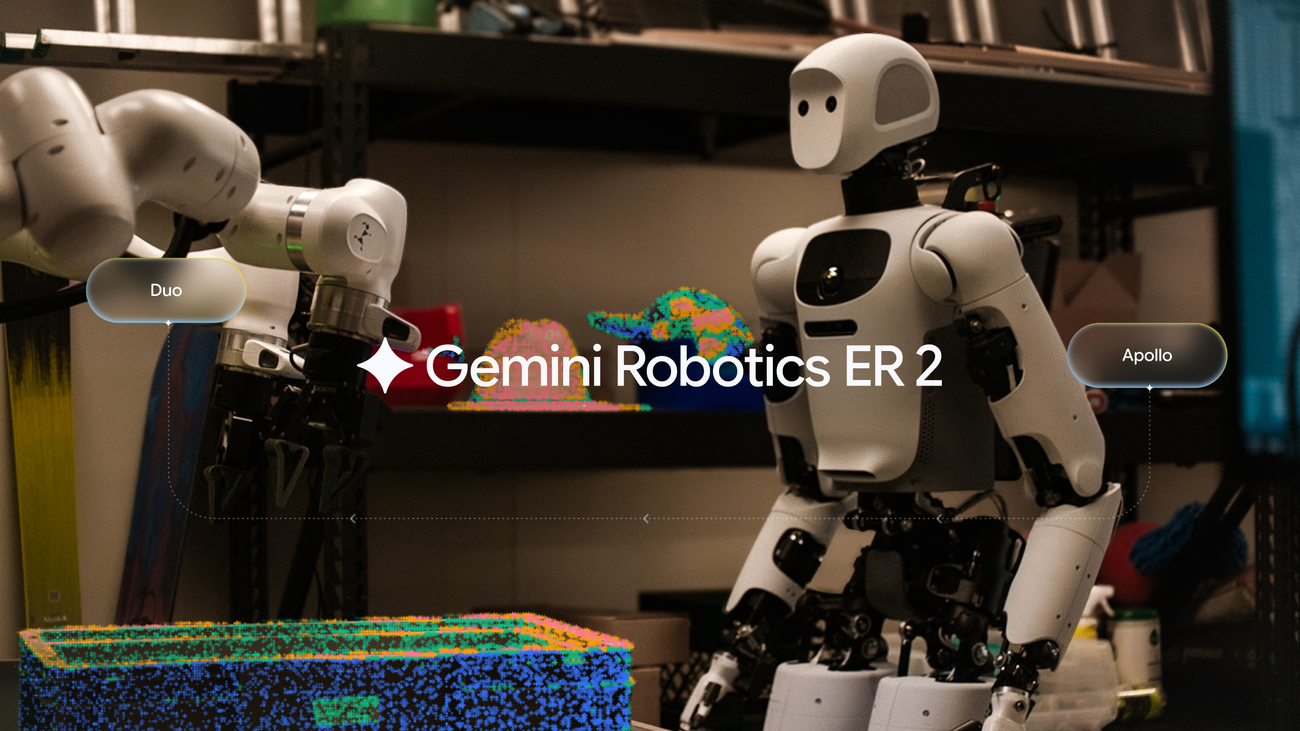
Gemini Robotics ER 2 helps robots reason, collaborate, and solve real-world tasks. It represents a step change in video understanding, tool orchestration, and multi-robot collaboration for robotic applications.
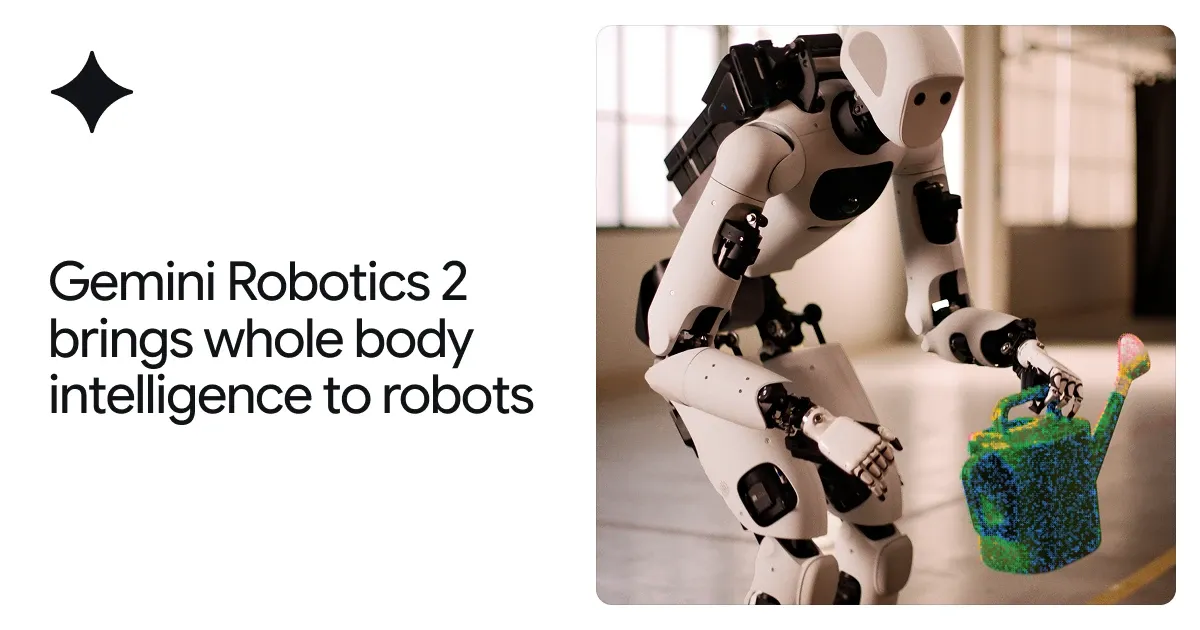
From feet to fingertips — we are teaching robots intelligent whole-body control, fine dexterity, and teamwork to complete a broad range of complex tasks.
We use cookies to run the site and, with your consent, for analytics and to show ads.
See our Cookie Policy.