Vision-Language-Action (VLA) policies provide strong behavioral priors for dexterous manipulation, yet adapting them on real robots remains challenging because high-DoF contact failures are difficult for humans to correct and online interaction is expensive. We present BORA, an offline-to-online reinforcement learning...
Zhongxi Chen, Yifan Han, Bin Qiu et al.· 0 citations
Imitation learning has enabled robots to acquire complex visuomotor manipulation skills from demonstrations, but deployment failures remain a major obstacle, especially for long-horizon action-chunked policies. Once execution drifts off the demonstration manifold, these policies often continue producing locally plausib...
Gehan Zheng, Sanjay Seenivasan, Matthew Johnson-Roberson et al.· 0 citations
Reinforcement Learning (RL) has shown strong potential for improving robotic manipulation policies, yet its practical use remains bottlenecked by the difficulty of specifying reward functions that are both semantically meaningful and reusable across tasks. In this paper, we propose Large Reward Models (LRMs), a framewo...
We present $multipanda\_ros2$, a novel open-source ROS2 architecture for multi-robot control of Franka Robotics robots. Leveraging ros2 control, this framework provides native ROS2 interfaces for controlling any number of robots from a single process. Our core contributions address key challenges in real-time torque co...
Jon \v{S}kerlj, Seongjin Bien, Abdeldjallil Naceri et al.· 0 citations
Reach audiences
Advertise in front of researchers, engineers, and readers.
Recent progress in contact-rich robotic manipulation has been striking, yet most deployed systems remain confined to simple, scripted routines. One of the barriers is the lack of motion planning algorithms that can provide verifiable guarantees for safety, efficiency and reliability. Constant-Time Motion Planning (CTMP...
Nayesha Gandotra, Itamar Mishani, Lai Yuan et al.· 0 citations
Urban micromobility applications, such as delivery robots, demand reliable navigation across large-scale urban environments while following long-horizon route instructions. This task is particularly challenging due to the dynamic and unstructured nature of real-world city areas, yet most existing navigation methods rem...
Anqi Li, Zhiyong Wang, Jiazhao Zhang et al.· 0 citations
Large Language Models (LLMs) are increasingly proposed as cognitive components for robotic systems, yet their opaque decision processes make it difficult to explain success or failure in closed-loop embodied tasks. Following an empirical AI methodology, we study an embodied LLM agent behaviorally by varying the availab...
Building reliable robot capabilities across diverse tasks requires substantial human effort to develop and maintain skills, design rewards, and integrate perception with control. We present Reconstruct, Practice, Go Real (RPG), a framework for autonomous improvement of robot execution systems without updating model wei...
Yen-Jen Wang, Hao-Zhe Jiang, Shu-Ying Deng et al.· 0 citations
Several state-of-the-art methods for online reinforcement learning in continuous control improve policies using action gradients of a learned critic. However, critics are typically trained to predict returns, and accurate value predictions do not necessarily yield accurate action derivatives, potentially leading to unr...
Sebastian Sanokowski, Alireza Sarmadi, Majid Khadiv· 0 citations
Robots operating in the physical world will increasingly need to coordinate with other robots, particularly in manipulation tasks where an object may be too large or heavy for a single robot to carry alone. Physical limitations caused by hardware degradation or actuator faults can restrict the actions a robot can relia...
Suyu Ye, Zheyuan Zhang, Vaishnav Tadiparthi et al.· 0 citations
Vision-language models (VLMs) and vision-language-action models (VLAs) have recently driven rapid progress in general-purpose robots, yet most progress has focused on single-robot settings. Extending these capabilities to multi-robot systems remains challenging because robots must coordinate long-horizon behaviors whil...
Han-Chu Zhou, De-Chen Gao, Hang Wang et al.· 0 citations
As robotic hardware and learning methods advance, humanoids need tools to perform tasks beyond their inherent physical limits. Successful tool use requires selecting a suitable tool and coordinating manipulation and, when needed, locomotion to complete the task. Existing benchmarks do not jointly evaluate these capabil...
Kyochul Jang, Seohyeon Park, Ohchul Kwon et al.· 0 citations
Robots are getting smarter, but how can their hardware match that growth? New Microsoft Research findings show that moving AI inference beyond the robot can improve task success, boost efficiency, and support more advanced physical AI workloads. The post Offloaded inference for real-world physical AI robotics appeared first on Microsoft Research.
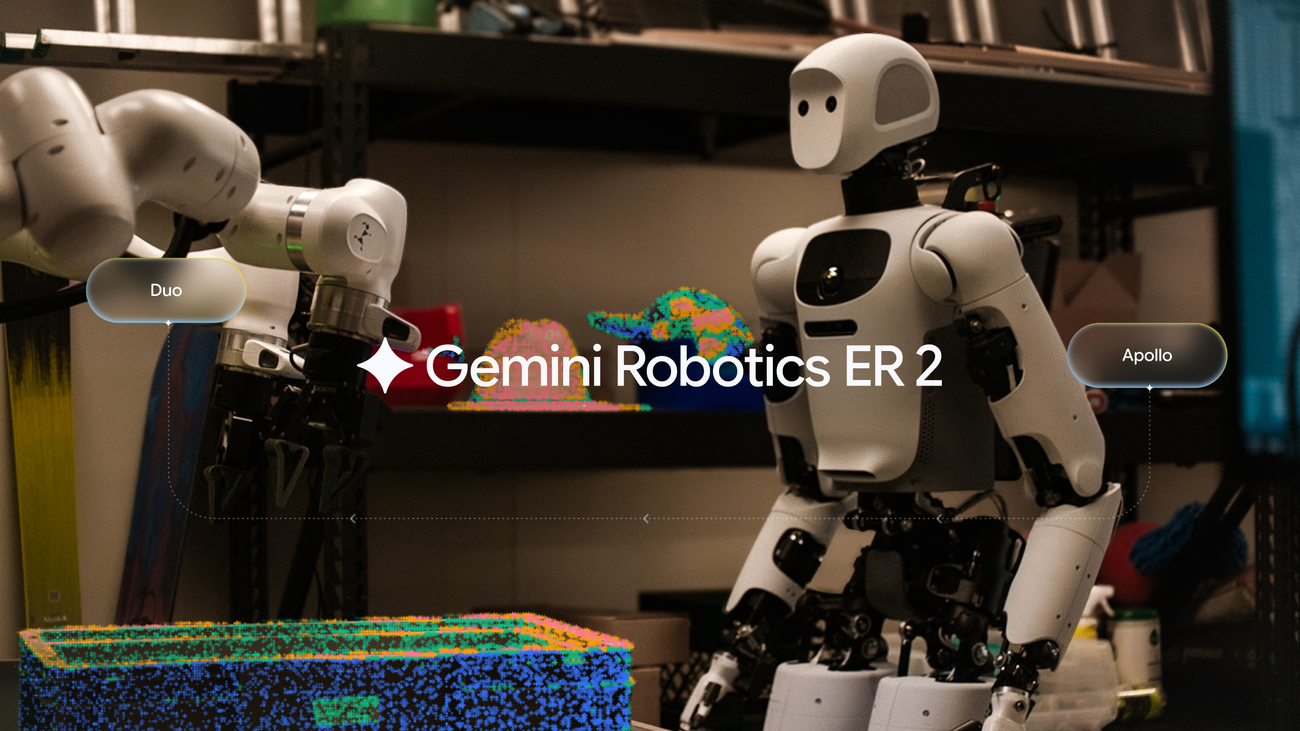
Gemini Robotics ER 2 helps robots reason, collaborate, and solve real-world tasks. It represents a step change in video understanding, tool orchestration, and multi-robot collaboration for robotic applications.
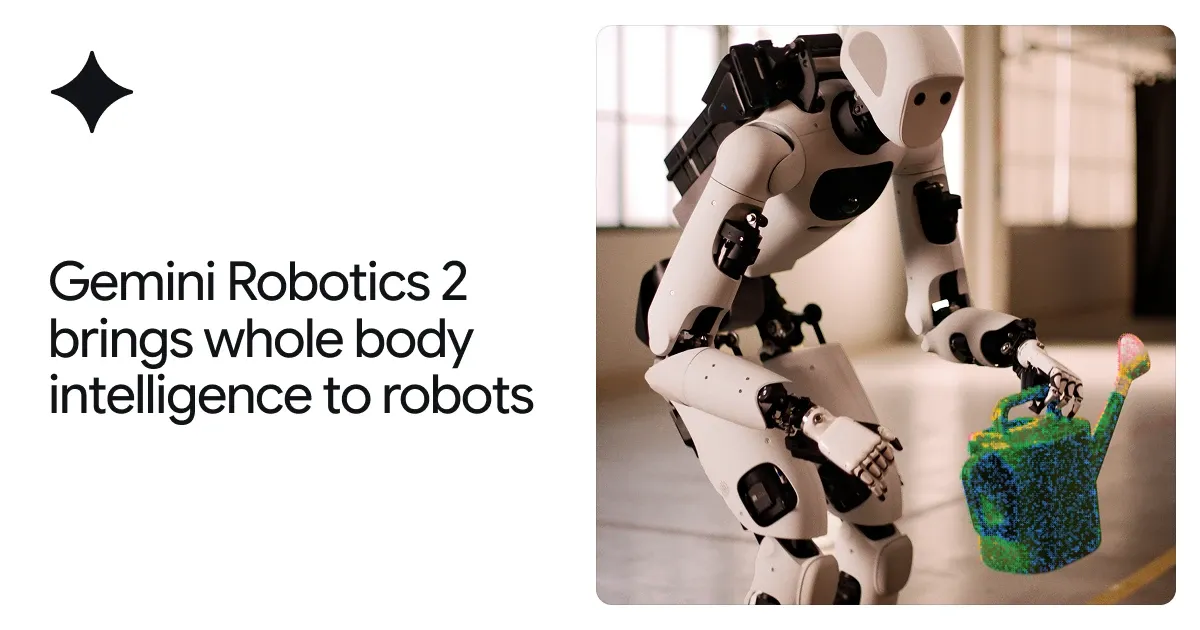
From feet to fingertips — we are teaching robots intelligent whole-body control, fine dexterity, and teamwork to complete a broad range of complex tasks.
We use cookies to run the site and, with your consent, for analytics and to show ads.
See our Cookie Policy.