A bipedal robot cannot deviate from its path to avoid an obstacle without disturbing its balance, and this coupling is most severe on underactuated platforms such as the biped considered here, which has four actuated joints per leg and no hip or ankle roll. This paper presents a Hierarchical Reinforcement Learning (HRL...
J. Sahoo, Saurabh Kumar, Surya Prakash S.K. et al.· 0 citations
In safety-critical domains such as autonomous driving, systems must be evaluated across a large number of environment conditions, often represented as composite scenarios built from primitive scenarios. Existing statistical model checking (SMC) approaches analyze each composite scenario independently, requiring many ex...
Abhinav Pomalapally, Arya Raeesi, Kevin Kai-Chun Chang et al.· 0 citations
World--action models (WAMs) promise a unified model that predicts action-conditioned futures, generates feasible actions, and supports planning in imagination. However, existing joint video--action models often use computationally heavy, fixed-horizon backbones ill-suited to streaming inference and stable long-horizon...
R. Khorrambakht, Joseph Amigo, F\'elix Lebel et al.· 0 citations
Model Predictive Control (MPC) provides a structured and constraint-aware mechanism for decision-making, but its reliance on optimization-friendly analytical dynamics models limits its use in tasks with contacts and other hard-to-model state dependencies. Model-free reinforcement learning avoids explicit modeling assum...
P. Schöch, Markus Ryll· 0 citations
Reach audiences
Advertise in front of researchers, engineers, and readers.
Learning robot policies directly on physical systems remains difficult because data collection is costly and policy exploration can be unsafe. We introduce Visual and Motor Policies from Sampling-Based Planning (VAMPS), a framework that uses Model Predictive Path Integral (MPPI) control to train reusable policies witho...
Mohamed Yassine Kabouri, Pietro Noah Crestaz, Q. Nguyen et al.· 0 citations
Partnered human-humanoid interaction couples locomotion with continuous physical contact. A humanoid needs to coordinate with a person's motion while responding to interaction forces and maintaining stable and natural movement. We present CoDance, a framework for learning reactive and compliant human-humanoid interacti...
Most vision-language-action models represent future motion as fixed-rate action chunks, tying temporal resolution and prediction horizon to a fixed output budget. This pointwise representation wastes capacity on highly correlated neighboring actions, leaves temporal continuity and smoothness to be learned implicitly, a...
Yifan Li, Jiaxu Wang, Dongming Wu et al.· 0 citations
Contrastive Reinforcement Learning (CRL) learns representations that estimate goal reachability, yet its policy remains conditioned on raw goals and therefore does not directly exploit the geometry encoded by its critic. We introduce Direction-Conditioned Policies (DCP), a method built around a small modification to CR...
S. Swaminathan, Damiya Gondha, Theyanesh Eswaramoorthy Rajahkrishnan et al.· 0 citations
Reinforcement learning controllers for underwater vehicles are usually trained against one physics representation and deployed against another, so reported performance does not always describe behavior outside training. This paper presents a pipeline-tracking architecture for a six-degree-of-freedom remotely operated v...
Cheng Siong Chin, M. Venkateshkumar, Jianhua Zhang· 0 citations
Scaling robot data and model capacity has improved Vision-Language-Action (VLA) policies, but further progress is constrained by the high cost of robotic data. Verifier-guided test-time scaling offers an efficient alternative by sampling multiple action candidates and selecting the one most likely to lead to task succe...
Seongheon Park, Heecheol Kim, Shu-Lin Tian et al.· 0 citations
Urban navigation requires embodied agents to pursue long-horizon goals through local decisions based on egocentric observations. However, existing agentic navigation methods often struggle to translate distant goals into coherent local decisions in large-scale physical environments. Their reliance on linguistic reasoni...
Jing Xie, Shou-Wei Ruan, Yu-Bin Wang et al.· 0 citations
Force-aware manipulation typically relies on specialized force or tactile sensors. We show that force-aware manipulation can instead be achieved through visual force prediction from the deformation of a compliant Fin Ray gripper. Our approach trains two models. First, we train a visual force estimator on calibration da...
Haonan Chen, Feiyang Wu, Yuxiang Ma et al.· 0 citations
Robots are getting smarter, but how can their hardware match that growth? New Microsoft Research findings show that moving AI inference beyond the robot can improve task success, boost efficiency, and support more advanced physical AI workloads. The post Offloaded inference for real-world physical AI robotics appeared first on Microsoft Research.
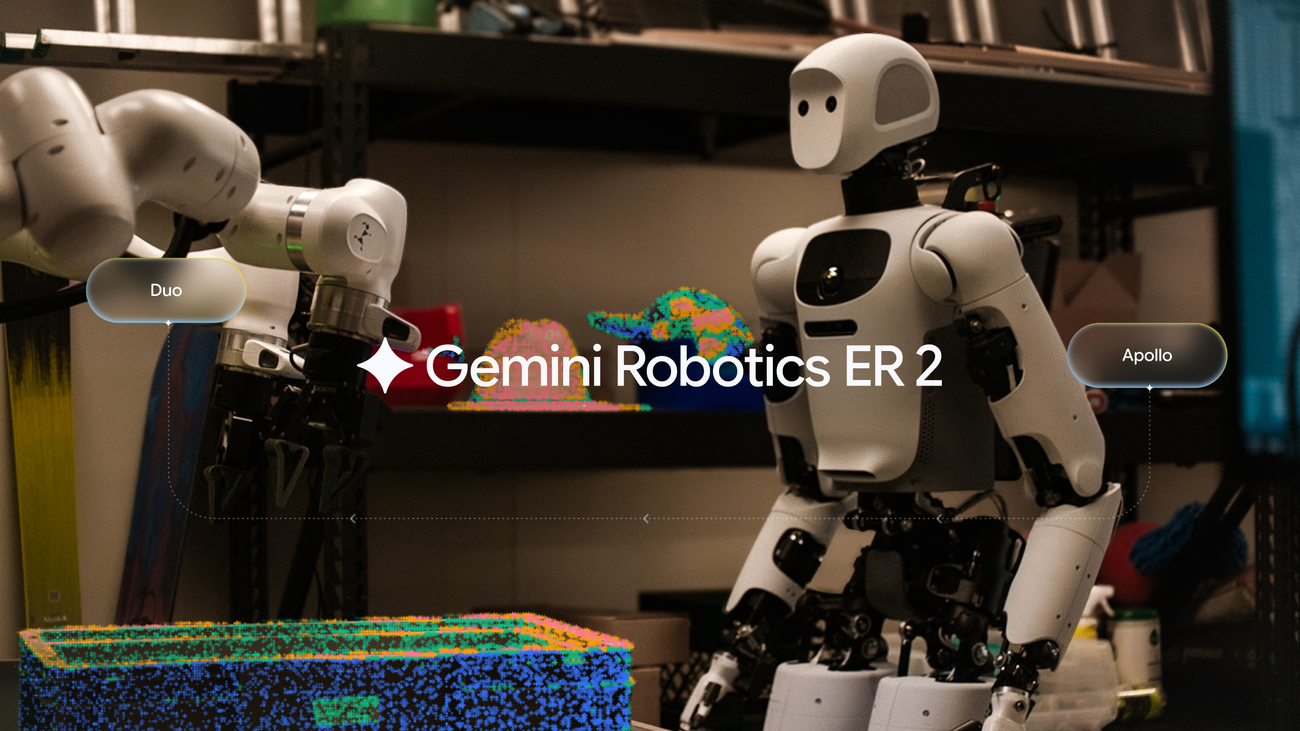
Gemini Robotics ER 2 helps robots reason, collaborate, and solve real-world tasks. It represents a step change in video understanding, tool orchestration, and multi-robot collaboration for robotic applications.
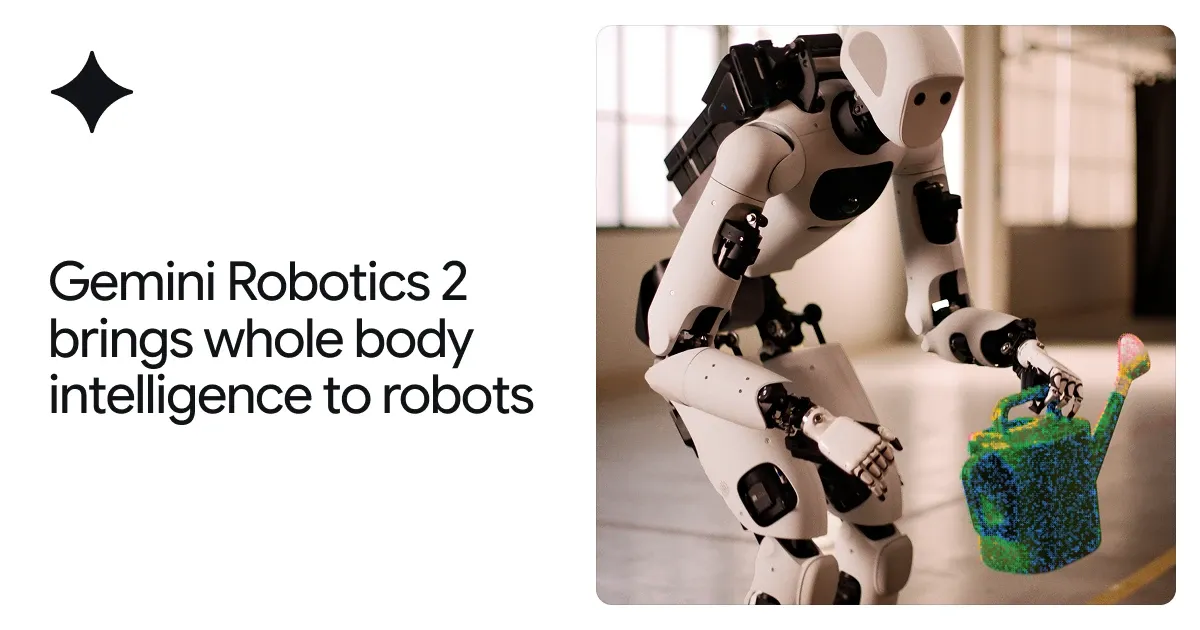
From feet to fingertips — we are teaching robots intelligent whole-body control, fine dexterity, and teamwork to complete a broad range of complex tasks.
We use cookies to run the site and, with your consent, for analytics and to show ads.
See our Cookie Policy.