Robot learning in simulation depends on the objects the simulator offers. Many tasks need objects with separate parts, joints that allow the required motion, and physical properties that remain valid under contact. Existing methods recover this structure anew for every image: generative models predict parts and joints...
Hao-Yun Yang, Xue-Yang Zhou, Zi-Yi Xie et al.· 0 citations
Action-conditioned robot world models must respond precisely to robot trajectories while preserving realistic visual dynamics, yet learning both from heterogeneous robot videos remains challenging. Simulation offers structured motion supervision, but appearance differences hinder direct transfer, and inaccurate simulat...
Xiaodong Wang, Tianle Li, Chuanxin Song et al.· 0 citations
To evaluate the frontier, we must measure models not by what they say, but by what they can engineer and build in grounded physical environments. We introduce \textsc{ArtifactArena}, an open-ended platform where models face a physically grounded hardware-software co-design challenge: engineering fully functional robots...
Kushagra Tiwary, David Mayo, Nikhil Behari et al.· 0 citations
Closed-loop evaluation of end-to-end driving requires continuous rollouts that reveal how earlier decisions affect subsequent driving. However, existing benchmarks evaluate only short segments and fail to capture later consequences. Ambiguous directional commands also obscure the intended navigation objective. We intro...
Jungho Kim, Hongjae Shin, Seung-Su Yu et al.· 0 citations
Reach audiences
Advertise in front of researchers, engineers, and readers.
GAMBIT is an opening chess move in which a player sacrifices a piece, typically a pawn, to gain a positional advantage later in the game. Analogously, in multi-robot coordination, individual robots may need to forgo locally reward-maximising behaviours to improve overall team performance. Such self-sacrificial behaviou...
Rishabh Jain, Akmaral Moldagalieva, Lorenzo Magnino et al.· 0 citations
World action models (WAMs) have emerged as a promising paradigm for robotic manipulation. They act by first predicting how a task should be performed and then decoding the actions from that future. However, the remaining actions are invalid once execution drifts from the prediction. Simply replanning from the already o...
Adapting vision-language-action (VLA) models to deployment-time distribution shifts is important for reliable robotic operation, but conventional first-order adaptation can exceed the memory budget of inference-oriented deployment platforms. Zeroth-order (ZO) optimization offers a forward-only alternative with inferenc...
Diffusion transformers (DiTs) achieve state-of-the-art image generation, but their sampling cost limits deployment. Quantizing both weights and activations to 4 bits reduces this cost, yet existing methods fall short in one of two ways. Calibration-based methods are tied to a specific checkpoint and prompt distribution...
Diffusion- and flow-based robot policies have recently become widespread in robotic Imitation Learning (IL) due to their high performance and ability to model continuous and multimodal distributions. However, the iterative denoising procedure used by these models introduces significant prediction latency, hindering hig...
Aksel Vaaler, Marco Job, Christian Holden et al.· 0 citations
This paper asks whether VLA generalization is grounded in a global understanding of objects' physical properties that enables policies to adapt their motion to unseen setups, or if policies simply replay the motions they've learnt that happen to succeed in new setups. The former reflects genuine generalization; the lat...
Latent world models based on Joint-Embedding Predictive Architecture (JEPA) are deterministic by design. While successful in fully observable scenarios, this paradigm breaks down when past observations and actions lead to multiple plausible future possibilities, e.g., due to occlusion. We introduce EpicWorldModel, a fr...
Bo-Wen Feng, Julian Ost, May Mei et al.· 0 citations
Benchmarks expose vision-language-action (VLA) policies to few canonical instructions, while exhaustive deployment testing is impossible. We introduce Object-Grounded Attention Monitoring (OGAM), connecting systematic testing to runtime assurance: testing reveals attention divergence between successful and failed execu...
Haki Darwish, Xiangyu Yin, Changwen Li et al.· 0 citations
Robots are getting smarter, but how can their hardware match that growth? New Microsoft Research findings show that moving AI inference beyond the robot can improve task success, boost efficiency, and support more advanced physical AI workloads. The post Offloaded inference for real-world physical AI robotics appeared first on Microsoft Research.
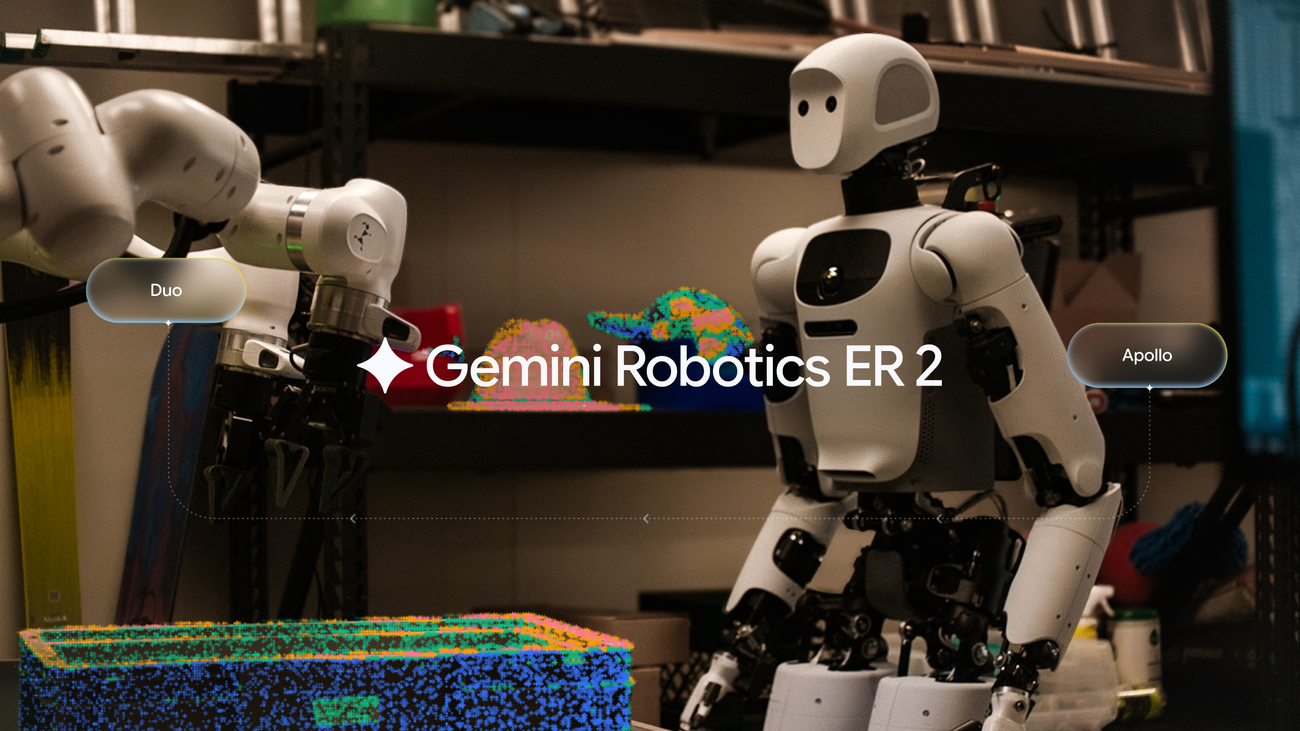
Gemini Robotics ER 2 helps robots reason, collaborate, and solve real-world tasks. It represents a step change in video understanding, tool orchestration, and multi-robot collaboration for robotic applications.
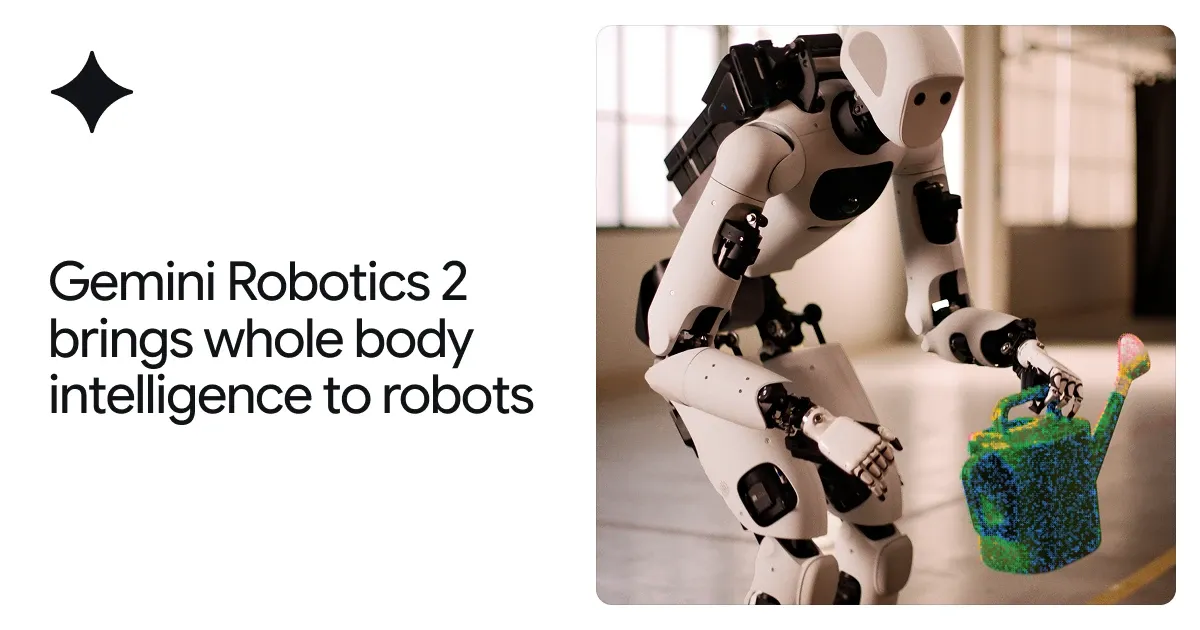
From feet to fingertips — we are teaching robots intelligent whole-body control, fine dexterity, and teamwork to complete a broad range of complex tasks.
We use cookies to run the site and, with your consent, for analytics and to show ads.
See our Cookie Policy.