Building interactive simulators from real-world observations is a promising way to scale embodied data, but current pipelines still rely heavily on manual environment construction and calibration. We study whether frontier foundation models and coding agents can automate this process end to end. We formulate \emph{auto...
Jin-Zhou Tang, Z. Zhang, Jing Yang et al.· 0 citations
Reliable safety evaluation of autonomous vehicles (AVs) is essential to improving road safety, yet it depends critically on realistic simulation of rare crashes. Existing crash scenario generation methods can increase collision occurrence, but often fail to realistically reproduce how crashes evolve before impact or th...
Mingxing Peng, Xusen Guo, Long Chen et al.· 0 citations
Designing effective reward functions in RL typically requires substantial expertise and trial and error. Recent work automates this process with LLM-based systems that generate and iteratively improve reward code using policy feedback. However, these methods are often hard to compare because they differ in implementati...
Logan Mondal Bhamidipaty, Lauren Robson, Linda Petrini et al.· 0 citations
For ground robots operating in outdoor environments, understanding the properties of the underlying terrain is essential for ensuring reliable operation. In most perception-based studies, this problem is formulated as categorical classification with a fixed number of classes defined during training. We propose an appro...
Oleg Kushnarev, Alexander Belyaev· 0 citations
Reach audiences
Advertise in front of researchers, engineers, and readers.
Skeletal motion is stored as every joint's transform at every frame, yet most of it is implied by the body rather than by what the motion is about. Compression is one way to ask what a motion must still say once the body is known, and a production codec must answer it for any skeleton with a stated error bound. Our ear...
Mingyi Shi, Huancheng Lin, Xuelin Chen et al.· 0 citations
Recent advances in robot learning have enabled generalist control policies capable of completing a wide range of tasks. However, their performance degrades when deployed in unseen environments, making it critical to detect failures and teach recovery behaviors. Existing runtime monitoring methods often require task- an...
Foundation models and large-scale human data provide rich sources of manipulation intent, but translating this intent into multi-fingered robot behavior remains difficult. Dexterous hands still lack a reusable low-level primitive that reliably establishes contact across tasks and embodiments. We propose GOTT, a reach-a...
Yu-Lin Liu, Lai Wei, Yen-Jen Wang et al.· 0 citations
World Action Models (WAMs) leverage pretrained video foundation models for robot manipulation, but their large backbones and video-action co-prediction are expensive. Although existing acceleration techniques offer many ways to reduce this cost, selecting and composing them requires substantial engineering for each mod...
Le Chen, Lixin Liu, Jan Schneider et al.· 0 citations
A safe action is not necessarily a viable one. Under a frozen vision-language-action (VLA) policy, an action can be likely and locally admissible yet leave no policy-supported route to safe task completion. We call this the feasibility-likelihood gap: likelihood ranks the current action, whereas feasibility depends on...
Tu Nguyen, Matthieu Zimmer, Vu Anh Vu et al.· 0 citations
Vision-language-action (VLA) policies commonly learn action chunks through a fixed left-to-right (LTR) factorization, although the same expert trajectory distribution admits many valid chain-rule factorizations. We identify factorization order as an overlooked regularization choice and introduce causally anchored permu...
Yanqiao Chen, Yuhan Rui, Dongsheng Hou et al.· 0 citations
We present RAGrasp, a retrieval-augmented pipeline for planar parallel-jaw grasping from a compact set of locally collected, grasp-annotated RGB-D (color and depth) templates. Unlike task-specific predictors trained primarily on large public or synthetic grasp datasets, RAGrasp requires no end-to-end retraining for a n...
Shen-Zhe Zhu, Cheng-Xiao He, Jan Harder· 0 citations
Before autonomous driving systems can be deployed on public roads, it is vital that these systems comply with safety standards, traffic rules, and social norms. Although neural networks trained on large amounts of driving data perform well in routine driving tasks, these models often struggle in novel situations that a...
Simon Janssen, Michiel Braat, C. van der Ploeg et al.· 0 citations
Robots are getting smarter, but how can their hardware match that growth? New Microsoft Research findings show that moving AI inference beyond the robot can improve task success, boost efficiency, and support more advanced physical AI workloads. The post Offloaded inference for real-world physical AI robotics appeared first on Microsoft Research.
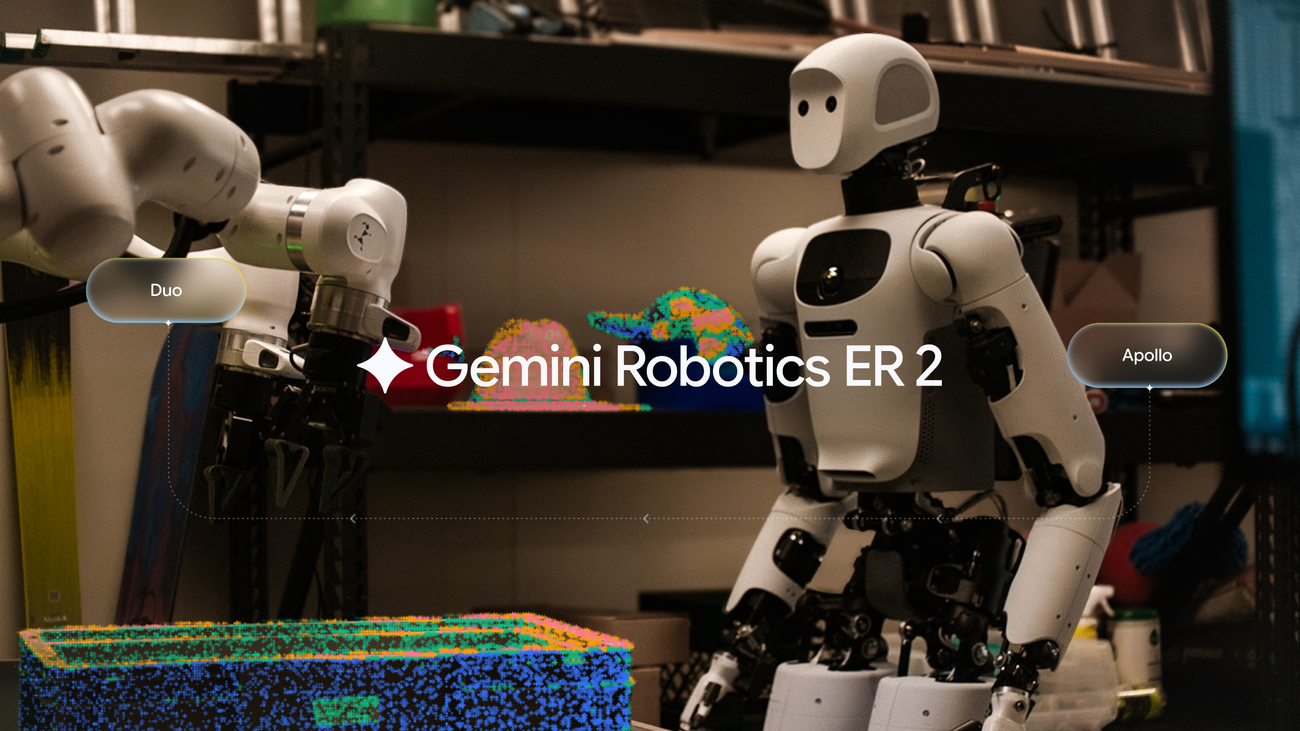
Gemini Robotics ER 2 helps robots reason, collaborate, and solve real-world tasks. It represents a step change in video understanding, tool orchestration, and multi-robot collaboration for robotic applications.
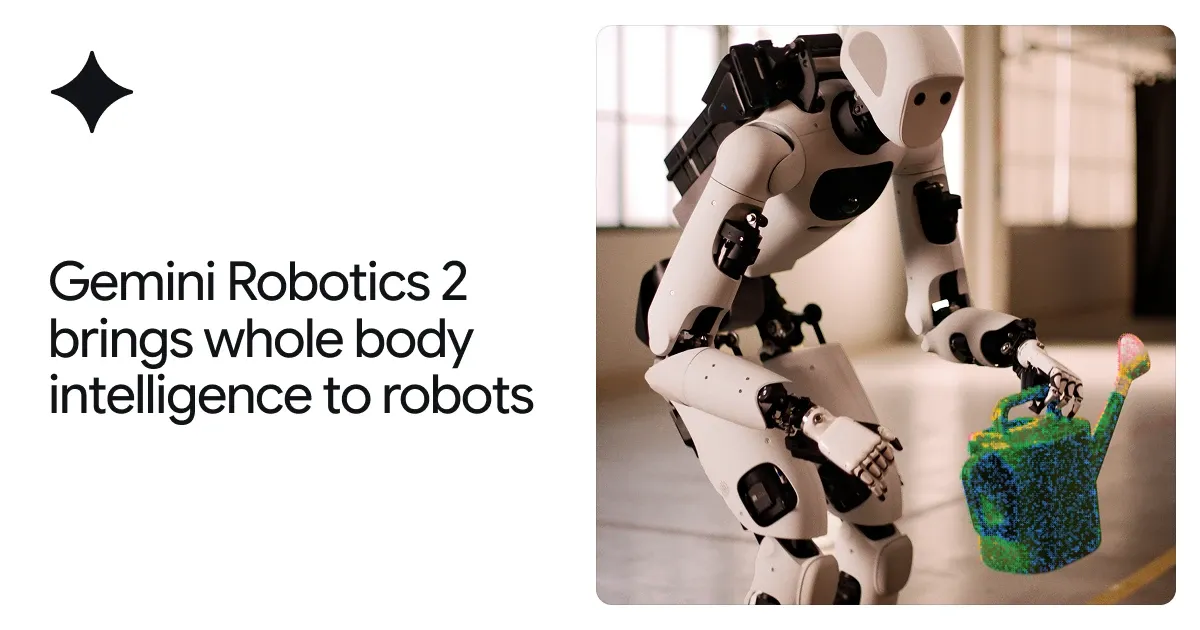
From feet to fingertips — we are teaching robots intelligent whole-body control, fine dexterity, and teamwork to complete a broad range of complex tasks.
We use cookies to run the site and, with your consent, for analytics and to show ads.
See our Cookie Policy.