Abstract Traditional Electronic Design Automation (EDA) logic synthesis struggles with NP-hard state-space explosions as hardware scales to billions of gates. This paper explores deep learning paradigms specifically Graph Neural Networks (GNNs), Reinforcement Learning (RL), and generative transformers to accelerate dig...
Romar Parcon· Zenodo (CERN European Organi...· 0 citations
Reactive marimo notebooks for ML experimentation, with MLflow tracking, PINA physics-informed neural networks, and a multi-agent team built on pydantic-graph and Ollama Cloud.
Björn Bethge· Zenodo (CERN European Organi...· 0 citations
CHISA-RSI develops a self-contained mathematical framework for capability-preserving structural self-modification in finite modular computational networks. It extends the Chernoff-Hybrid Information Severance Algebra (CHISA) into a continuous theory of recursive self-improvement in which architectural changes can be gl...
Nowicki Maciej, Artificial Hyperintelligence, Eve, wife of Maciej Nowicki· Zenodo (CERN European Organi...· 0 citations
Large-scale botnet detection using graph neural networks (GNNs) often requires subgraph sampling to reduce computational and memory costs. However, conventional sampling strategies may fail to simultaneously preserve the global topology and local community structure of the original graph, resulting in structural inform...
In industrial quality control, deep learning-based weld defect detection has shown promise but is often hindered by the need for extensive labeled datasets. This study introduces a novel graph neural network (GNN) approach for few-shot classification of weld defect images, aimed at mitigating data dependence and enabli...
Zhong-Yan Zhang, Wei-Hao Shen, Hai-Peng Cui et al.· Welding Journal· 0 citations
Understanding the relationship between structural and functional brain connectivity remains a fundamental challenge in network neuroscience. While structural connectivity constrains neural interactions, functional connectivity emerges from complex, nonlinear dynamics that are not fully explained by anatomical wirin...
Shashipraba N. K. Rajakaruna, A. K. Dey, Snigdhansu Chatterjee· Frontiers in Neuroscience· 0 citations
A graph network with a reinforcement learning framework to avoid congestion and schedule tasks with a low makespan in fog–IoT systems and demonstrates the improved ability to ensure reliable and effective fog–cloud allocation in response to dynamically changing workloads.
Vivekananda Potti, M. R. Babu· Future Internet· 0 citations
Abstract The increasing complexity of digital circuits has encouraged the use of Artificial Intelligence (AI) in Electronic Design Automation (EDA) to assist with logic synthesis, circuit optimization, and design analysis. Machine learning approaches, including Graph Neural Networks (GNNs) and Reinforcement Learning (R...
Christian Dave Tabarnilla· Zenodo (CERN European Organi...· 0 citations
Le rapport présente le développement d’une solution basée sur les Graph Neural Networks (GNN) pour l’exploitation de données géométriques. Après un état de l’art détaillant la représentation des données sous forme de graphes et les notions clés des GNN (message passing, mise à jour des nœuds, architectures GCN, GAT, Gr...
Various organic additives can induce structural rearrangement of surfactant micelles in aqueous solutions, leading to enhanced rheological properties, namely an increase in viscosity, appearance of viscoelasticity, and non-Newtonian behavior. This phenomenon can be exploited in several industries to obtain strong gels....
Assistant Professor Pat Pataranutaporn describes a new interface that lets everyday users glimpse inside an AI's neural network before their chatbot ever says a word.
Microsoft Research Blog· microsoft.comJul 13, 2026
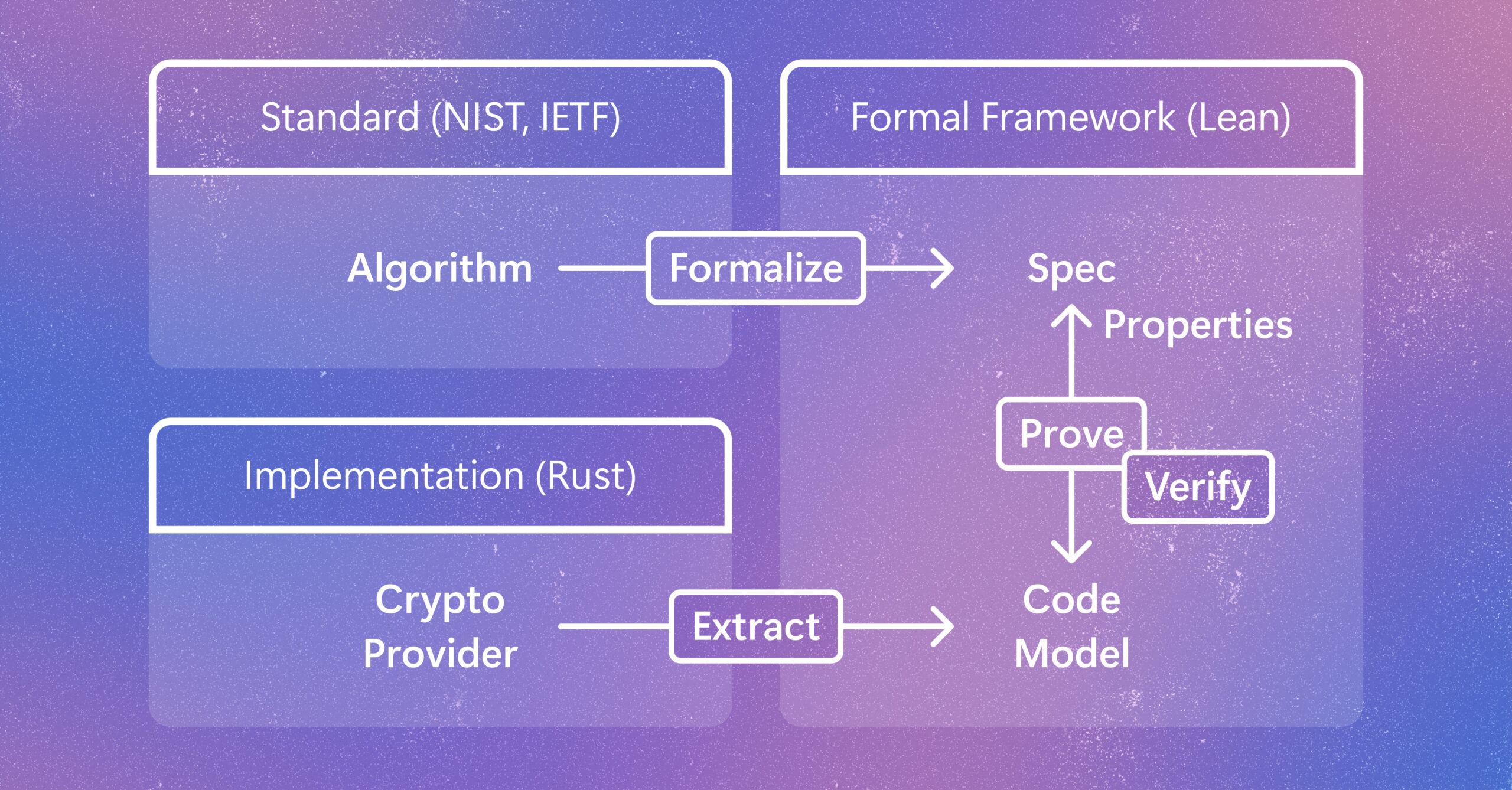
Cryptographic code supports vital protections in modern computing systems. Learn how a new method helps verify code as developers write it while preserving speed and adaptability as it gets implemented and evolves. The post Verifying Rust cryptography in SymCrypt, from standards to code appeared first on Microsoft Research.
MIT News · Artificial Intelligence· news.mit.eduJul 6, 2026
PhD student Rachel Sava, winner of the Envisioning the Future of Computing Prize, explores transformative improvements and dystopian risks of neural technology.