Machine-learning-based inverse design can accelerate the discovery of materials with targeted properties, but conventional structure--property models often require large training datasets and generalize poorly beyond their training distribution. Here, we present a differentiable inverse design framework based on a grap...
S. A. Shteingolts, Salman N. Salman, R. Levie et al.· Research Square· 0 citations
Here, reported ML-assisted studies on MXene prediction and design are organized by target property and workflow, and ML–DFT screening, graph neural networks, uncertainty quantification, active learning, and interpretability are examined.
Ling-Hong Lu, Qian-Kun Li, Xin-Chen Wang et al.· Smart Chemical Engineering· 0 citations
A central controversy in computational neuroscience—recently formalized as The Digital Sphinx debate (Brunton,Abe, Hu, & Tuthill, 2026)—asserts that deep reinforcement learning (DRL) can optimize arbitrary artificial neural networktopologies to generate realistic animal locomotion. Consequently, high-level behavioral r...
Anish Pathak· Zenodo (CERN European Organi...· 0 citations
Le rapport présente le développement d’une solution basée sur les Graph Neural Networks (GNN) pour l’exploitation de données géométriques. Après un état de l’art détaillant la représentation des données sous forme de graphes et les notions clés des GNN (message passing, mise à jour des nœuds, architectures GCN, GAT, Gr...
Anas Djobbi· Figshare· 0 citations
Reach audiences
Advertise in front of researchers, engineers, and readers.
Propagation-based detectors classify a story from the shape of the cascade that carries it, and they report strong benchmark figures. This article measures what those figures are worth. On UPFD, a bidirectional graph convolutional network reaches macro-F1 0.832 on PolitiFact and 0.920 on GossipCop. Handed the same node...
Adam Terrak, Abdelah El Harsal, Ayman Ouguerd et al.· Zenodo (CERN European Organi...· 0 citations
A computational framework for modelling intrinsic and extrinsic factors driving cell plasticity using spatial transcriptomics data, graph neural networks (GNNs) and geostatistical regression.
Eloise W, Cenk Çelik, Maria Secrier· Zenodo (CERN European Organi...· 0 citations
Abstract. Regional atmospheric trace gas inverse modelling frameworks depend on accurately simulating mole fractions, which result from transporting surface fluxes within a domain and carrying mole fractions into the region from its boundaries. With the aim of improving the computational efficiency of inverse modelling...
Nawid Keshtmand, Elena Fillola, Jeffrey N. Clark et al.· 0 citations
Abstract Traditional Electronic Design Automation (EDA) logic synthesis struggles with NP-hard state-space explosions as hardware scales to billions of gates. This paper explores deep learning paradigms specifically Graph Neural Networks (GNNs), Reinforcement Learning (RL), and generative transformers to accelerate dig...
Romar Parcon· Zenodo (CERN European Organi...· 0 citations
This repository contains the data, source code, configuration files, trained-model implementation, and supporting materials required to reproduce the experiments presented in the associated manuscript on systemic-risk forecasting. The repository provides the processed dataset comprising 2,516 observations and 16 integr...
Li Hao· Zenodo (CERN European Organi...· 0 citations
A central controversy in computational neuroscience—recently formalized as The Digital Sphinx debate (Brunton,Abe, Hu, & Tuthill, 2026)—asserts that deep reinforcement learning (DRL) can optimize arbitrary artificial neural networktopologies to generate realistic animal locomotion. Consequently, high-level behavioral r...
Anish Pathak· Zenodo (CERN European Organi...· 0 citations
The Pseudo-Random Number Generator (PRNG) designed using chaotic systems has been widely used in the field of security communication and some other privacy-required applications because of its excellent nonlinear dynamics. However, in practical engineering applications, the digital realization of chaotic systems on fin...
Zijing Jiang, Qun Ding· International Journal of Bif...· 0 citations
Assistant Professor Pat Pataranutaporn describes a new interface that lets everyday users glimpse inside an AI's neural network before their chatbot ever says a word.
Microsoft Research Blog· microsoft.comJul 13, 2026
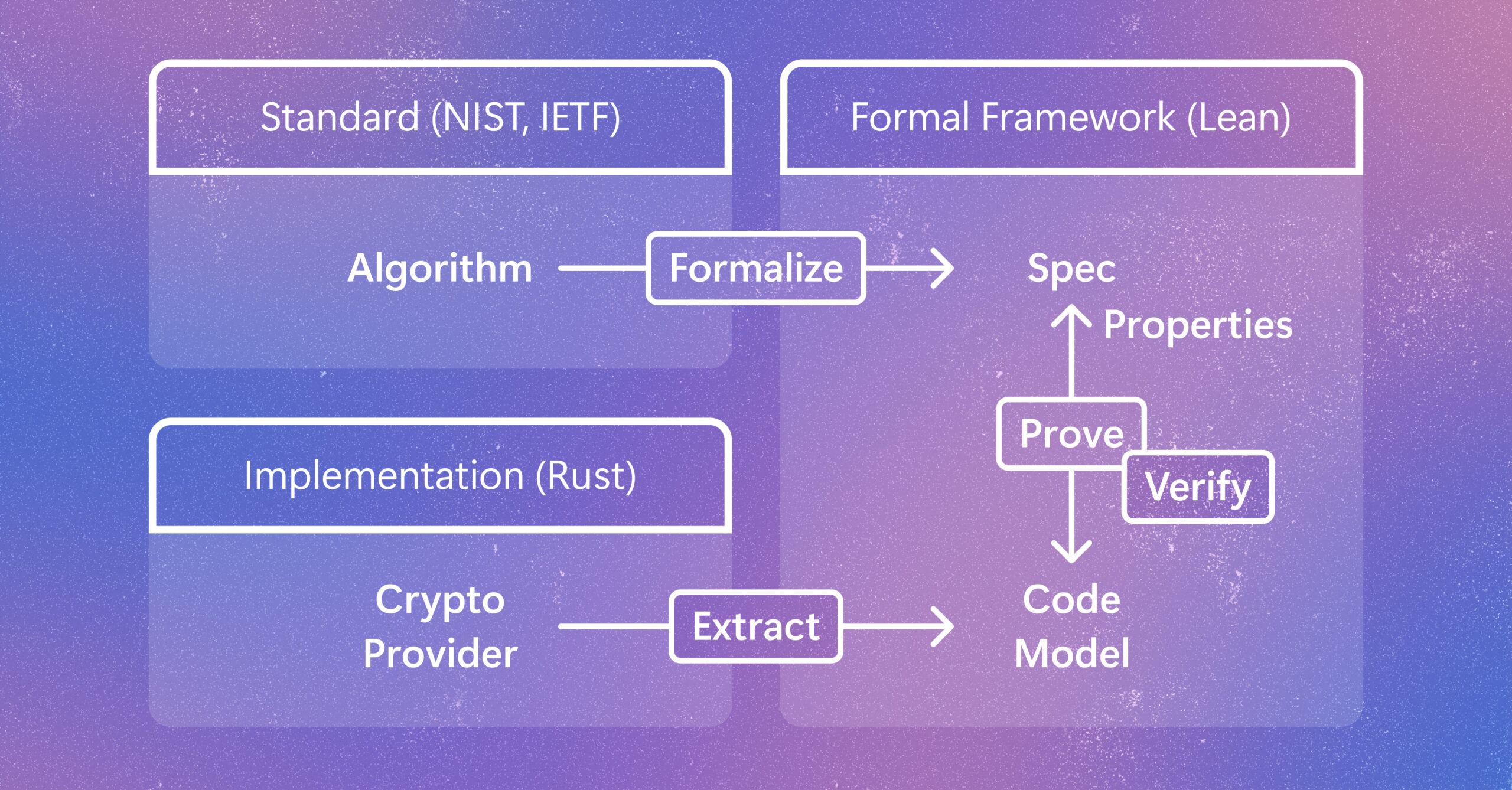
Cryptographic code supports vital protections in modern computing systems. Learn how a new method helps verify code as developers write it while preserving speed and adaptability as it gets implemented and evolves. The post Verifying Rust cryptography in SymCrypt, from standards to code appeared first on Microsoft Research.
MIT News · Artificial Intelligence· news.mit.eduJul 6, 2026
PhD student Rachel Sava, winner of the Envisioning the Future of Computing Prize, explores transformative improvements and dystopian risks of neural technology.