End-to-end planners based on waypoint regression achieve strong open-loop accuracy, but they primarily learn to mimic expert geometry and remain difficult to adapt to deployment-time safety constraints. We propose a query-based cost-learning framework that estimates bounded costs for dynamically reachable ego trajector...
Ahmed Abouelazm, Rupert Polley, Qingyuan Zhang et al.· 0 citations
Path-following control strategies typically follow the bi-objective optimization dilemma: minimizing deviations from a reference path while maintaining smooth speed profiles. The latter objective is especially relevant for Electric Vehicles (EVs), since their limited driving range can be extended by recovering energy t...
In mill yards, log loaders clear dense piles by a sequence of bundle grasps: hundreds of logs rest in contact, and each removal changes the pile available to the next grasp. A learned policy chooses where to place and orient the grapple from unsegmented point clouds and runs on a trailer-mounted hydraulic forestry cran...
George Sideris, Lucas Bessai, Heshan Fernando et al.· 0 citations
In this paper, we study robust decision-making in the latent space of world models (WMs). Robust optimization is a mathematical framework where, given explicitly specified dynamics and physically meaningful disturbances, a robot can select actions that remain effective even under worst-case disturbances. However, apply...
Junwon Seo, Andrea Bajcsy· 0 citations
Reach audiences
Advertise in front of researchers, engineers, and readers.
A robot description does more than specify a physical mechanism: it also encodes arbitrary conventions, such as joint-axis direction, joint-angle zero, and the order and names of links and joints. Morphology-aware policies consume interfaces built from these descriptions, yet cross-embodiment evaluation typically chang...
Rahath Malladi, Arshia Sangwan, Rajesh K. Gupta et al.· 0 citations
Humanoid household manipulation requires the arms to act while the body balances, steps and changes posture. We present BiGym 2.0, an adaptation of BiGym for the Unitree G1 across 20 household tasks using a unified whole-body controller for demonstration and evaluation. The suite provides 60 native human virtual-realit...
Zexi Zhang, Zecheng Zhu, Zidong Chen et al.· 0 citations
Vision-Language-Action (VLA) models have become a major paradigm for Vision-and-Language Navigation (VLN). However, in safety-critical facilities, invisible risks such as radiation or temperature spikes cannot be detected by an RGB camera, and handling each risk is expensive, requiring a new encoder, new data, and mode...
Mobile manipulators such as humanoid robots are increasingly deployed in dynamic, unstructured environments to perform dexterous manipulation tasks. However, end-to-end manipulation policies trained to imitate demonstration data collected from a single robot pose are brittle: even centimeter-scale deviations in robot p...
Suzannah Wistreich, Stephen Tian, Isabella Huang et al.· 0 citations
Behavioral cloning (BC), despite its simplicity, exhibits many counterintuitive phenomena in the real world. For example, the performance of BC often keeps increasing as the model overfits more to the dataset, and fully closed-loop policies often completely fail without action chunking. Unfortunately, properly studying...
Gaussian Belief Propagation (GBP) is a distributed inference algorithm that passes messages in graphical models, making it attractive for scalable spatial intelligence. However, we find GBP most effective locally: it rapidly smooths message errors that vary sharply between neighbor variables, but corrects global errors...
Yuzhou Cheng, Tom Yates, Ignacio Alzugaray et al.· 0 citations
Reinforcement-learning quadrotor controllers are usually trained under simplified wind models, yet the impact of wind-field fidelity, as opposed to magnitude, on policy robustness remains unquantified. This paper compares five disturbance-fidelity levels, from wind-free flight and discrete 1-cosine gusts through statis...
Deep Reinforcement Learning policies can produce nonsmooth action oscillations that hinder deployment on physical robots. Existing architectural and penalty-based approaches seek spatial smoothness by directly reducing sensitivity to changes in state inputs, but their broad constraints can degrade task performance as s...
Robots are getting smarter, but how can their hardware match that growth? New Microsoft Research findings show that moving AI inference beyond the robot can improve task success, boost efficiency, and support more advanced physical AI workloads. The post Offloaded inference for real-world physical AI robotics appeared first on Microsoft Research.
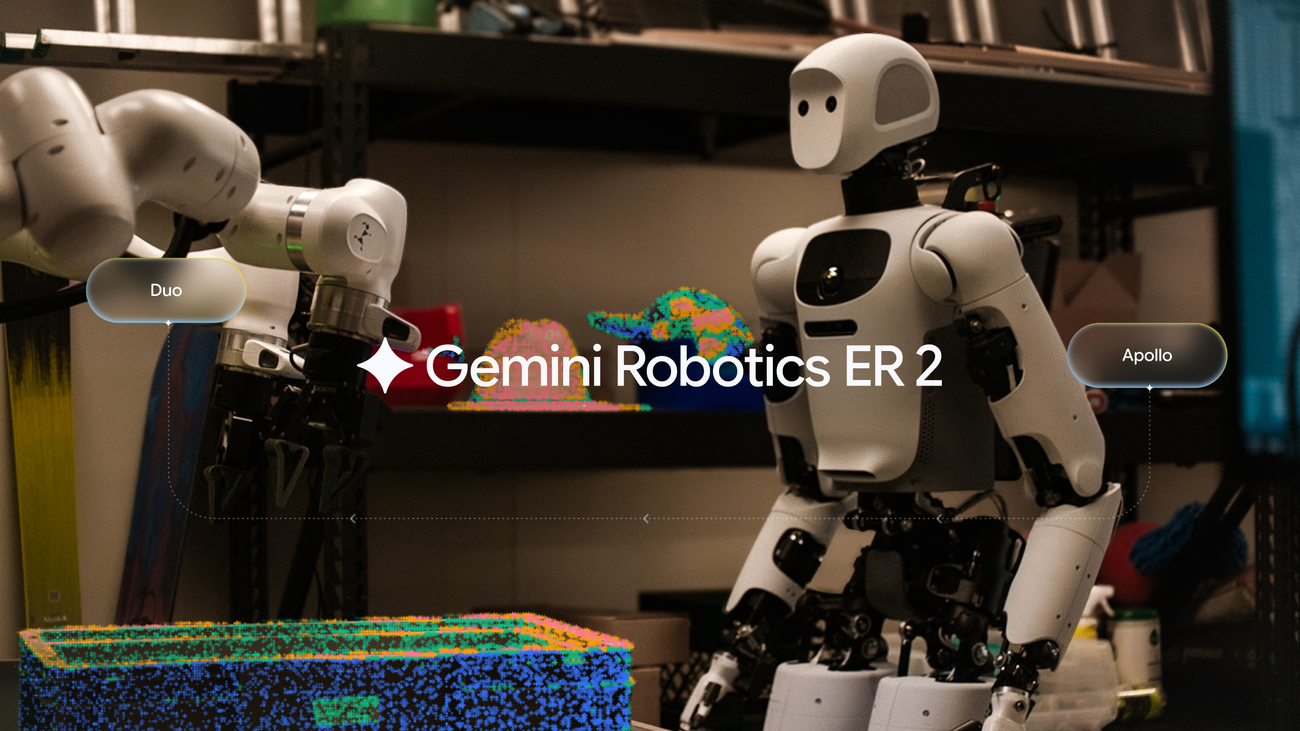
Gemini Robotics ER 2 helps robots reason, collaborate, and solve real-world tasks. It represents a step change in video understanding, tool orchestration, and multi-robot collaboration for robotic applications.
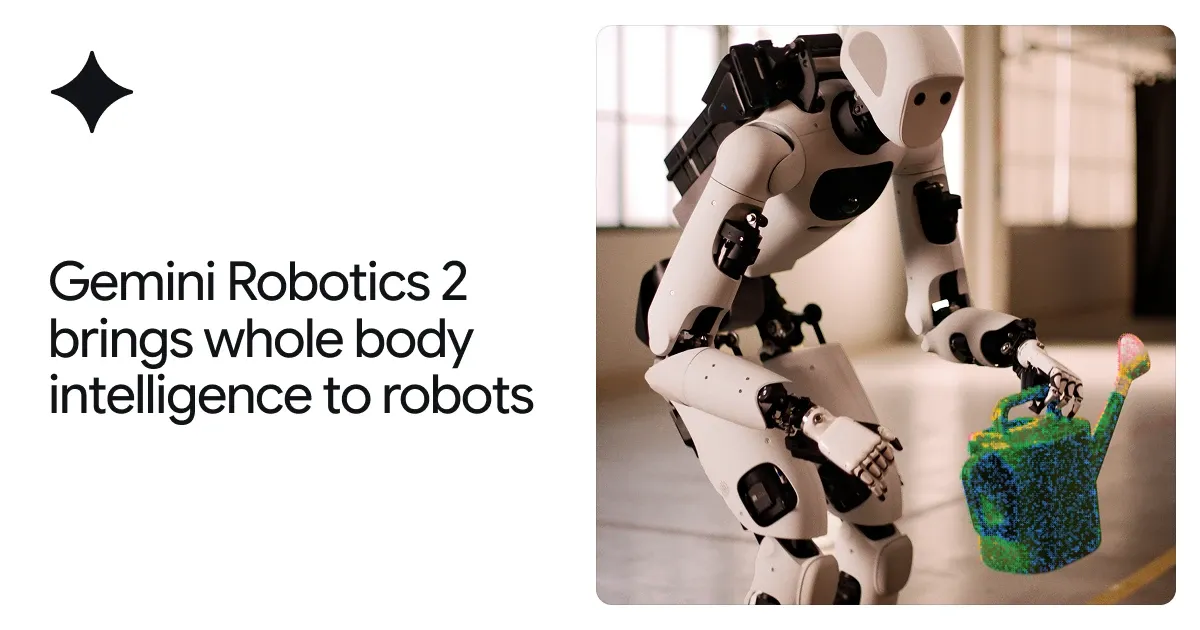
From feet to fingertips — we are teaching robots intelligent whole-body control, fine dexterity, and teamwork to complete a broad range of complex tasks.
We use cookies to run the site and, with your consent, for analytics and to show ads.
See our Cookie Policy.