Robotic systems often exhibit unstable modes, along which small perturbations and disturbances can cause unbounded growth unless corrected through feedback. Controlling such systems from high-dimensional visual observations requires representations that preserve these modes. Joint-embedding predictive architectures (JE...
Leonardo F. Toso, Yann LeCun, James Anderson et al.· 0 citations
Heterogeneous multi-robot path planning is a well-studied problem in which agents with disparate kinematic and dynamic models must coordinate to achieve shared objectives. These formulations, however, treat all agents as robotic-their cost models are mechanical and their traversability is sensor-derived. In human-robot...
Kristian Dalland, Prithvi Poddar, Souma Chowdhury et al.· 0 citations
Robot delivery studies can overstate transport capacity when travel to pickups and human support fall outside the modeled schedule. We formulate a location aware dispatch model that couples robot admission to transporter support and shared elevators, charging, and cleaning. The model replays 33,079 observed hospital re...
Krzysztof Siwek, Aleksandra \'Swietlicka· 0 citations
Autonomous social navigation requires balancing efficiency, physical safety, and social compliance. Reinforcement Learning (RL) methods provide a viable and effective solution but often rely on unrealistic assumptions, such as the knowledge of humans' position and velocity. In this paper, we introduce JESSI (JAX-based...
Tommaso Van Der Meer Andrea Garulli, Antonio Giannitrapani, Renato Quartullo et al.· 0 citations
Reach audiences
Advertise in front of researchers, engineers, and readers.
We propose a force-based model for social navigation of a tour-guide robot. Social forces due to various factors like obstacles, user position and heading, have been accounted for in the model. We claim that each one of these forces makes the robot more sociable to the user and we design an experimental setup for evalu...
For residual learning that refines existing behavior, sample efficiency depends on two things: how much information each rollout returns, and how efficiently the learner uses that information. Reinforcement learning's standard scalar reward carries far less information than the directional task error that defines the t...
Kai Ploeger, Alap Kshirsagar, Jan Peters· 0 citations
Reinforcement learning has shown strong performance in robotic manipulation, but learned policies often degrade in performance when test conditions differ from the training distribution. This limitation is especially important for reliable robot planning and control in contact-rich tasks such as pushing and pick-and-pl...
Shaifalee Saxena, Rafael Fierro, Alexander Scheinker· 0 citations
World-action models (WAMs) jointly generate future video and robot actions through iterative diffusion, achieving strong performance on manipulation benchmarks but requiring tens of denoising steps, a cost that precludes real-time control. Step distillation has emerged as the natural remedy, but off-the-shelf methods b...
Arman Akbari, Ci Zhang, Arash Akbari et al.· 0 citations
Vision-language-action (VLA) models achieve favorable task performance, yet runtime errors in closed-loop execution evolve with alternating updates of actions and observations. Existing VLA quantization methods mainly trade off inference speed and model performance while rarely investigating how quantization alters run...
Zihao Zheng, Hangyu Cao, Chibang Tao et al.· 0 citations
Imitation learning, also known as learning from demonstrations, is a popular approach to train AI models; however, the vulnerability of these models to adversarial attacks remains underexplored. We present the first systematic study of adversarial attacks, across a range of both classic and recently proposed imitation...
Akansha Kalra, Basavasagar Patil, Guanhong Tao et al.· 0 citations
The CADENCE algorithm solves the Partially Observable Cooperative Guard Art Gallery Problem (POCGAGP) with formal coverage and connectivity guarantees, but leaves unspecified which valid corner each agent should be deployed to, a choice that strongly affects efficiency. We introduce two learned corner-selection heurist...
World Action Models (WAMs) incorporate visual representations from video generation backbones to guide action prediction. Recent efficient WAMs adopt Mixture-of-Transformers (MoT) architectures and compute video representations once for reuse by the action expert. However, intra-expert iteration (\ie, multi-step action...
Cheng-Tao Lv, Jin-Yang Du, Shu-Yi Feng et al.· 0 citations
Robots are getting smarter, but how can their hardware match that growth? New Microsoft Research findings show that moving AI inference beyond the robot can improve task success, boost efficiency, and support more advanced physical AI workloads. The post Offloaded inference for real-world physical AI robotics appeared first on Microsoft Research.
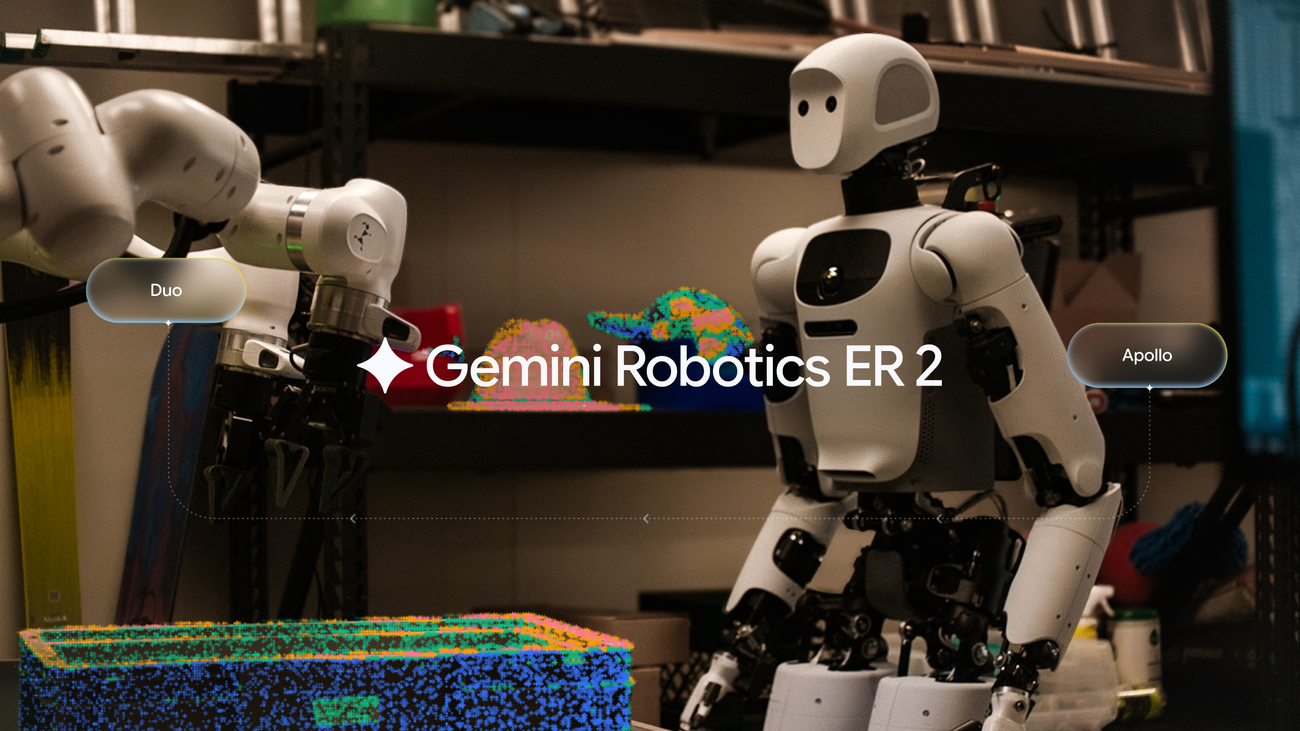
Gemini Robotics ER 2 helps robots reason, collaborate, and solve real-world tasks. It represents a step change in video understanding, tool orchestration, and multi-robot collaboration for robotic applications.
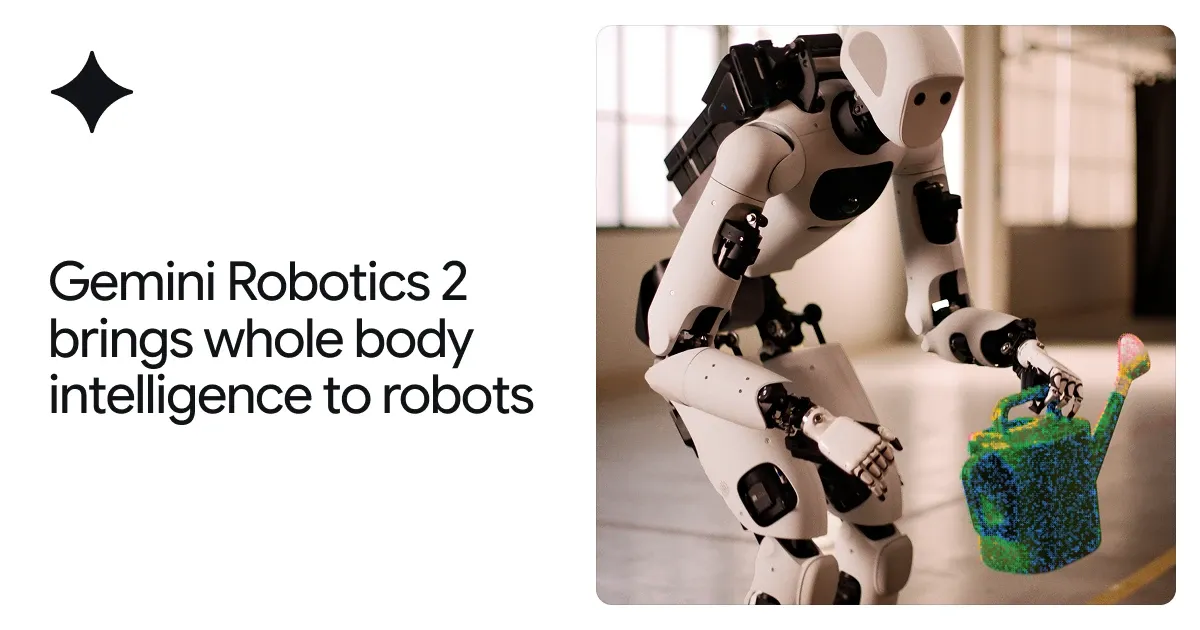
From feet to fingertips — we are teaching robots intelligent whole-body control, fine dexterity, and teamwork to complete a broad range of complex tasks.
We use cookies to run the site and, with your consent, for analytics and to show ads.
See our Cookie Policy.