Losing the name before the box: measuring and repairing what narrow fine-tuning costs a detector outside its deployment vocabulary
Trung Minh BuiJongsul MoonYoungOuk KimJung-Hoon HwangDongin Shin
Sep 2026
Machine LearningComputer VisionRobotics
Abstract
A detector pretrained on a broad corpus is fine-tuned on a narrow domain, its in-domain accuracy improves, and it ships. We ask what happens meanwhile to its coverage of objects the vocabulary never names, which in obstacle detection and inspection carry the risk. No in-domain test set holds an example of one. We give a longitudinal protocol: one pretrained checkpoint against its own fine-tuned descendants. It tracks held-out top-$K$ proposal coverage $C_\tau$: of categories pretraining covered and the vocabulary omits, the share of boxes a detector's top $K$ regions still cover. The quantity is the open-world proposal literature's; the longitudinal reading is not. $C_\tau$ falls while in-domain accuracy rises, on four architectures and three domains, by $5.12$ to $63.35$ points on boxes above $1024$ px$^2$. No in-domain number identifies the fall, and neither does detection average precision, which charges a missed and a misnamed box alike. On the one architecture scoring both, adaptation costs $87\%$ of the AP against a fifth of the coverage, and the naming goes first at all six depths of its freeze ladder, every run. What breaks is structured: three architectures sharing no pretraining run agree on which categories lose coverage, and those a model never learned do not lose any. A repair follows and needs no training: mixing a quarter of the pretrained state back, normalisation statistics included, raises coverage on every cell swept for at most $2.47$ points of in-domain accuracy. Seeing it costs one extra evaluation pass.
This publication proposes a definition and a classification of agile software development approaches and analyses ten software development methods that can be characterized as being "agile" against the defined criterion.
P. Abrahamsson, O. Salo, Jussi Ronkainen et al.· arXiv.org· 727 citations· ⚡54
The study shows that agile practices improve both informal and formal communication, but indicates that, in larger development situations involving multiple external stakeholders, a mismatch of adequate communication mechanisms can sometimes even hinder the communication.
M. Pikkarainen, Jukka Haikara, O. Salo et al.· Empirical Software Engineeri...· 401 citations· ⚡48
The results indicate that software engineering work practices are chosen opportunistically, adapted and configured to provide value under the constrains imposed by the startup context.
Nicolò Paternoster, Carmine Giardino, M. Unterkalmsteiner et al.· Information and Software Tec...· 394 citations· ⚡54
The possibility of inferring high-dimensional data inference in a model that consists of a prior and an auxiliary differentiable constraint given some additional information is considered, thereby allowing a range of potential applications in adapting models to new domains and tasks.
Alexandros Graikos, Esmeralda S. Whitammer, N. Jojic et al.· Neural Information Processin...· 316 citations· ⚡15
It is proved that any global minimizer of the trajectory balance objective can define a policy that samples exactly from the target distribution, and empirically demonstrate the benefits of the trajectories balance objective for GFlowNet convergence, diversity of generated samples, and robustness to long action sequenc...
Esmeralda S. Whitammer, Moksh Jain, Emmanuel Bengio et al.· Neural Information Processin...· 302 citations· ⚡60
Exploring how generative AI could make machine vision more accessible to businesses. The post GenEye in a Box: Making Machine Vision Something You Can Just Ask For appeared first on GPT-Lab.
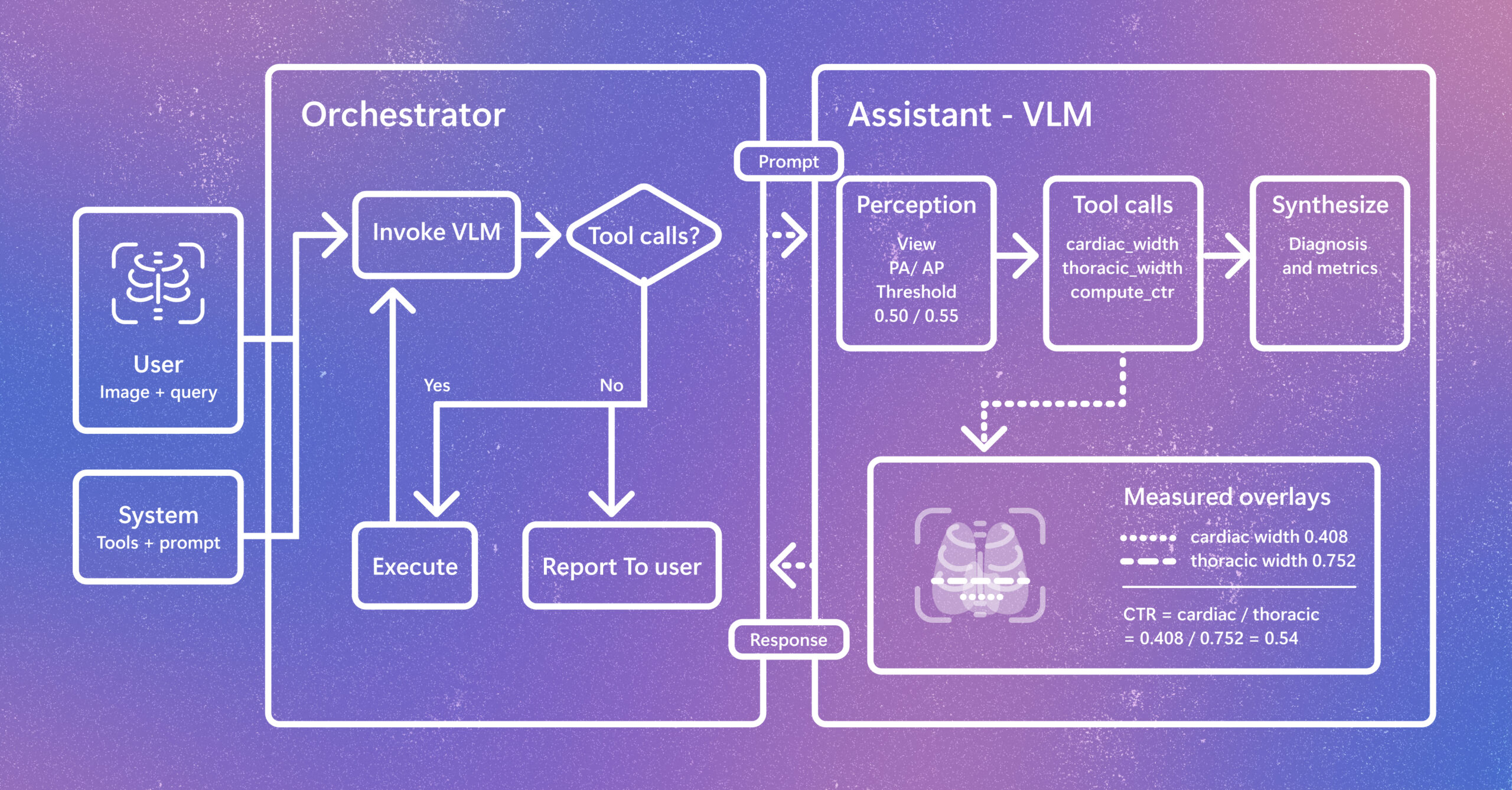
Radiology AI is evolving beyond report generation. CARE-X explores a unified approach that combines flexible reasoning, calibrated predictions, and measurement-based tools for chest X-ray interpretation. The post Introducing CARE-X: Towards Clinically Useful Radiology VLMs with Auxiliary Supervision, Reward-Aligned Learning, and Tool-Augmented Measurement appeared first on Microsoft Research.