Generalist robot policies, such as vision-language-action models (VLAs) and world-action models (WAMs), combine powerful pretrained backbones with expressive generative action heads trained via flow matching on large-scale robotic datasets. Despite their strong empirical performance in robotic manipulation, these polic...
Ralf R\"omer, Maximilian Seeliger, Saida Liu et al.· 0 citations
Human interventions provide crucial corrective signals for post-training Vision-Language-Action (VLA) models. However, enabling seamless humanoid interventions is a formidable systems challenge due to complex whole-body kinematics and dexterous-hand control. Consequently, the collected intervention trajectories are oft...
Wei Xiao, Weiliang Tang, Yuying Ge et al.· 0 citations
World models paired with model predictive control (MPC) can be trained offline on large-scale datasets of expert trajectories and enable generalization to a wide range of planning tasks at inference time. Compared to traditional MPC procedures, which rely on slow search algorithms or on iteratively solving optimization...
Rohun Agrawal, Nimit Kalra, Arjun Parthasarathy et al.· 0 citations
Endovascular brain-computer interfaces (BCIs) avoid craniotomy but require precise device delivery through anatomically variable cerebral veins. This work presents the first demonstration of in vitro autonomous robotic navigation for endovascular BCI access in the cerebral venous system. Soft Actor-Critic controllers w...
Harry Robertshaw, Weijie Qi, Nikola Fischer et al.· 0 citations
Reach audiences
Advertise in front of researchers, engineers, and readers.
World action models (WAMs) have advanced robot control by predicting how observations and actions evolve over time. Despite this progress, RGB and action based future prediction does not explicitly address the spatial understanding needed for robot manipulation. Existing efforts often add a limited set of spatial predi...
Ting-Ting Du, Zi-Yao Wang, Guoheng Sun et al.· 0 citations
Generative planners based on diffusion/flow matching can learn to synthesize long-horizon trajectories from demonstrations. However, real-world deployment requires (i) enforcing safety constraints during execution and (ii) tight online replanning at fast execution rates. Prior safe diffusion/flow planners generate the...
Seunghwan Jang, Jeongyong Yang, Siddharth Ancha et al.· 0 citations
Transformer policies are attractive for multi-agent robot learning because self-attention can model interactions among agents. However, multi-agent teams are unordered, while transformers typically process agents as ordered token sequences. We study how this mismatch affects cooperative navigation policies under agent-...
Monitoring planned driving trajectories requires accurately estimating the collision likelihood with actors whose motion is itself impacted by the ego motion. Existing classical approaches are often limited by the quality of their forecasting model. Vision-language models (VLMs) have shown promise in reasoning about th...
Lu\'is Marques, Rong Fang, Disha Kamale et al.· 0 citations
Robot demonstrations may contain useful behavior even when individual episodes are inefficient or unsuccessful. Trajectory stitching offers a way to compose these behaviors into improved training data, but identifying useful connections and verifying their feasibility is difficult in high-dimensional robot data, where...
A growing body of work suggests that tactile sensing gives robot policies contact information that complements vision in dexterous manipulation. However, visuo-tactile robot data remains scarce: dexterous demonstrations require teleoperating robots, which limits dataset scale. Human demonstrations are far cheaper to co...
Jing-Yun Yang, Bai-Yu Shi, Timothy Yu et al.· 0 citations
Online reinforcement learning (RL) enables robot policies to improve through physical interaction, but the assistance they require changes as their competence evolves. Existing intervention strategies based on offline estimates or fixed decision rules can therefore become mismatched to the current policy. To address th...
Yu-Dong Lin, Hao-Yuan Deng, Zhuo-Xuan Yuan et al.· 0 citations
Long-horizon tasks with sparse rewards pose an exploration bottleneck for goal-conditioned reinforcement learning: a policy started from the initial state rarely reaches the goal and receives no learning signal. Reference motions, hand-designed curricula, and shaped rewards supply this signal but require demonstrations...
J. Pfammatter, Kai-Xian Qu, Clemens Schwarke et al.· 0 citations
Robots are getting smarter, but how can their hardware match that growth? New Microsoft Research findings show that moving AI inference beyond the robot can improve task success, boost efficiency, and support more advanced physical AI workloads. The post Offloaded inference for real-world physical AI robotics appeared first on Microsoft Research.
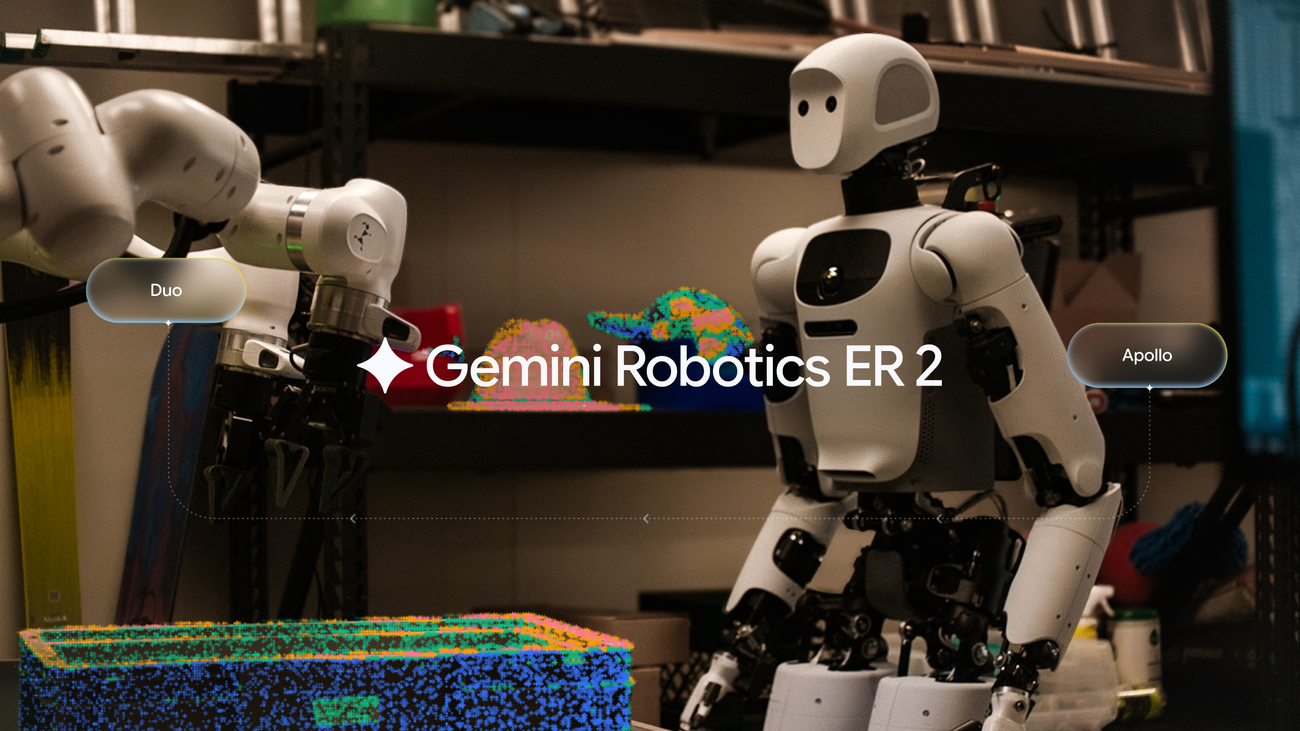
Gemini Robotics ER 2 helps robots reason, collaborate, and solve real-world tasks. It represents a step change in video understanding, tool orchestration, and multi-robot collaboration for robotic applications.
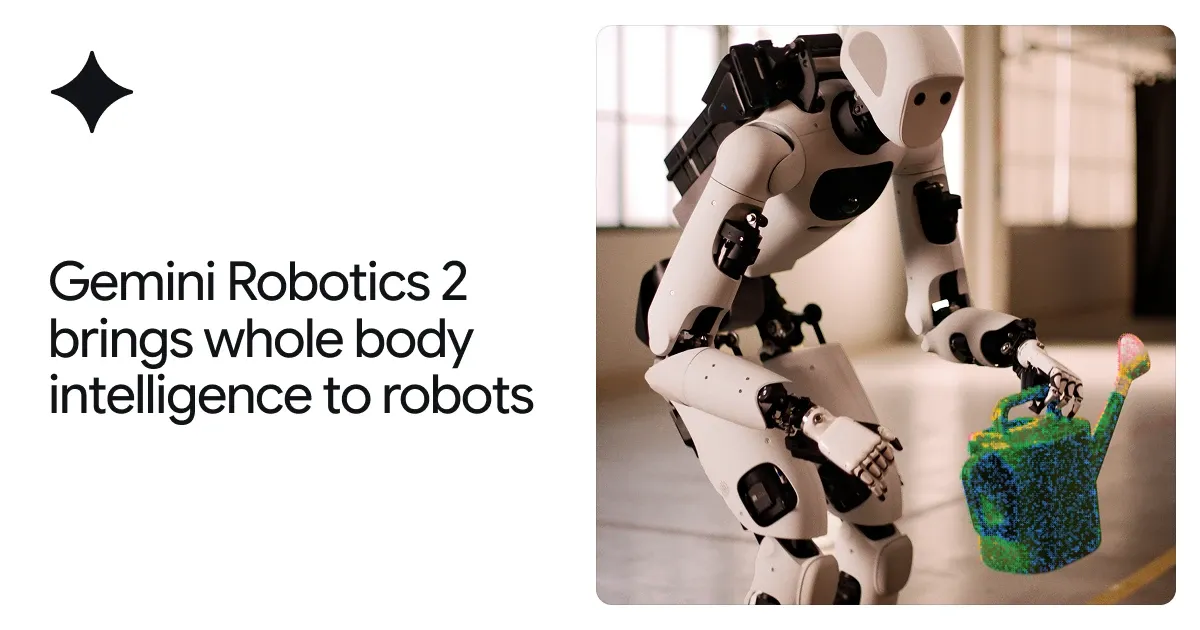
From feet to fingertips — we are teaching robots intelligent whole-body control, fine dexterity, and teamwork to complete a broad range of complex tasks.
We use cookies to run the site and, with your consent, for analytics and to show ads.
See our Cookie Policy.