World action models (WAMs) have advanced robot control by predicting how observations and actions evolve over time. Despite this progress, RGB and action based future prediction does not explicitly address the spatial understanding needed for robot manipulation. Existing efforts often add a limited set of spatial prediction tasks through specialized heads or branches, leaving both the range of spatial supervision and the model architecture fragmented. We introduce XGenAct, a world action model that represents RGB observations, robot actions, metric depth, surface normals, and functional role segmentation as RGB videos through deterministic codecs. By sampling perception and action tasks during training, XGenAct uses one video diffusion transformer and one objective to learn temporal prediction across these spaces without modality specific learned heads. On held out RLBench tasks, structured perception training improves average closed loop success over RGB only training, and XGenAct achieves 52% success in the five task external comparison, versus 26% for the strongest evaluated baselines. It also predicts future depth and segmentation more accurately than the evaluated pipelines that generate RGB first and then apply a frozen perception expert.
This publication proposes a definition and a classification of agile software development approaches and analyses ten software development methods that can be characterized as being "agile" against the defined criterion.
P. Abrahamsson, O. Salo, Jussi Ronkainen et al.· arXiv.org· 727 citations· ⚡54
The study shows that agile practices improve both informal and formal communication, but indicates that, in larger development situations involving multiple external stakeholders, a mismatch of adequate communication mechanisms can sometimes even hinder the communication.
M. Pikkarainen, Jukka Haikara, O. Salo et al.· Empirical Software Engineeri...· 401 citations· ⚡48
The results indicate that software engineering work practices are chosen opportunistically, adapted and configured to provide value under the constrains imposed by the startup context.
Nicolò Paternoster, Carmine Giardino, M. Unterkalmsteiner et al.· Information and Software Tec...· 394 citations· ⚡54
The possibility of inferring high-dimensional data inference in a model that consists of a prior and an auxiliary differentiable constraint given some additional information is considered, thereby allowing a range of potential applications in adapting models to new domains and tasks.
Alexandros Graikos, Esmeralda S. Whitammer, N. Jojic et al.· Neural Information Processin...· 316 citations· ⚡15
Exploring how generative AI could make machine vision more accessible to businesses. The post GenEye in a Box: Making Machine Vision Something You Can Just Ask For appeared first on GPT-Lab.
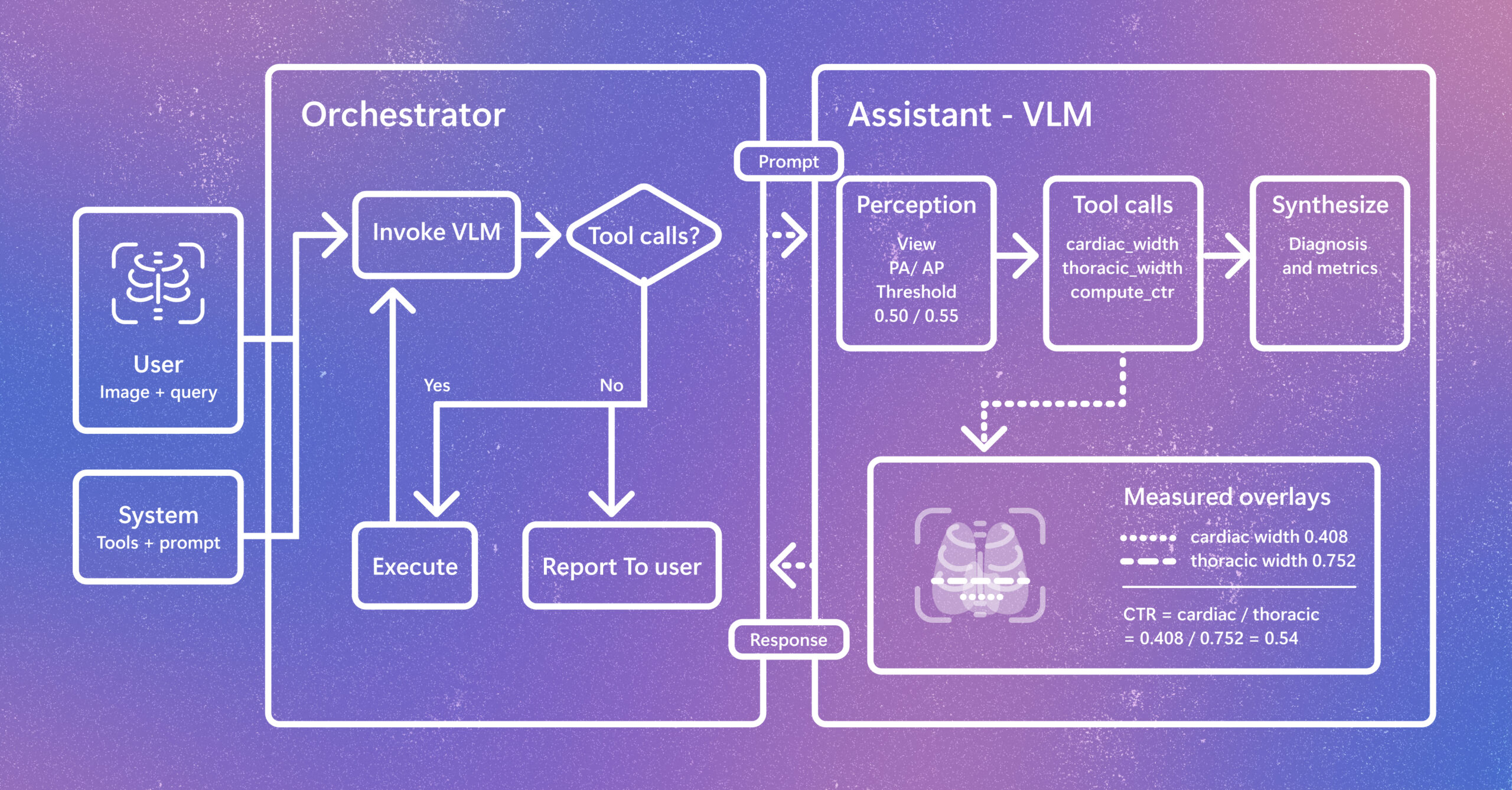
Radiology AI is evolving beyond report generation. CARE-X explores a unified approach that combines flexible reasoning, calibrated predictions, and measurement-based tools for chest X-ray interpretation. The post Introducing CARE-X: Towards Clinically Useful Radiology VLMs with Auxiliary Supervision, Reward-Aligned Learning, and Tool-Augmented Measurement appeared first on Microsoft Research.