Language-enabled robot systems increasingly combine semantic-graph planning with temporal-logic safety monitors. We investigate a trace-completeness assumption in these systems: whether the high-level action sequence checked by a monitor represents the navigation and implicit action effects induced during execution. We...
Stabak Das, Priyesh Ranjan, Xiang-Fang Li et al.· 0 citations
Offline multi-agent reinforcement learning (MARL) faces a persistent trade-off. Expressive generative policies can represent multi-modal coordination in the data, but cannot distinguish high-value regions, while value-optimized policies exploit the learned Q-function but collapse the multi-modal into a single dominant...
Finding an optimal behaviour policy within a given environment is a widely studied problem in domains as diverse as games, robotics, energy infrastructure, communication networks, and multi-agent systems. Numerous benchmarks have been developed to support such research, but the vast majority assume that the agent's emb...
Aviraj Newatia, Yordan Tsvetkov, Leonard Pleiss et al.· 0 citations
Synthesizing safe and robust neural controllers in simulation for reliable sim-to-real deployment remains a critical challenge in robotics. Existing learning-based methods typically lack safety and performance guarantees over an explicitly defined operating region, while post-training verification techniques provide no...
Riccardo Curcio, Hongpeng Cao, Marco Caccamo· 0 citations
Reach audiences
Advertise in front of researchers, engineers, and readers.
Forward-backward (FB) representations provide a powerful framework for learning the successor representation (SR) in continuous spaces by enforcing a low-rank factorization. However, a fundamental spectral mismatch often exists between the high-rank transition dynamics of continuous environments and the low-rank bottle...
Seyed Mahdi B. Azad, Jasper Hoffmann, Iman Nematollahi et al.· 0 citations
Robotic locomotion is often approached with the goal of maximizing robustness and reactivity by increasing motion control frequency. We challenge this intuitive notion by demonstrating robust and dynamic locomotion with a learned motion controller executing at as low as 8 Hz on a real ANYmal C quadruped. The robot is a...
Siddhant Gangapurwala, Luigi Campanaro, Ioannis Havoutis· 0 citations
This paper examines the role of Novel View Synthesis (NVS) in geometric representation learning. In principle, NVS should reason about 3D scene structure, thereby enabling transferable multi-view geometric representations. Yet, existing encoder-based NVS methods yield poor representations. This is not because of a lack...
Keerthi Kaashyap, D. Anthony, Akshay Krishnan et al.· 0 citations
Inspired by human vision, we introduce a framework using active gaze to enable fine-grained bimanual manipulation with only a single stereo camera. EyeRobot 2.0 physically attends to a 3D fixation point in the scene by swiveling two eye viewpoints to center their gaze on it. The resulting images are processed foveally...
Kush J. Hari, Justin Kerr, Nidhya Shivakumar et al.· 0 citations
Adversarial patches can disrupt Vision-Language-Action (VLA) models by manipulating visual observations, leading to failures in robot control. However, it remains poorly understood which internal mechanisms underlie these failures and how targeted interventions can mitigate them. In this work, we mechanistically analyz...
Yukiya Horiba, Koshiro Aoki, Shunsuke Yasuki et al.· 0 citations
Long-horizon mobile manipulation presents significant challenges due to compounding execution errors and capacity interference between locomotion and arm control. While recent Vision-Language-Action models excel at short-horizon tasks, they lack the hierarchical reasoning required for multi-stage objectives. Furthermor...
Chen-Zhi Liu, Yue Zhang, Jie-Hong Lin et al.· 0 citations
Imitation learning for contact-rich manipulation requires high-quality expert data that is expensive to obtain. This makes learning a sample-efficient policy a key issue. To address this, we propose VISTA, a workspace-level equivariant visuotactile diffusion policy for data-efficient contact-rich imitation learning. VI...
Lik Hang Kenny Wong, Yiyao Ma, Xiu-Shen Wei et al.· 0 citations
In lifelong reinforcement learning, retaining previously learned policies is not sufficient for effective transfer to a new task. Useful knowledge may be distributed across several prior policies, and its relevance may change as the learner acquires experience. One hypothesis is that task similarity can be effectively...
Saptarshi Nath, Inish M. D'Souza, Antonio Carta et al.· 0 citations
Robots are getting smarter, but how can their hardware match that growth? New Microsoft Research findings show that moving AI inference beyond the robot can improve task success, boost efficiency, and support more advanced physical AI workloads. The post Offloaded inference for real-world physical AI robotics appeared first on Microsoft Research.
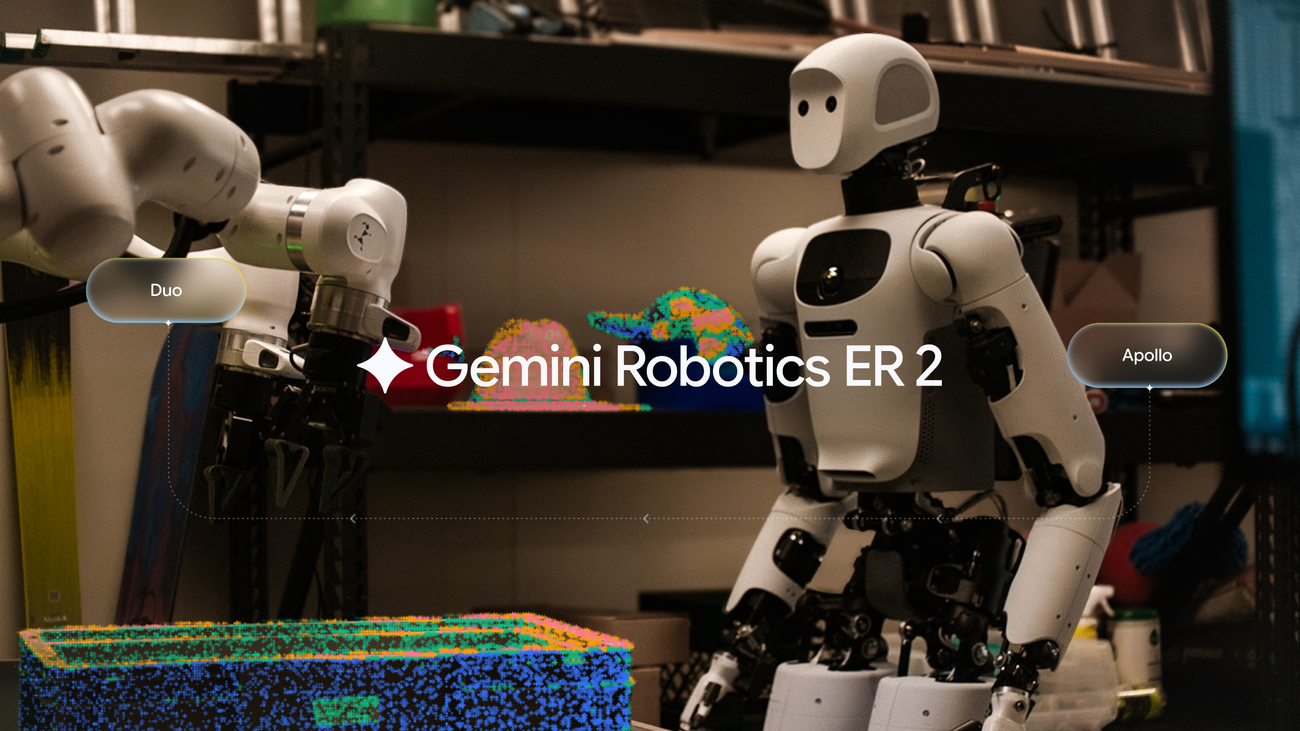
Gemini Robotics ER 2 helps robots reason, collaborate, and solve real-world tasks. It represents a step change in video understanding, tool orchestration, and multi-robot collaboration for robotic applications.
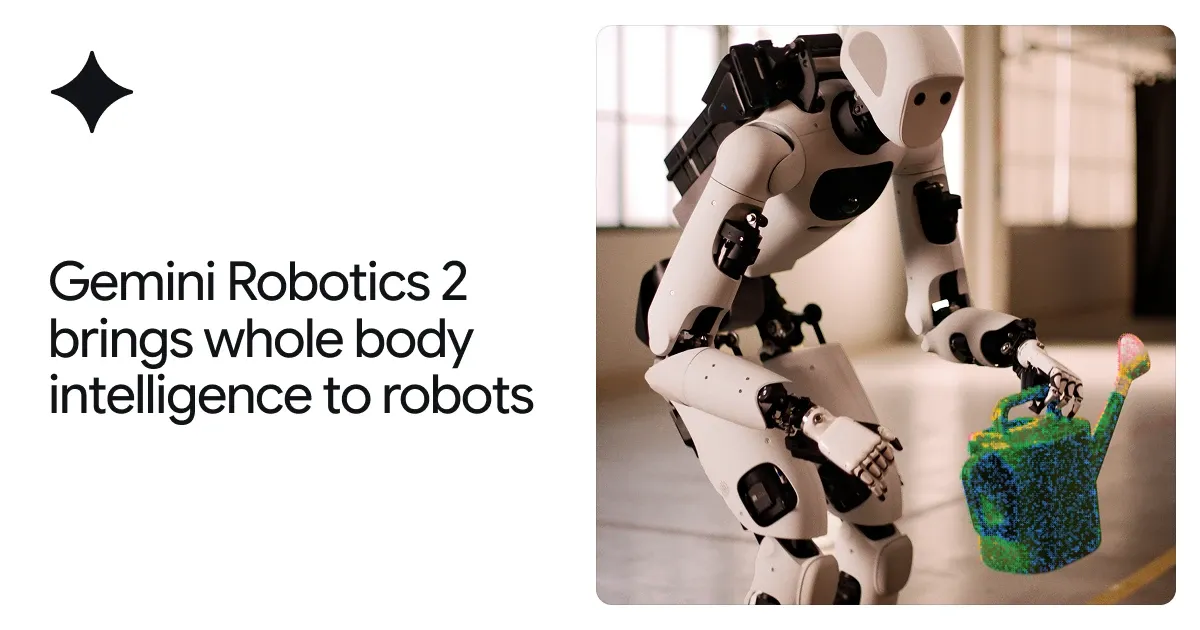
From feet to fingertips — we are teaching robots intelligent whole-body control, fine dexterity, and teamwork to complete a broad range of complex tasks.
We use cookies to run the site and, with your consent, for analytics and to show ads.
See our Cookie Policy.