Behavior-cloned policies often learn multiple behavior modes from demonstration datasets, including modes that are unsafe or otherwise undesired at deployment. For example, a policy trained on diverse handover demonstrations may learn to pass a knife blade-first. Standard remedies such as data curation and inference-ti...
Hao Wang, Jiuzhou Lei, Dayou Li et al.· 0 citations
Vision-Language-Action (VLA) policies are typically evaluated under the assumption that the robot starts acting only after the user has finished typing or speaking. In real interactions, however, entering an instruction can take several seconds, leaving the policy idle for a substantial fraction of the interaction. Par...
Joonha Park, Jiseung Jeong, Taesik Gong· 0 citations
Generative robot policies trained on demonstrations using behavior cloning often learn actions that are sub-optimal or misaligned with respect to the downstream task. Policy improvement approaches aim to bridge this gap and improve the cumulative reward with minimal interventions on the pre-trained policy. However, an...
Omkar Patil, Ondrej Biza, Thomas Weng et al.· 0 citations
An agent meets a model as served: through an endpoint with a price card, a shared cache and other tenants, or on whatever hardware a self-hosted model runs. Benchmarks rank the weights. We introduce a Tetris benchmark that measures what agents get from models as served: every move is scored against an oracle, and every...
Haochuan Wang· 0 citations
Reach audiences
Advertise in front of researchers, engineers, and readers.
The advancement of robotics and autonomous navigation systems hinges on the ability to accurately predict terrain traversability. Traditional methods for generating datasets to train these prediction models often involve putting robots into potentially hazardous environments, posing risks to equipment and safety. To so...
Shreya Gummadi, Mateus V. Gasparino, Gianluca Capezzuto et al.· 0 citations
Vertical localization, particularly floor separation, remains a major challenge in indoor positioning systems operating in GPS-denied multistory environments. This paper proposes a fully data-driven, graph-based framework for blind floor separation using only Wi-Fi fingerprint trajectories, without requiring prior buil...
Navigation and manipulation are core capabilities in Embodied AI, but training agents to perform them directly in the real world is costly, time-consuming, and unsafe. Therefore, sim-to-real transfer has emerged as a key approach, yet the sim-to-real gap persists. This survey examines how physics simulators address thi...
Lik Hang Kenny Wong, Xueyang Kang, Kaixin Bai et al.· 0 citations
Long-horizon manipulation under sparse rewards remains challenging for reinforcement learning due to delayed feedback and inefficient exploration. Existing skill-based approaches often assume a fixed parametric prior (e.g., a single Gaussian), limiting their ability to capture diverse and multi-modal skill structures r...
Yuan Meng, Xiangtong Yao, Yansong Wu et al.· 0 citations
Robotic long-horizon manipulation requires robots to compose perception, reasoning, and action over extended task sequences, yet existing language-conditioned frameworks often rely on dense step-wise feedback, learned action policies, or unstructured prompting, which limits robustness and generalization. We propose DAH...
Yuan Meng, Xiangtong Yao, Haihui Ye et al.· 0 citations
In this paper, we study the problem of methodically obtaining a sufficient set of kinesthetic demonstrations, one at a time, such that a robot can be confident of its ability to perform a complex manipulation task in a given region of its workspace. Although programming by demonstration has been an active area of resea...
Dibyendu Das, Aditya Patankar, Nilanjan Chakraborty et al.· 0 citations
LLM agents that orchestrate frozen vision-language-action (VLA) policies improve across episodes through text memory, which records what the agent did but not how the task is done. A demonstration video shows it, but fits poorly into an agent's context. The full video slows every turn, fixed keyframes lose the contact...
Wen-Rui Bao, Xin-Xin Liu, Bing-Xin Xu et al.· 0 citations
World models learn to predict how their environment will evolve, making them an important foundation for general-purpose robotic control. Yet world action models depend on camera inputs whose manipulation can corrupt the visual representations used across tasks and action policies. Existing attacks on these models opti...
Xuanyu Lu, Fengqing Jiang, Kaiyuan Zheng et al.· 0 citations
Robots are getting smarter, but how can their hardware match that growth? New Microsoft Research findings show that moving AI inference beyond the robot can improve task success, boost efficiency, and support more advanced physical AI workloads. The post Offloaded inference for real-world physical AI robotics appeared first on Microsoft Research.
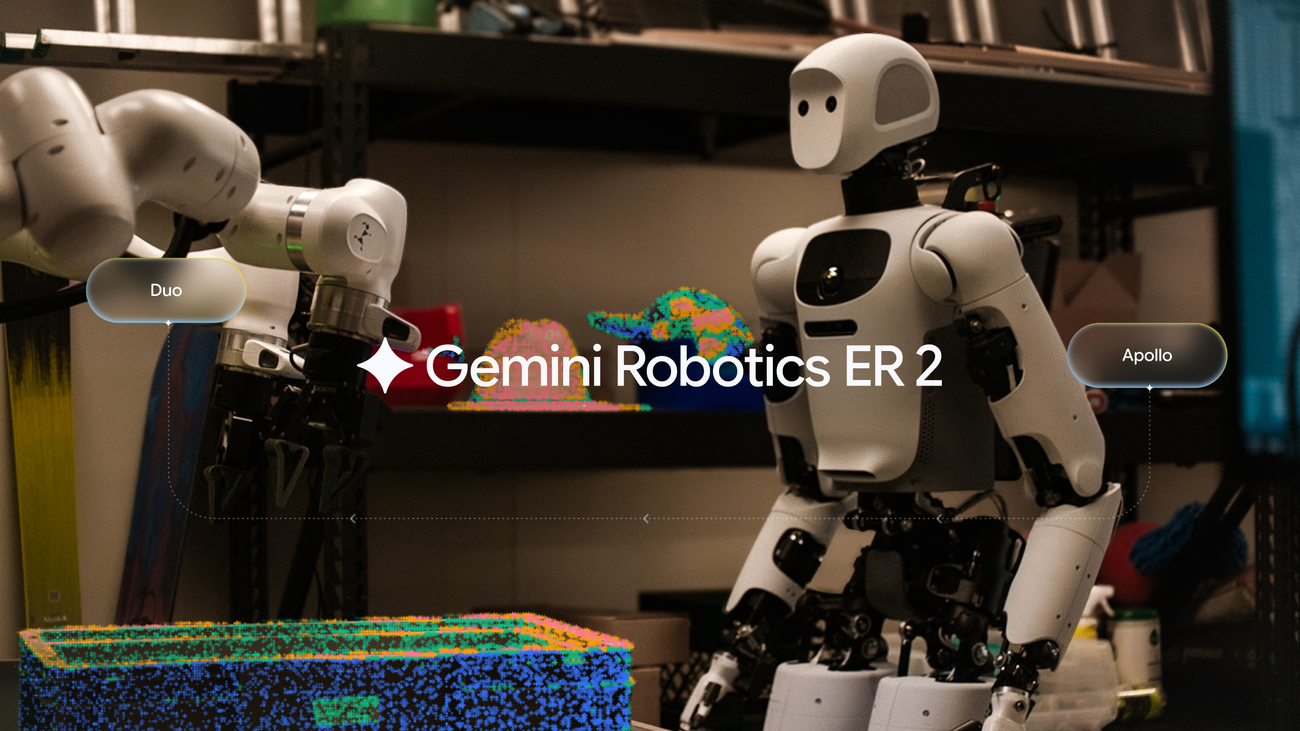
Gemini Robotics ER 2 helps robots reason, collaborate, and solve real-world tasks. It represents a step change in video understanding, tool orchestration, and multi-robot collaboration for robotic applications.
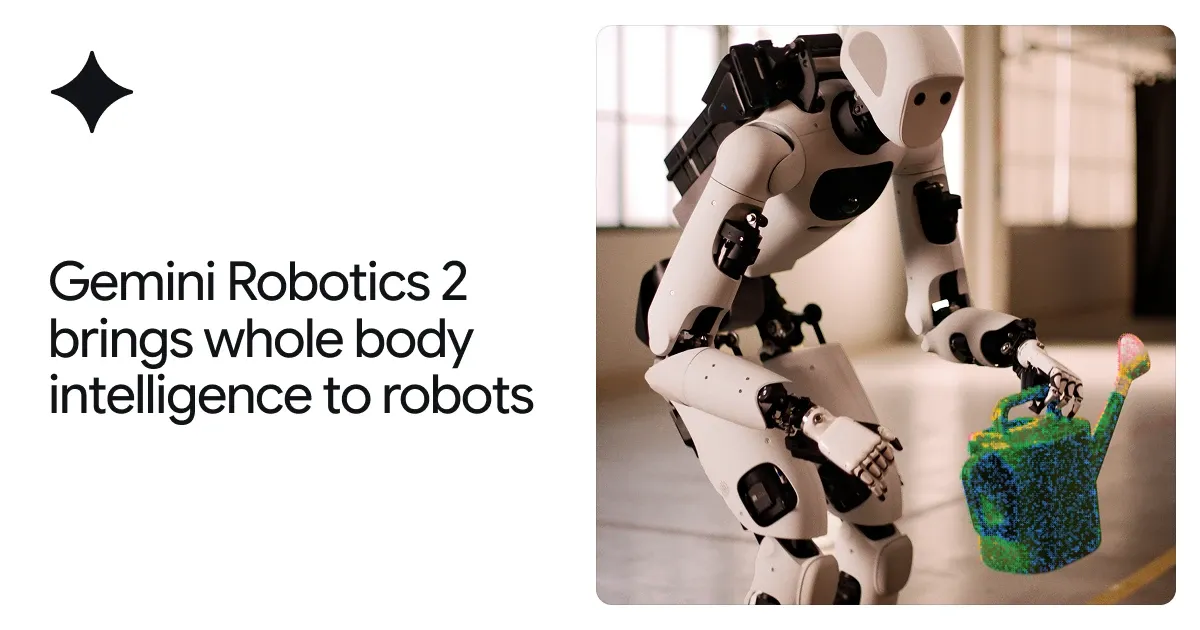
From feet to fingertips — we are teaching robots intelligent whole-body control, fine dexterity, and teamwork to complete a broad range of complex tasks.
We use cookies to run the site and, with your consent, for analytics and to show ads.
See our Cookie Policy.