Emerging mission classes such as on-orbit servicing, satellite inspection, and active debris removal require trajectory design methods that are adaptable to a variety of mission scenarios. We present a diffusion-based trajectory generation approach for rendezvous and proximity operations (RPO) that enables flexible con...
Mariko A. Storey-Matsutani, Richard Linares· 0 citations
Long-horizon mobile manipulation requires a task plan and the motion that executes it. Generative planners trained on demonstration produce both in one pass, requiring neither a symbolic domain nor search. To date, however, they have relied on thousands of scripted demonstrations of fixed-base arms and executed open lo...
Zuleika Redondo Garcia, Andreu Matoses Gimenez, Javier Alonso-Mora· 0 citations
Latent world models enable robots to plan by predicting the consequences of actions. Planning long tasks with control-rate actions requires many prediction steps, which enlarges the search space and accumulates error. Skill-level actions shorten these sequences, but a symbolic skill vocabulary requires domain knowledge...
Andreu Matoses Gimenez, Andrei-Carlo Papuc, Christian Pek et al.· 0 citations
Hierarchical control architectures are widely used to decompose complex control problems into interacting control levels and are particularly important in robotics, where planning, whole-body motion, and lower-level control must be coordinated across different levels of abstraction and time scales. Their overall closed...
Sebastian Hirt, Lukas Theiner, Jan Peters et al.· 0 citations
Reach audiences
Advertise in front of researchers, engineers, and readers.
Transferring visual representations pretrained on human videos to robot manipulation requires learning reliable correspondences between human and robot demonstrations. However, paired demonstrations can differ in execution rate and in the proportion of non-key frames that do not directly reflect task progress. Frames a...
Xizhe Zhang, Jingfeng Zhang, Zirun Zhou et al.· 0 citations
Latent safety filters certify safety on a learned low-dimensional representation of the state, enabling constraints that resist analytic description. Because the encoder is lossy, a filter can report safe while the physical state is unsafe, with no detectable model error. Existing transfer conditions leave the effect o...
Johannes Mootz, Zahra Nili Ahmadabadi, Reza Akhavian· 0 citations
Humanoid robots could transport payloads substantially heavier than themselves by pulling passive wheeled vehicles instead of carrying the load. This capability, however, creates a coupled locomotion problem: the robot must maintain persistent upper-body contact while adapting to unknown, configuration-dependent forces...
Yang-Zhi Yang, Xian-Sheng Lin, Zhao-Ming Xie et al.· 0 citations
Balanced discrete optimal transport between n sources and n targets of unit mass is exactly the minimum-cost assignment problem-a bipartite perfect matching-and is therefore solvable exactly by industrial matching engines in milliseconds to seconds. We ask when the exact approach beats the standard approximate alternat...
Vision-language-action models (VLAs) inherit strong semantic grounding from pretrained vision-language backbones but are typically optimized for predicting actions rather than future observations. They can see and act, but they do not imagine the future before acting. World action models (WAMs) built on video diffusion...
Rhythm Syed, Jean-Pierre Mercat, Sedrick Scott Keh et al.· 0 citations
Long-horizon planning with latent world models requires reasoning across timescales and levels of abstraction. Existing task-agnostic JEPA world models predict and plan at a single timescale or with multiple horizons in one shared latent space. We introduce H-JEPA, an end-to-end recipe for training a hierarchy of actio...
Wancong Zhang, Basile Terver, Michael Rabbat et al.· 0 citations
Diffusion policies provide expressive action distributions for continuous-control reinforcement learning. However, safety-aware online diffusion policy optimization remains underexplored, particularly methods that use predictive reachability information without an explicit dynamics model. We propose Reachability-Aware...
Hikmet Simsir, Kutay Demiray, Ozgur S. Oguz· 0 citations
Post-training quantization has been shown to preserve VLA performance under standard evaluation conditions, but whether it preserves the full-precision model's robustness and generalization remains underexplored. In this study, we systematically study the robustness and generalization of post-quantized VLA policies und...
Shen Ruan, Wenchang Gao, Jin Wang et al.· 0 citations
Robots are getting smarter, but how can their hardware match that growth? New Microsoft Research findings show that moving AI inference beyond the robot can improve task success, boost efficiency, and support more advanced physical AI workloads. The post Offloaded inference for real-world physical AI robotics appeared first on Microsoft Research.
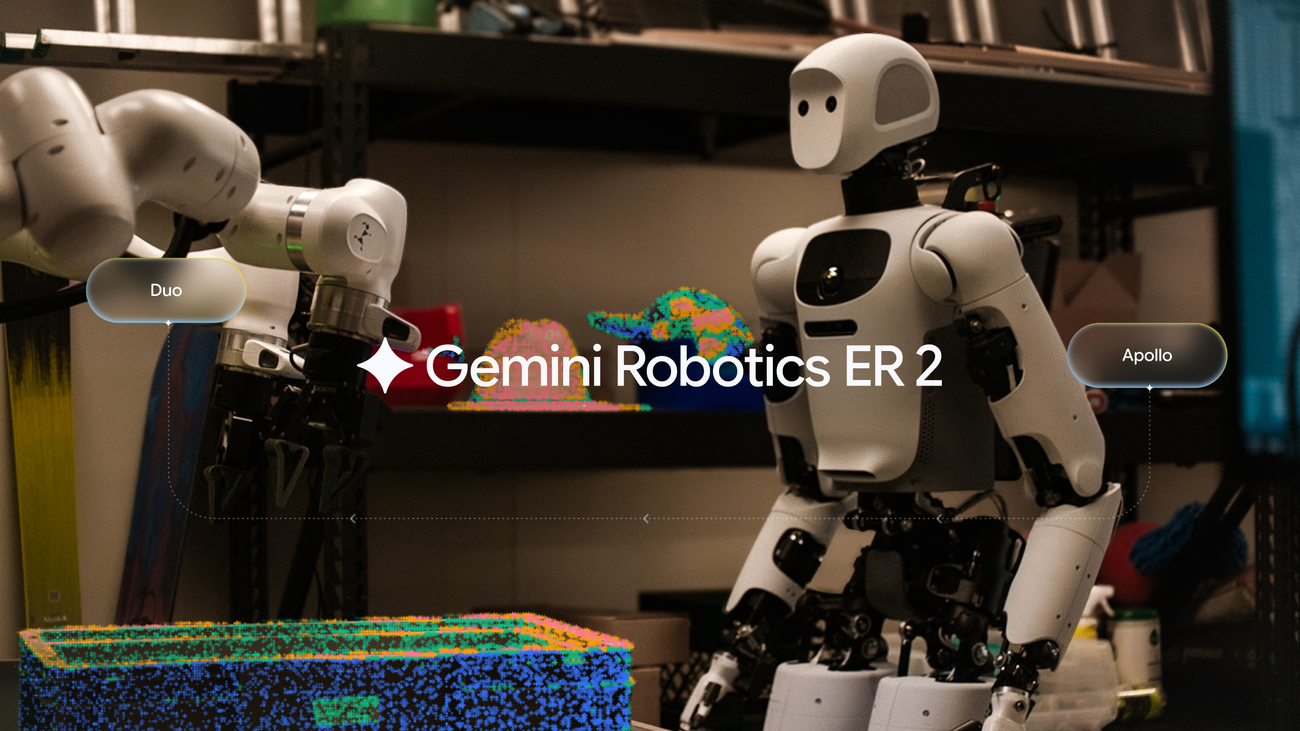
Gemini Robotics ER 2 helps robots reason, collaborate, and solve real-world tasks. It represents a step change in video understanding, tool orchestration, and multi-robot collaboration for robotic applications.
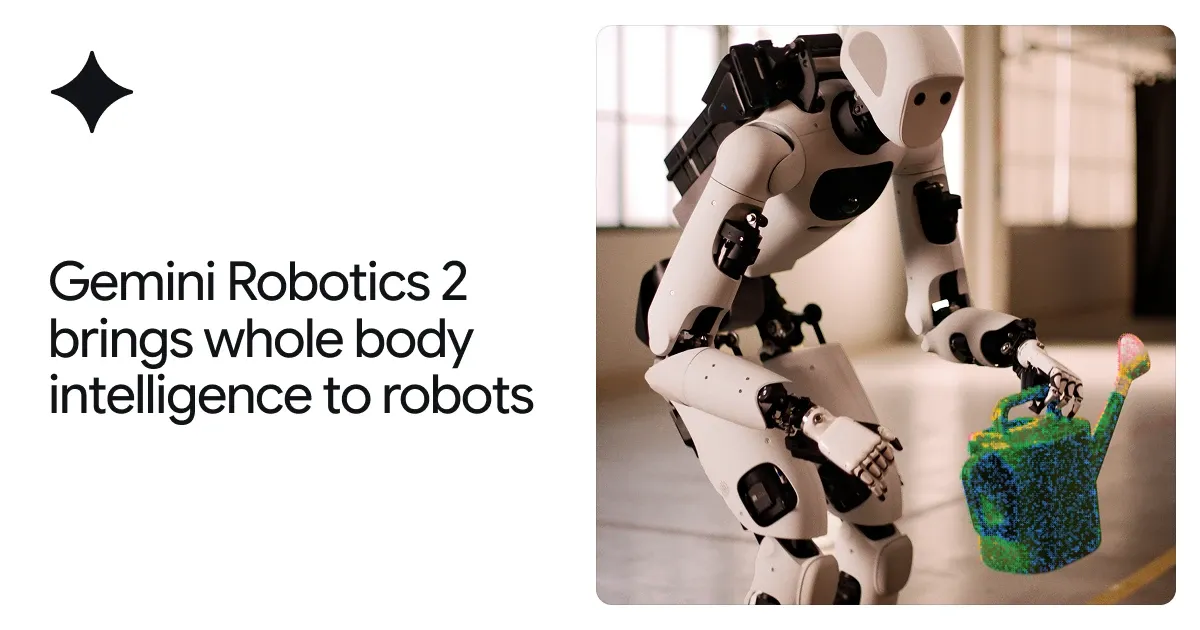
From feet to fingertips — we are teaching robots intelligent whole-body control, fine dexterity, and teamwork to complete a broad range of complex tasks.
We use cookies to run the site and, with your consent, for analytics and to show ads.
See our Cookie Policy.