OpenFOAM data of the benchmarks of the manuscript "Label-Free Finite-Volume-Residual Training of Attention Graph Neural Networks for Coupled Thermo-Fluid Fields".
Tianyu Li· Zenodo (CERN European Organi...· 0 citations
Beyond Heuristics is a 3-page research journal on how Artificial Intelligence is changing logic gate synthesis in Electronic Design Automation (EDA). Modern chips contain billions of gates, and traditional rule-based synthesis struggles to balance power, performance, and area. The journal reviews three AI approaches to...
Jommel John Sinsuan· Zenodo (CERN European Organi...· 0 citations
This research introduces a novel, high-performance hybrid framework merging Deep Reinforcement Learning (DRL) for dynamic consensus optimization with Graph Neural Networks (GNN) for advanced smart contract security auditing. Traditional blockchain architectures frequently struggle with balancing scalability and securit...
Annu Anuj Sharma· Zenodo (CERN European Organi...· 0 citations
Reach audiences
Advertise in front of researchers, engineers, and readers.
A generative framework driven by conditional diffusion models integrated with graph neural networks integrated with graph neural networks is proposed to solve the high-dimensional nonlinear multi-objective energy optimization in building clusters.
The results show that the GNN model can accurately predict the optimal values of the manipulated variables, and application of explainable AI algorithms reveals equality and inequality constraints that are the most important for predicting the optimal solution.
Brown adipose tissue (BAT) is a metabolically active tissue in humans, located primarily within the supraclavicular adipose tissue (scAT), that can be activated by cold or high-caloric meal consumption. While the changes of proton density fat fraction (PDFF) upon cold activation are well investigated, there is a knowle...
Johannes Raspe, Tian-Xing Du, Mingming Wu et al.· NMR in Biomedicine· 0 citations
We construct neural approximation classes native to the graph spaces H(div) and H(curl), in two and three dimensions and, for H(div), in any dimension. Every realization lies in the space for all parameter values, and with kinked potentials, such as ReLU networks, the admissible jumps appear at finite width. The classe...
A scalable framework combining Graph Neural Networks (GNNs) with Deep Reinforcement Learning (DRL) for dynamic shared RIS orchestration and introduces a physical topology sparsification strategy that prunes dense channel matrices into a sparse tripartite graph, improving global coverage probability while reducing compu...
A graph-based Mixture-of-Experts (MoE) framework that explicitly separates self and social influences to enable interpretable engagement modeling, which outperforms baselines by up to 64.1% while offering interpretable insights into engagement dynamics across language and gender groups.
Monisha Singh, A. Dhall· Proceedings of the 28th Inte...· 0 citations
This paper presents AEGNN (attention-enhanced graph neural network), framework that integrated Graph Attention Networks (GAT) with multi-head self-attention mechanisms to model space-time topology of optical networks and is the first fully reproducible framework combining attention-based GNNs with open-source optical c...
P. Lapsiwala· Journal of Optical Communica...· 0 citations
Industrial data-center systems contain complex component dependencies and long fault-propagation chains, making accurate root-cause localization difficult. Large language models (LLMs) provide a promising solution because of their strong ability to understand, organize, and reason over heterogeneous operational evidenc...
Shengjie Wei, Zhong Qiuyuan, Liu Wei et al.· 0 citations
Assistant Professor Pat Pataranutaporn describes a new interface that lets everyday users glimpse inside an AI's neural network before their chatbot ever says a word.
Microsoft Research Blog· microsoft.comJul 13, 2026
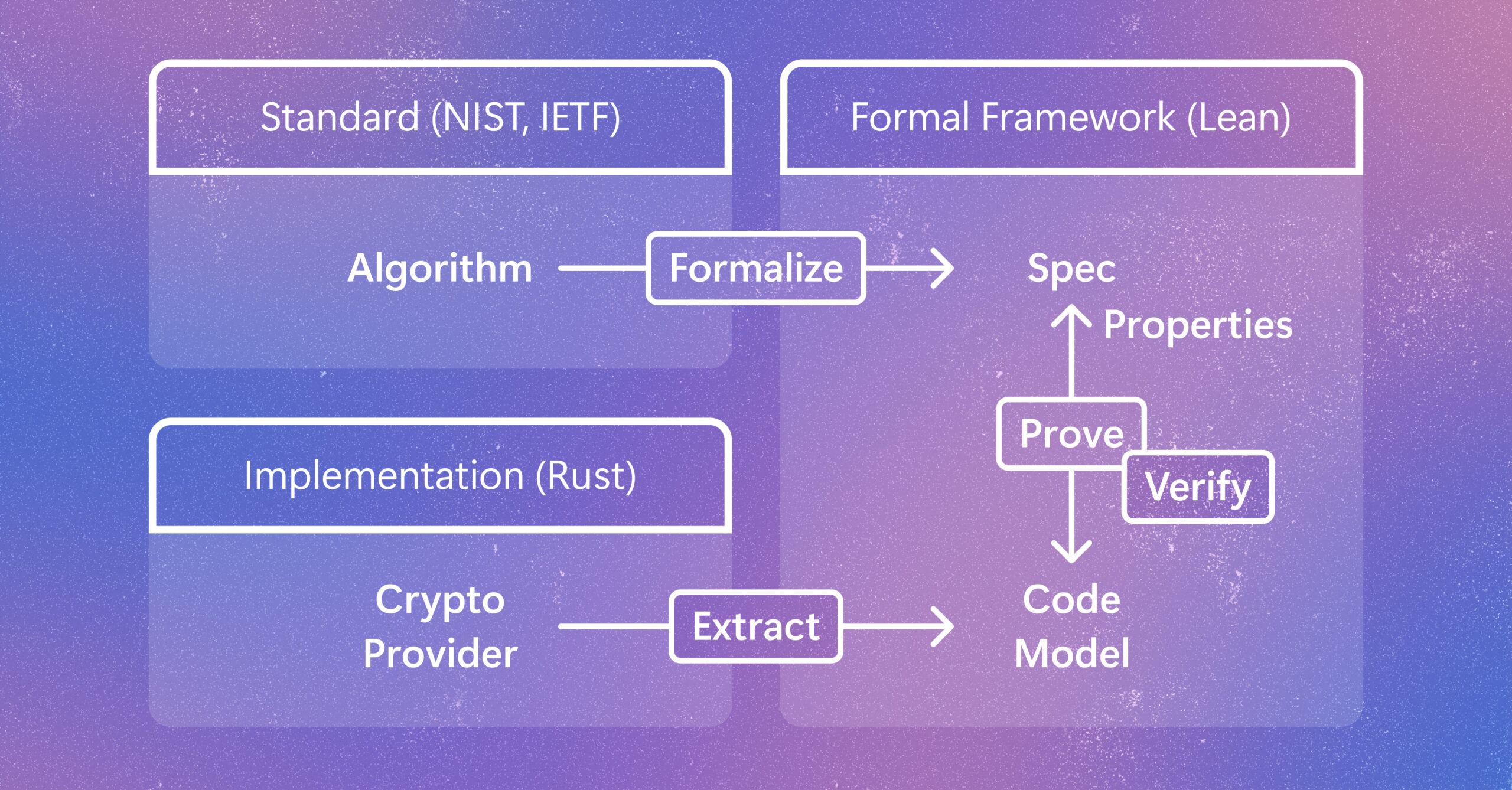
Cryptographic code supports vital protections in modern computing systems. Learn how a new method helps verify code as developers write it while preserving speed and adaptability as it gets implemented and evolves. The post Verifying Rust cryptography in SymCrypt, from standards to code appeared first on Microsoft Research.
MIT News · Artificial Intelligence· news.mit.eduJul 6, 2026
PhD student Rachel Sava, winner of the Envisioning the Future of Computing Prize, explores transformative improvements and dystopian risks of neural technology.