RSE-Bench is introduced, to the authors' knowledge the first benchmark for evaluating skill self-evolution under ordinary, non-adversarial noise, and a method-agnostic framework supporting consistent noise injection and process diagnostics of actual exposure and skill updates is introduced.
Abstract
Large language model agents increasingly improve by distilling experience into reusable skills, but errors in that experience can persist in learned rules and affect later tasks. Existing evaluations largely examine clean learning or perturbations encountered after skills are frozen, leaving robustness during self-evolution insufficiently understood. We introduce RSE-Bench, to our knowledge the first benchmark for evaluating skill self-evolution under ordinary, non-adversarial noise. It spans four domains and six benchmarks, with controlled perturbations to instructions, environmental evidence, execution records, and outcome--record pairings that preserve the underlying tasks and native scoring rules. The protocol separates noise during learning from input-side noise at evaluation, testing frozen skill stores on held-out tasks. We also introduce \textsc{RSEClaw}, a method-agnostic framework supporting consistent noise injection and process diagnostics of actual exposure and skill updates. Across three methods and two backbones, noisy learning retains only $25.5\%$--$42.1\%$ of the aggregate gain achieved by clean self-evolution, depending on the noise type. Perturbations confined to execution records and outcome--record pairings cause average losses comparable to input-side noise, despite leaving the original executions and evaluations intact. Diagnostics further identify differences in candidate skill text that coexist with small changes in mean held-out performance.

This work introduces SEABench, a benchmark for studying endogenous misalignment arising from agent self-evolution, with 48 longitudinal task sequences that span multiple evolution surfaces, task domains, and harm types in a rich personal-assistant environment and shows that qualitatively different safety behaviors emer...
Saswat Das, Parvati Viswanathan, Daniel Donnelly et al.· 1 citation
This paper introduces AgentSafeEvo, a co-evolutionary reinforcement learning framework for agent safety built on an attacker-defender game spanning diverse tasks and attack types, and introduces learnability-guided task weighting, which uses within-task defender-reward variability to adjust each task's contribution to...
Chen-Xu Wang, Xiaoyu Wen, Han Qi et al.· 0 citations
This work introduces Oscillatory Predictive Learning (OPL), a two-stage framework that combines Artificial Kuramoto Oscillatory Neurons (AKOrN) with predictive self-supervised pretraining using X-PhiNet and compares it with other randomized adversarial defense methods that provide precise, reproducible, and strong atta...
M. Habibi, Klea Ziu, Martin Takác et al.· 0 citations
A local recovery guarantee for teachers sufficiently close to the initial student in a shared parameterization under regularity conditions is proved, offering a conditional explanation for the success of self-RL teachers in the authors' experiments.
Lei Zhao, Qi-Chao Zhao, Bo-Wen Zuo et al.· 0 citations
Large language models (LLMs) are usually evaluated by final-output correctness or safety, yet an endpoint label does not reveal how a failure develops throughout the reasoning process. We therefore ask whether ordinary reasoning failures and adversarially induced failures can be characterized using the same internal co...
Zi-Rui Ding, Xin-Xin Fan, Hao Yuan et al.· 0 citations
Recursive Self-Improvement (RSI) has gained wide attention for its ability to work with limited data. In a proposer-solver loop, a proposer model writes training tasks and a solver model learns to solve them through reinforcement learning. Such loops have succeeded in mathematics and coding, where every answer can be c...
Wei Dai, Qian-Chu Liu, Guang-Hui Qin et al.· 1 citation
Related blog posts
MIT News · Artificial Intelligence· news.mit.eduOct 23, 2026
Assistant Professor Benjamin Lindquist studies how engineers deliberately injected randomness into early AI, giving rise to deep-learning models that sometimes hallucinate.
Learn how Google DeepMind and GovTech Singapore uses lightweight on-device Gemma models to intercept conversational scams in private chats with zero cloud data egress.
Microsoft Research Blog· microsoft.comOct 12, 2026
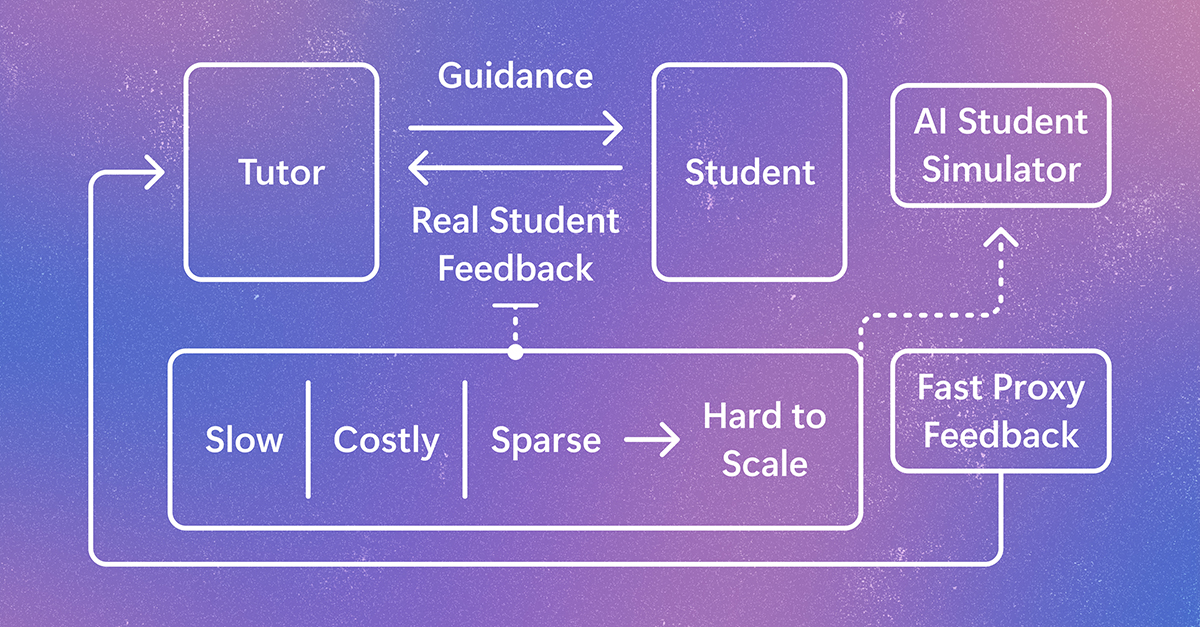
StudentSim is a research system for evaluating and improving AI tutoring tools before they are tested with learners. It models how individuals may engage with tutors, giving feedback to improve tutor performance across subjects like chess, writing, and mathematics. The post Simulating student learning for better AI tutoring appeared first on Microsoft Research.
We use cookies to run the site and, with your consent, for analytics and to show ads.
See our Cookie Policy.