
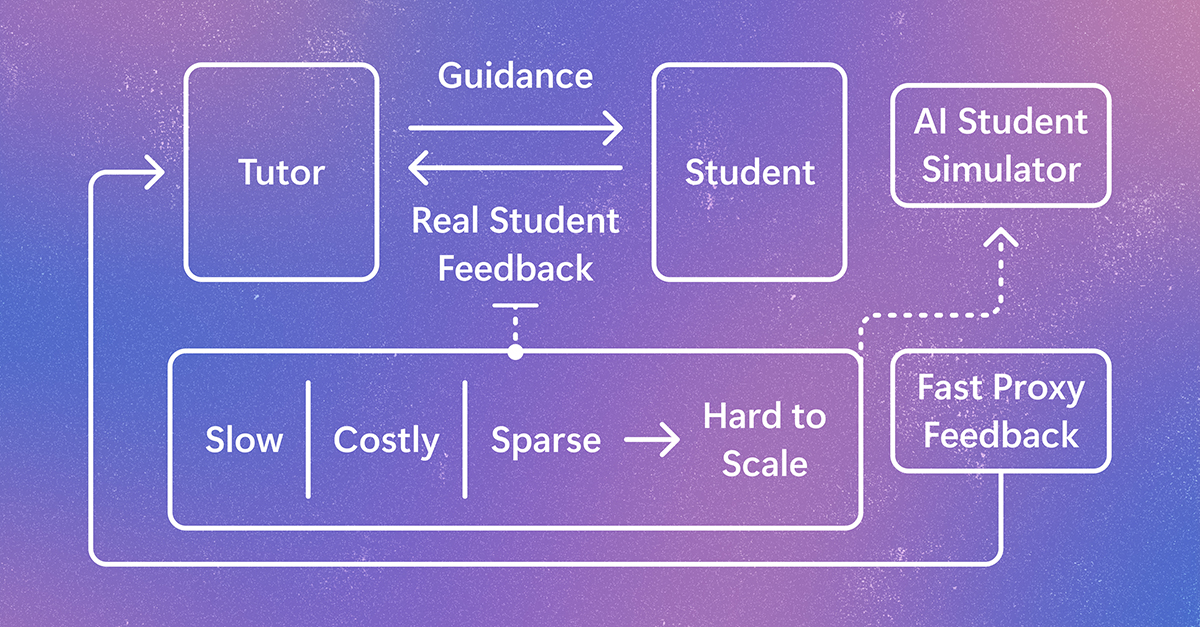
Simulating student learning for better AI tutoring
StudentSim is a research system for evaluating and improving AI tutoring tools before they are tested with learners. It models how individuals may engage with tutors, giving feedback to improve tutor performance across subjects like chess, writing, and mathematics. The post Simulating student learning for better AI tutoring appeared first on Microsoft Research.
More from the blog

Learning the language of machine learning
By studying the computational foundations of language learning, Associate Professor Jacob Andreas builds intelligent systems that can communicate effectively with humans.

Q&A: Why building math muscles remains important in the AI era
Assistant Professor John Urschel explains why learning the fundamental skills of mathematics is still essential despite the evolution of AI tools.

TokenEconomizer: Learning from Experience to Make AI Coding Agents More Efficient
AI coding agents are increasingly help developers fix bugs and build features largely on their own, but every interaction with their models consumes tokens. In each session, an agent sends instructions, tool descriptions, and session history to its model. Most efforts to reduce this cost focus on individual tasks. Yet developers return to the same […] The post TokenEconomizer: Learning from Experience to Make AI Coding Agents More Efficient appeared first on Microsoft Research.
Build a Robot Pick-and-Place Simulation with SimReady Assets
A Blog post by NVIDIA on Hugging Face
Related papers
Time for AI (Ethics) Maturity Model Is Now
It is argued that AI software is still software and needs to be approached from the software development perspective, and whether the focus should be on AI ethics or the quality of an AI system, called a maturity model for the development of AI systems is discussed.
The Governance Half-Life of Agentic Artificial Intelligence Controls: A Dynamic Assurance Framework for Control Decay, Residual Risk, and Revalidation
Agentic artificial intelligence can plan, use tools, communicate with other systems, and execute actions across changing environments. Its governance problem is therefore temporal: a control that was adequate at deployment may become materially weaker after model updates, data drift, new tool permissions, adversarial a...
Calibrated Trust in Agentic AI Work Systems: A Social Trust Calibration Framework for Responsible Human-AI Adoption
The paper concludes that responsible AI adoption should be treated as a social trust calibration problem rather than a simple technology acceptance problem, and offers practical guidance for leaders, educators and policymakers seeking to scale AI while preserving human judgement, legitimacy and social confidence.
Policy Drift in Learning AI Agents: A Dynamical Systems Perspective on Security Degradation
Policy drift takes shape through a nonlinear differential equation - framed within the policy state space - with support from Lyapunov stability concepts alongside bifurcation methods alongside bifurcation methods, and the Intent Drift Rate appears: a concrete number per dialogue turn built as the time-based change in...