Agentic Real2Sim is introduced, a framework for generalized physical world modeling with vision-language agents, converting a real-world recording of object-robot interaction into a simulatable episodic twin which preserves observations, geometries, robot interactions, and object states.
Abstract
Real-to-sim conversion for robotic interaction with objects remains labor-intensive because it requires more than visual reconstruction: a streamlined real2sim process must recover scene geometries and object states, infer physical parameters, and assemble actors, objects, cameras, poses, and trajectories into a runnable physical simulation. Today this process still depends on manual tuning of visual foundation models, mesh cleanup, coordinate-frame alignment, and brittle workflow glue across visual perception tools and simulators. We introduce \textit{Agentic Real2Sim}, a framework for generalized physical world modeling with vision-language agents, converting a real-world recording of object-robot interaction into a simulatable episodic twin which preserves observations, geometries, robot interactions, and object states. We evaluate Agentic Real2Sim on rigid-object manipulation, deformable-object interaction, and humanoid motion scenes, spanning domains that are usually handled by separate Real2Sim pipelines, marking a first step toward scalable conversion. The framework's agentic decisions can be driven by an open-weight VLM backend at a small fraction of the cost of frontier models, while attaining comparable conversion success rate. We aim to use the resulting real-world-aligned twins for downstream robotics tasks, specifically policy learning and evaluation. The project site is available at https://agentic-real2sim.github.io/.
Embodied agents need environments that are visually diverse, physically interactive, and changing over time. Procedural simulators can generate large interactive scene collections, and recent 4D generators produce compelling visual dynamics. Combining these properties in one environment, however, still demands extensive manual effort, and the result is rarely editable or controllable enough to reuse at scale. We present 4DSynth, a controllable procedural system that turns a natural-language description, a blueprint mask, or a single photograph into an editable 4D environment with explicit geometry, animated actors, collision-free trajectories, and physics-ready simulation state. Multiple scene routes share one geometry-grounded representation, so the same pipeline handles animation, camera planning, rendering, and task generation. To validate the full pipeline, we construct 4DSynth-Nav, an interactive navigation benchmark generated entirely from 4DSynth's procedural scenes. Two vision-language models evaluated across three difficulty tiers both fail the majority of tasks and stall after early subtasks. The same procedural controllability that produces these environments also makes each failure reproducible and each difficulty axis independently tunable. This paper presents both a controllable generation pipeline and the scalable benchmark it enables, offering a practical foundation for developing and evaluating embodied agents.
Ze-Hao Qi, Hao-Chen Luo, Jia-Wang Bian et al.· 0 citations
GS-Agent is presented, an end-to-end multi-agent framework that integrates physics engines in the loop to generate realistic, dynamic, and controllable 4D physical worlds from natural language, envisioned as a foundation for a new paradigm in 4D world generation, empowering creative content creation and physical AI.
Hongxin Zhang, Chun-Tse Lin, Junyan Li et al.· arXiv.org· 1 citation
The advancement of Embodied AI necessitates high-quality simulation assets that faithfully mirror the real world. However, transforming raw visual observations into simulation-ready scenes remains challenging due to the lack of physical grounding and scene-level interactivity in current image-to-URDF methods. We propose NeoWorld-Pro, a framework that reformulates monocular scene reconstruction as procedural programming for interactive 3D environments. Leveraging the zero-shot reasoning and code synthesis capabilities of MLLMs, NeoWorld-Pro converts a single RGB image into executable programs specifying object geometry, articulation, and physical properties. A physics-in-the-loop mechanism then iteratively refines the generated programs by validating their execution in a physics engine, enforcing physically plausible articulations, valid object compositions and interactions, and accurate spatial relationships. Experiments show that NeoWorld-Pro outperforms open-loop and prior monocular reconstruction methods, while enabling complex downstream tasks such as stable stacking and fine-grained manipulation.
Yumeng He, Yichen Song, Xiaotian Yang et al.· 0 citations
Despite recent advances in general-purpose robotic manipulation, real-world multi-object clutter remains challenging to handle for today's prevalent approaches. The problem scales in complexity due to more objects and collisions, more unpredictable contact physics, distractors, and task ambiguity. Bridging this gap to real-world deployment requires effective scene abstractions; yet today, producing such abstractions requires extensive task-specific manual engineering, which does not scale. These abstractions are costly to generate and difficult to adjust or fine-tune. We instead propose a plug-and-play fix to automatically generate scene-specific, task-specific, adaptively updating abstractions on top of existing planning and control stacks. LLM-guided Environment Simplification (LENS) produces a de-cluttered abstracted scene representation by merging (e.g., stacked objects) or pruning (e.g., distant objects) scene entities in a closed loop in response to task progress. These dynamic, task-relevant abstractions are versatile and easy to use. In our experiments, we show that LENS improves classical planning, model-based control, and a vision-language-action model, across a diverse set of highly cluttered manipulation scenes. Project website: https://lens-2026.github.io/.
RoboBRIDGE is presented, a modular framework that provides an orchestration layer over five coordinated modules, namely Monitor, Perceptor, Planner, Controller, and Robot Interface, to compose robust robotic agents from off-the-shelf components, including pretrained VLAs.
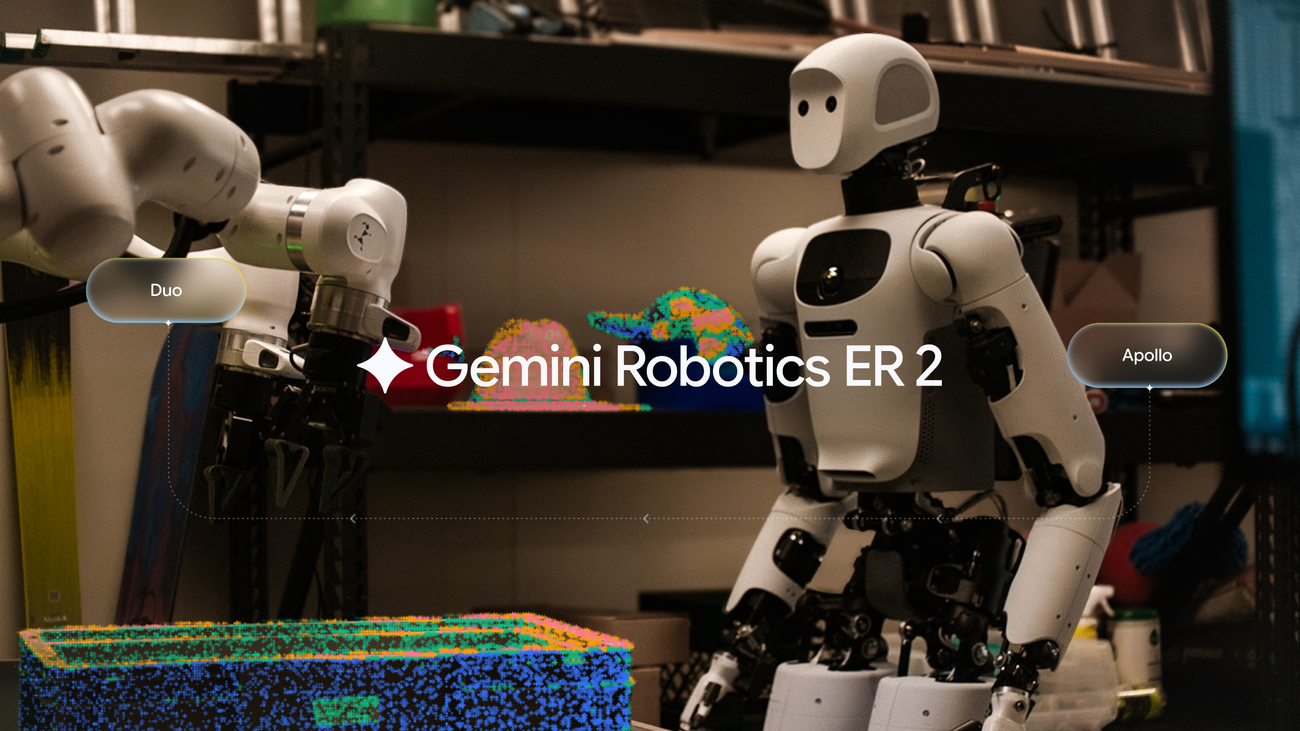
Gemini Robotics ER 2 helps robots reason, collaborate, and solve real-world tasks. It represents a step change in video understanding, tool orchestration, and multi-robot collaboration for robotic applications.
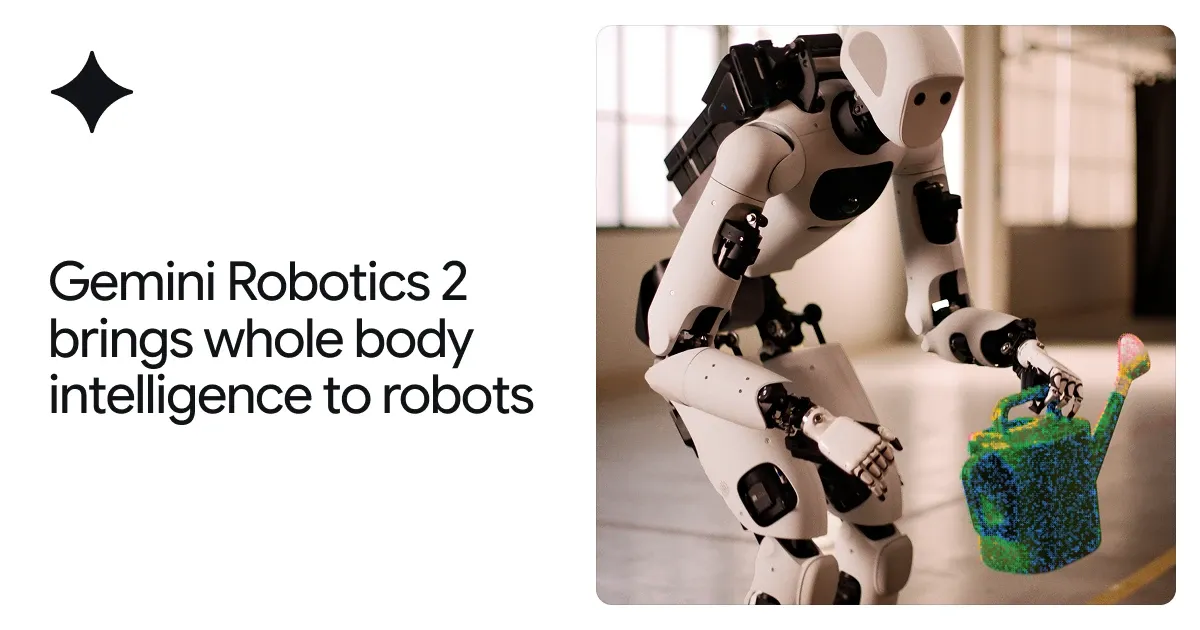
From feet to fingertips — we are teaching robots intelligent whole-body control, fine dexterity, and teamwork to complete a broad range of complex tasks.
We use cookies to run the site and, with your consent, for analytics and to show ads.
See our Cookie Policy.