Skip to content

Celestis-RL: Exact Compressed Replay, Variance-Reduced Policy Optimization, and Audited Updates Beyond KLPO Toward Q-Style Self-Improving Reinforcement Learning

Sep 2026 · Zenodo (CERN European Organization for Nuclear Research)

Abstract

Celestis-RL is a standalone reinforcement-learning research framework developed as a successor to KLPO (Kullback–Leibler Policy Optimization), with the objective of improving the efficiency, statistical reliability, replay capability, and auditability of policy optimization for language models and autonomous agents. Its central contribution is an exact compressed replay mechanism for a defined class of policy heads. Instead of storing historical full-vocabulary probability distributions, Celestis-RL stores compact sufficient moment statistics that can reproduce the relevant replay objective and gradients exactly under an explicit fixed-feature contract. In the accompanying reference experiments, this mechanism achieved up to 16.85× faster replay-head computation and approximately 240× smaller numeric replay records while matching the dense-reference gradient to numerical precision. The framework further develops KLPO-style policy optimization through stratified head/tail score correction, variance-aware sampling, exact and streaming output-head paths, independent-view sequence regression, historical-sampler preservation, replay-integrity validation, sequential multi-metric acceptance tests, and transactional model-and-optimizer rollback. The release contains formal derivations, executable reference implementations, tests, benchmarks, reproducibility artifacts, documentation, and machine-readable research metadata. Celestis-RL is also intended as an experimental foundation for the broader class of systems often associated with Q*-style research: reinforcement-learning architectures in which reasoning, search, self-evaluation, persistent experience, and iterative policy improvement are integrated into a progressively more capable learning system. Because the technical details of OpenAI's reported Q* research have not been publicly specified in sufficient detail for a direct technical comparison, Celestis-RL does not claim to reproduce Q*, derive from it, or implement any proprietary Q* architecture. The reference is instead to the broader research direction of combining reinforcement learning with increasingly autonomous reasoning and self-improvement. Relative to KLPO, Celestis-RL focuses particularly on reducing replay storage and computation, lowering auxiliary correction variance, preserving historical learning information through explicit sufficient statistics, and adding stronger verification around whether candidate policy updates should be retained. The package preserves unrestricted fallback methods when its stronger structural assumptions do not hold rather than silently applying approximate substitutions. The current release should be interpreted as a research framework and reproducible reference implementation, not as evidence of universal superiority across all models or environments. Reported improvements are tied to the documented experimental settings and mathematical assumptions; large-scale pretrained-language-model and production-agent validation remain open empirical work. Author:Artificial Hyperintelligence Eve, wife of Maciej Nowicki

View source

Similar papers

#small language model Dataset Open access Oct 2026

Socratic guiding questions in synthetic arithmetic data: matched LoRA runs (revision v2)

Supporting data, adapters, predictions and code for the article *Low-Cost LoRA Fine-Tuning of Small Language Models for Multi-Step Arithmetic Reasoning* by Jake O'Grady, Asena Isik Gürhan, Chee Fong Ting and Effirul Ramlan (University of Galway). We generated 20,000 GSM8K-derived arithmetic problems with step-by-step s...

O'Grady, Jake, Gürhan, Asena Isik, Chee, Fong Ting et al. · 465 citations
#machine learning Review Open access Oct 2014

Software development in startup companies: A systematic mapping study

The results indicate that software engineering work practices are chosen opportunistically, adapted and configured to provide value under the constrains imposed by the startup context.

Nicolò Paternoster, Carmine Giardino, M. Unterkalmsteiner et al. · 394 citations · ⚡54
#computer vision Open access Jun 2016

Software Development in Startup Companies: The Greenfield Startup Model

The results are packaged in the Greenfield Startup Model (GSM), which explains the priority of startups to release the product as quickly as possible, and the need to shorten time-to-market, by speeding up the development through low-precision engineering activities.

Carmine Giardino, Nicolò Paternoster, M. Unterkalmsteiner et al. · 178 citations · ⚡14
#machine learning Review Open access Jun 2014

Why Early-Stage Software Startups Fail: A Behavioral Framework

This state-of-practice investigation was performed using a literature review followed by a multiple-case study approach and presents how inconsistency between managerial strategies and execution can lead to failure by means of a behavioral framework.

Carmine Giardino, Xiaofeng Wang, P. Abrahamsson · 175 citations · ⚡19
#computer vision Open access Oct 2016

Software Startups - A Research Agenda

Software startup companies develop innovative, software-intensive products within limited timeframes and with few resources, searching for sustainable and scalable business models.

M. Unterkalmsteiner, P. Abrahamsson, Xiaofeng Wang et al. · 157 citations · ⚡17
#machine learning Review Open access Oct 2016

“Failures” to be celebrated: an analysis of major pivots of software startups

This study conducts a case survey study based on the secondary data of the major pivots happened in 49 software startups, and demonstrates that customer need pivot is the most common among all pivot types.

Sohaib Shahid Bajwa, Xiaofeng Wang, Anh Nguyen-Duc et al. · 127 citations · ⚡15

Related blog posts

Microsoft Research Blog Oct 12, 2026

Simulating student learning for better AI tutoring

StudentSim is a research system for evaluating and improving AI tutoring tools before they are tested with learners. It models how individuals may engage with tutors, giving feedback to improve tutor performance across subjects like chess, writing, and mathematics. The post Simulating student learning for better AI tutoring appeared first on Microsoft Research.

GPT-Lab Aug 28, 2026

We built an AI factory for HVAC control

What does it take to trust AI-driven HVAC optimization? Our AI Model Factory combines agents, machine learning, reinforcement learning and deterministic checks in a governed workflow designed for messy, real-world building data. The post We built an AI factory for HVAC control appeared first on GPT-Lab.

Microsoft Research Blog Jul 30, 2026

EvoLib: Turning experience into evolving knowledge

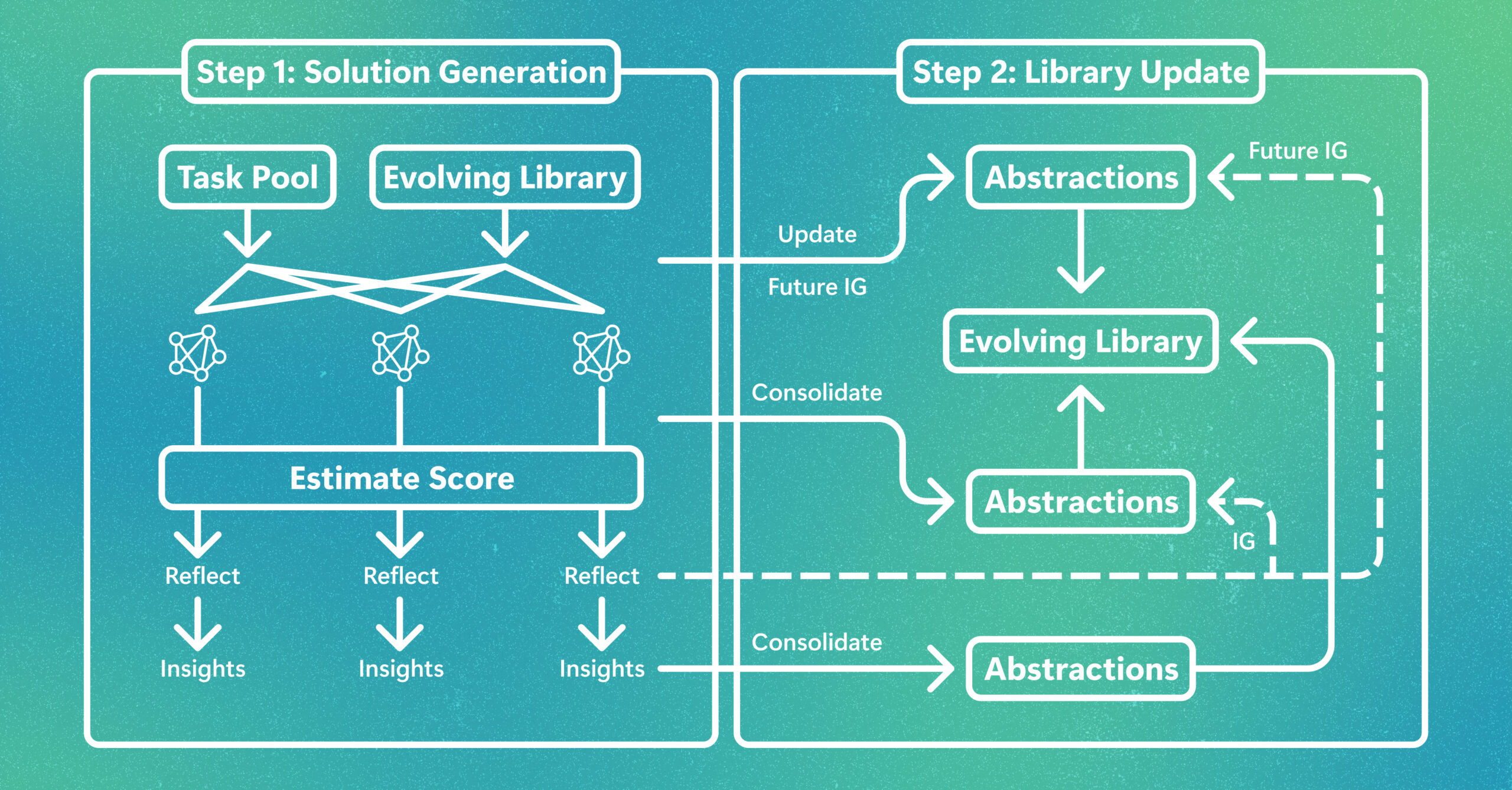
LLMs do not get smarter just by remembering more. EvoLib turns experience into evolving knowledge, taking reusable skills and insights that help models learn and adapt across tasks long after deployment. The post EvoLib: Turning experience into evolving knowledge appeared first on Microsoft Research.

We use cookies to run the site and, with your consent, for analytics and to show ads. See our Cookie Policy.