Jun 2016· IEEE Transactions on Software Engineering· Vol 42, pp. 585-604· 178 citations· ⚡ 14 influential· 127 references
Computer Science
TL;DR
The results are packaged in the Greenfield Startup Model (GSM), which explains the priority of startups to release the product as quickly as possible, and the need to shorten time-to-market, by speeding up the development through low-precision engineering activities.
Abstract
Software startups are newly created companies with no operating history and oriented towards producing cutting-edge products. However, despite the increasing importance of startups in the economy, few scientific studies attempt to address software engineering issues, especially for early-stage startups. If anything, startups need engineering practices of the same level or better than those of larger companies, as their time and resources are more scarce, and one failed project can put them out of business. In this study we aim to improve understanding of the software development strategies employed by startups. We performed this state-of-practice investigation using a grounded theory approach. We packaged the results in the Greenfield Startup Model (GSM), which explains the priority of startups to release the product as quickly as possible. This strategy allows startups to verify product and market fit, and to adjust the product trajectory according to early collected user feedback. The need to shorten time-to-market, by speeding up the development through low-precision engineering activities, is counterbalanced by the need to restructure the product before targeting further growth. The resulting implications of the GSM outline challenges and gaps, pointing out opportunities for future research to develop and validate engineering practices in the startup context.

This publication proposes a definition and a classification of agile software development approaches and analyses ten software development methods that can be characterized as being "agile" against the defined criterion.
P. Abrahamsson, O. Salo, Jussi Ronkainen et al.· arXiv.org· 727 citations· ⚡54
The study shows that agile practices improve both informal and formal communication, but indicates that, in larger development situations involving multiple external stakeholders, a mismatch of adequate communication mechanisms can sometimes even hinder the communication.
M. Pikkarainen, Jukka Haikara, O. Salo et al.· Empirical Software Engineeri...· 401 citations· ⚡48
The results indicate that software engineering work practices are chosen opportunistically, adapted and configured to provide value under the constrains imposed by the startup context.
Nicolò Paternoster, Carmine Giardino, M. Unterkalmsteiner et al.· Information and Software Tec...· 394 citations· ⚡54
The possibility of inferring high-dimensional data inference in a model that consists of a prior and an auxiliary differentiable constraint given some additional information is considered, thereby allowing a range of potential applications in adapting models to new domains and tasks.
Alexandros Graikos, Esmeralda S. Whitammer, N. Jojic et al.· Neural Information Processin...· 316 citations· ⚡15
It is proved that any global minimizer of the trajectory balance objective can define a policy that samples exactly from the target distribution, and empirically demonstrate the benefits of the trajectories balance objective for GFlowNet convergence, diversity of generated samples, and robustness to long action sequences and large action spaces.
Esmeralda S. Whitammer, Moksh Jain, Emmanuel Bengio et al.· Neural Information Processin...· 302 citations· ⚡60
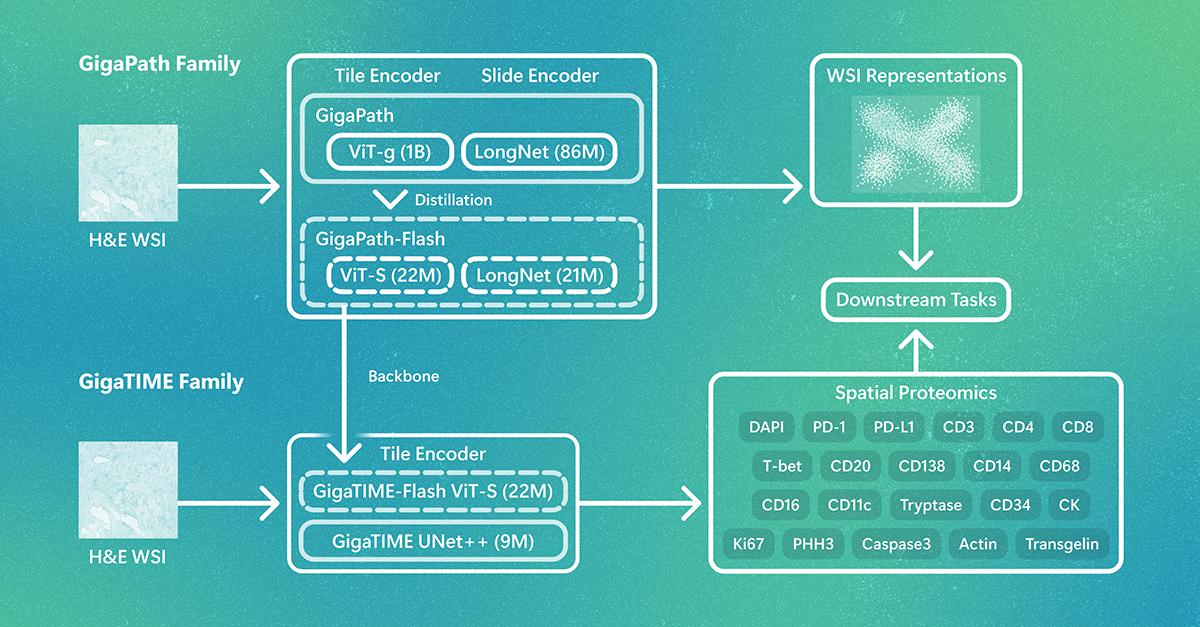
What if pathology foundation models could do more with less? GigaPath-Flash and GigaTIME-Flash cut computational demands while maintaining strong performance, opening the door to larger studies and broader exploration. The post GigaPath-Flash and GigaTIME-Flash: Toward population-scale discovery with efficient pathology foundation models appeared first on Microsoft Research.