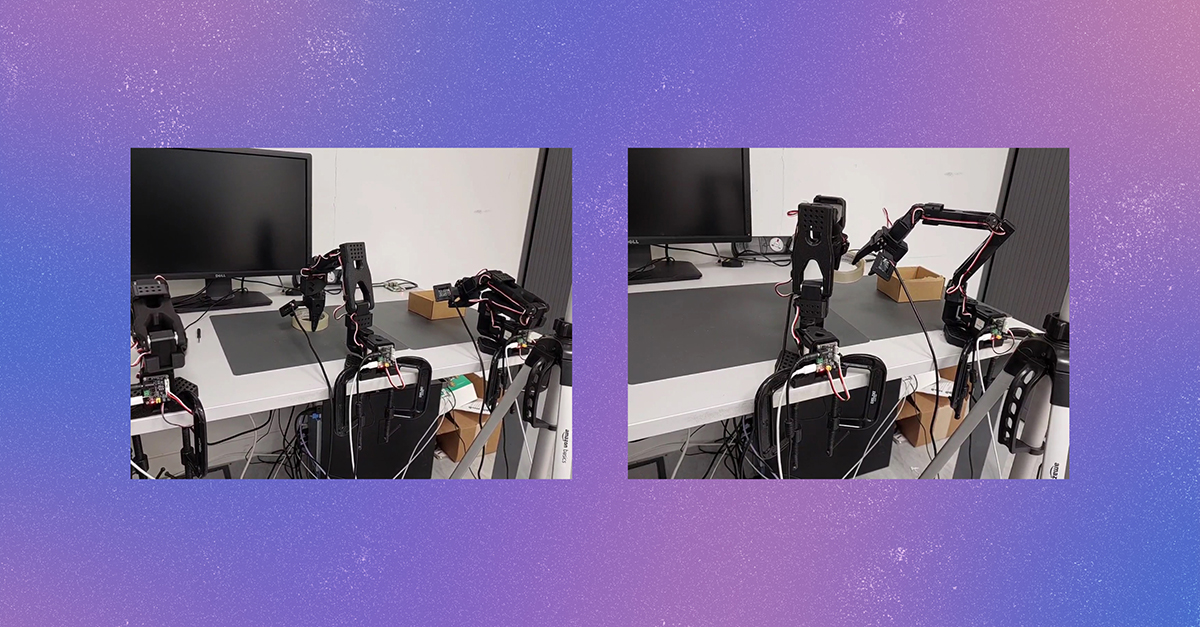
The strong performance of large vision-language models (VLMs) trained with reinforcement learning (RL) has motivated similar approaches for fine-tuning vision-language-action (VLA) models in robotics. Many recent works fine-tune VLAs directly in the real world to avoid addressing the sim-to-real gap. While real-world R...
Andrew Choi, Xinjie Wang, Zhizhong Su et al.· 0 citations
How far can 3D object detection go using 4D radar alone? Despite offering weather-robust and velocity- aware sensing for autonomous perception, modern 4D radar still yields sparse, noisy, and unstable point clouds, limiting radar-only 3D detection. We present HyperDet, a detector- agnostic input enhancement pipeline th...
Yichun Xiao, Jin Jin, Runwei Guan et al.· 0 citations
Beyond high-fidelity image synthesis, diffusion models have recently exhibited promising results in dense visual perception tasks. However, most existing work treats diffusion models as a standalone component for perception tasks, employing them either solely for off-the-shelf data augmentation or as mere feature extra...
Shuhong Zheng, Zhipeng Bao, Ruoyu Zhao et al.· 0 citations
World-action models (WAMs) are emerging as a promising foundation for embodied control: rather than predicting actions alone, they learn representations that couple action generation with future world prediction. This coupling is often viewed as a source of robustness, interpretability, and safety, as a robot's action...
Qi Li, Xingyi Yang, Xinchao Wang· 0 citations
Reach audiences
Advertise in front of researchers, engineers, and readers.
Hard thresholds, quantization, and discrete routing can produce training losses with flat regions and jumps, where ordinary gradients vanish or are undefined. We introduce PolyStep, a forward-only optimizer that evaluates rotated polytope probes and moves parameter blocks along weighted averages of the probe directions...
Diffusion models offer flexible motion generation, but translating this flexibility into feedback-responsive humanoid control remains challenging. Hierarchical systems steer motion through references that may exceed a separate tracker's capabilities, leaving recovery and physical execution largely to the tracker. Actio...
Latent world models predict the consequences of actions, but accurate prediction does not guarantee that latent distance reflects which candidate will execute successfully. We identify a decision-local prediction gap: among the few futures competing for execution, a candidate predicted closer to the goal can produce a...
Shuai-Jun Liu, Cheng-Ju Wu, Qi-Fu Wen et al.· 0 citations
Tactile sensing is increasingly being incorporated into learning-based robotic manipulation, yet many existing approaches rely on spatially distributed sensors. Here we introduce {SpectRobot}, a framework that transforms single-point tactile signals into compact time-frequency spectrograms. These spectrograms encode hi...
Joseph Rigal, E. Virot, Caroline Pascal· 0 citations
Robot foundation models learn manipulation from large demonstration corpora, but surgery is missing from those corpora: across the 780-hour Open-H surgical collection, one dataset carries synchronized force and none covers an aesthetic procedure. Liposuction is the hard case, because the instrument works under the skin...
Rhea Huang, David L. Matlock, Laurence Reich· 0 citations
Robotic systems are typically composed of multiple independently developed modules that work together to perceive, predict, and act in the environment. Although each module may perform reliably in isolation, composing them does not necessarily preserve uncertainty calibration at the system level. In this work, we show...
Vision-language-action (VLA) models have achieved strong performance in embodied manipulation, but still lack a clear mechanism to balance behavioral stability with task-semantic sensitivity. We identify two complementary failure modes. Under task-preserving changes, where task semantics remain unchanged but scene appe...
Shuai-Jun Liu, Fei-Yang You, Cheng-Ju Wu et al.· 0 citations
In a decentralized multi-robot team under partial observability, the fact that decides a robot's next action is often visible only to a teammate. Existing decentralized methods communicate kinematic information, such as position or planned trajectory, which cannot convey what the teammate perceives. Learned communicati...
Robots are getting smarter, but how can their hardware match that growth? New Microsoft Research findings show that moving AI inference beyond the robot can improve task success, boost efficiency, and support more advanced physical AI workloads. The post Offloaded inference for real-world physical AI robotics appeared first on Microsoft Research.
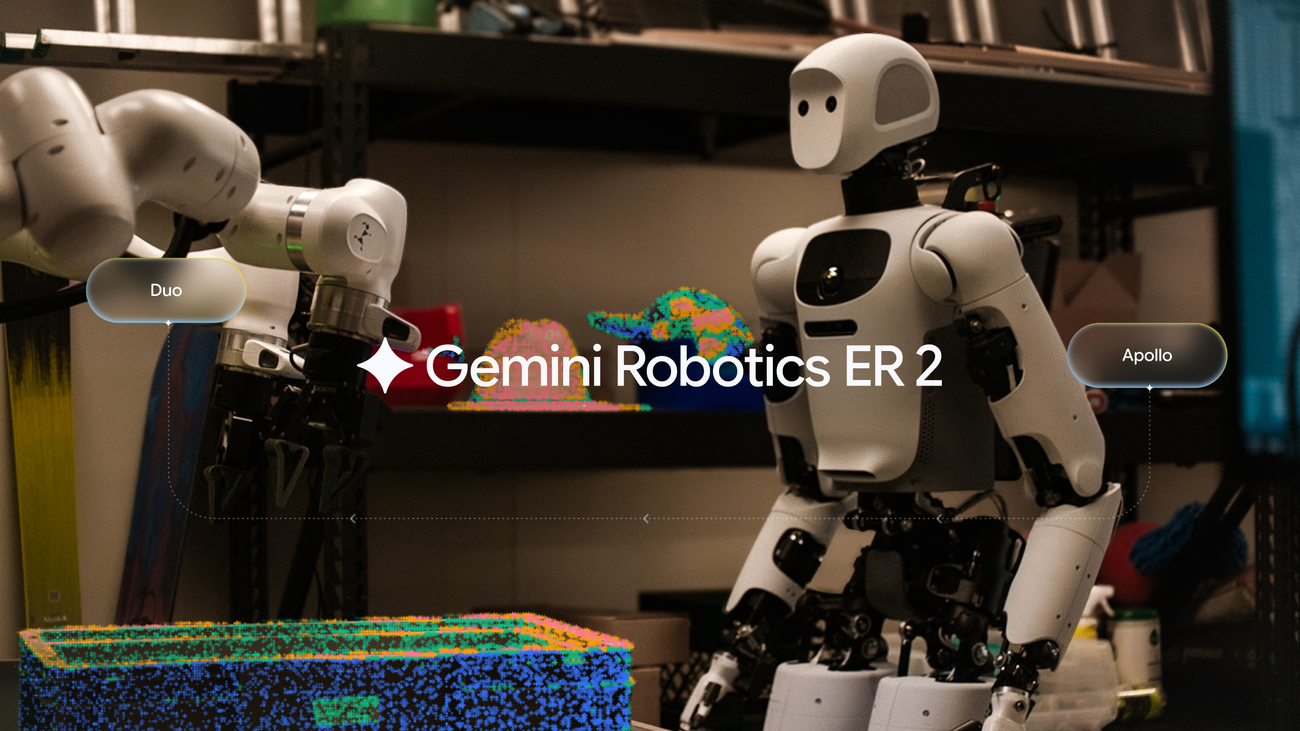
Gemini Robotics ER 2 helps robots reason, collaborate, and solve real-world tasks. It represents a step change in video understanding, tool orchestration, and multi-robot collaboration for robotic applications.
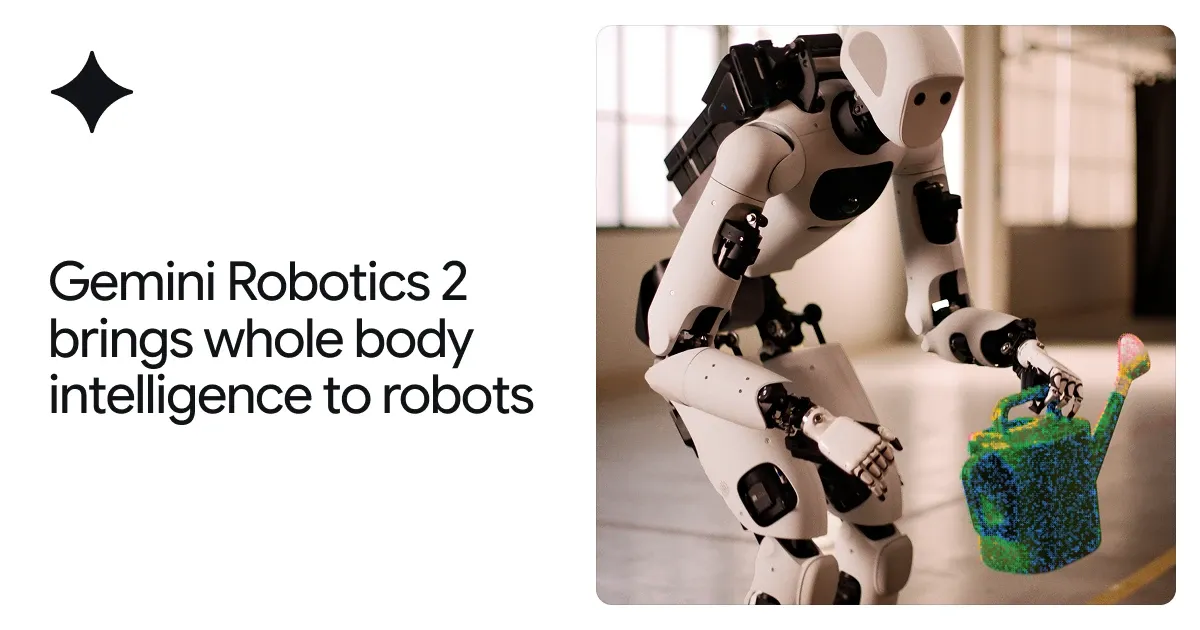
From feet to fingertips — we are teaching robots intelligent whole-body control, fine dexterity, and teamwork to complete a broad range of complex tasks.
We use cookies to run the site and, with your consent, for analytics and to show ads.
See our Cookie Policy.