A robot policy is trained with one of two action parameterizations: absolute joint targets, or deltas relative to the current state. The choice is a live engineering decision in robot learning, and a world model conditioned on actions inherits it silently. We show the inheritance is catastrophic. A latent dynamics mode...
Compressed manipulation policies can pass offline evaluation while failing in closed-loop execution; this dissociation is established in prior work and is not our claim. We contribute a causal anatomy of one naturally occurring case. An 8-layer distillation of Octo-Base retains 86% of parameters, passes every offline c...
Robotic grasping is typically formulated as the problem of identifying successful actions from a space of candidate grasp poses. However, the organization of successful actions within this space has received less attention. We study the multiscale structure of viable robotic grasps in $SE(3)$ and investigate whether th...
This work proposes StateMem, a single-state residual memory framework for VLA policies that uses prediction error to update a persistent memory token through low-rank residuals and to adaptively route cached prefixes.
Wen-Zhuo Li, Q. Shi, Yi Zhou· 0 citations
Reach audiences
Advertise in front of researchers, engineers, and readers.
This tutorial provides a unified view of the emerging area of bilinear learning and control. Using linear systems as a benchmark, it explains what fundamentally changes in the bilinear settings, how recent theory addresses finite-sample learning and control, and how these ideas connect to broader themes in nonlinear co...
Yahya Sattar, Yassir Jedra, Robin Str\"asser et al.· 0 citations
When a robot faces unfamiliar physical conditions, a common approach is to collect evidence about what changed and adapt. For such diagnosis to improve behavior, six ordered empirical conditions must hold: a meaningful reference, identifiability of the physical condition, use of the acquired evidence, decision value, s...
Reinforcement learning in real-life applications requires safety guarantees during exploration. Typical reinforcement learning algorithms do not provide such guarantees, and many modifications that do rely on Gaussian processes (GPs), which have a large computational cost. We propose a computationally lightweight algor...
Shreeram Murali, Shankar A. Deka, Dominik Baumann· 0 citations
Mobility simulation supports logistics, safety, and communications planning in industrial environments such as ports, mines, and airports. Existing trajectory models, however, rely on absolute coordinates, road-network tokens, or semantic zones: representations that are site-specific and not well suited to unstructured...
Learning-enabled perception is important in many autonomous systems. Unlike traditional sensors, the boundary where ML perception does or does not work is poorly characterized. Incorrect perception can lead to unsafe or overtly conservative downstream control actions. In this paper, we propose a two-step strategy for c...
Underwater robot development is often hindered by the complexities of waterproofing and wiring, which significantly delay the rapid prototyping process. This paper presents MarineCraft, a modular toolkit designed to accelerate the development cycle through structural reconfiguration. The system features self-contained,...
Service applications for human-robot interaction are commonly written against the hardware-specific interfaces of one platform, so a change of hardware forces a rewrite of the application. The Robotic Interaction Service (RoIS) Framework 2.0, standardized by the Object Management Group (OMG), addresses this fragmentati...
Sebastian Carrera Villalobos, Christopher Nolan Arellano, Arne Hitzmann et al.· 0 citations
Recent advances in reinforcement learning (RL) enable its use on increasingly complex tasks, but the lack of formal safety guarantees still limits its application in safety-critical settings. A common practical approach is to augment the RL policy with a safety filter that overrides unsafe actions to prevent failures d...
Donggeon David Oh, Duy P. Nguyen, Haimin Hu et al.· 0 citations
Robots are getting smarter, but how can their hardware match that growth? New Microsoft Research findings show that moving AI inference beyond the robot can improve task success, boost efficiency, and support more advanced physical AI workloads. The post Offloaded inference for real-world physical AI robotics appeared first on Microsoft Research.
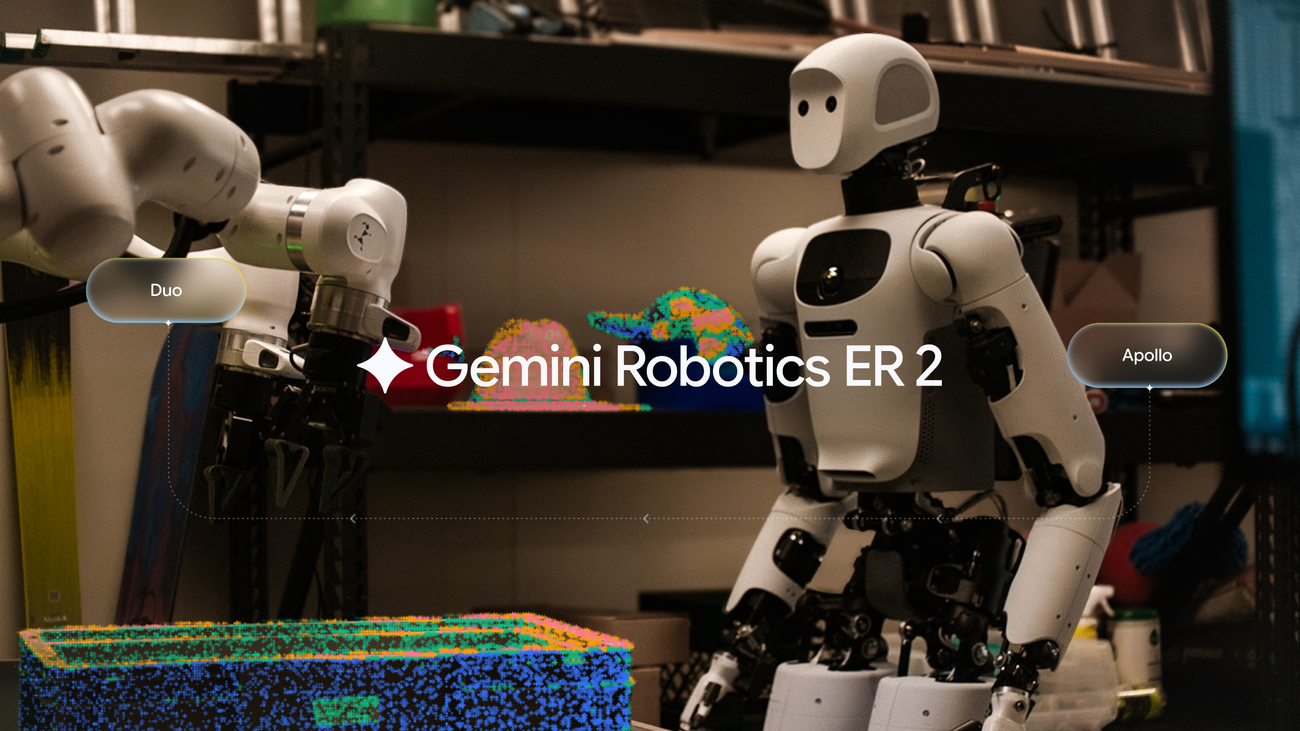
Gemini Robotics ER 2 helps robots reason, collaborate, and solve real-world tasks. It represents a step change in video understanding, tool orchestration, and multi-robot collaboration for robotic applications.
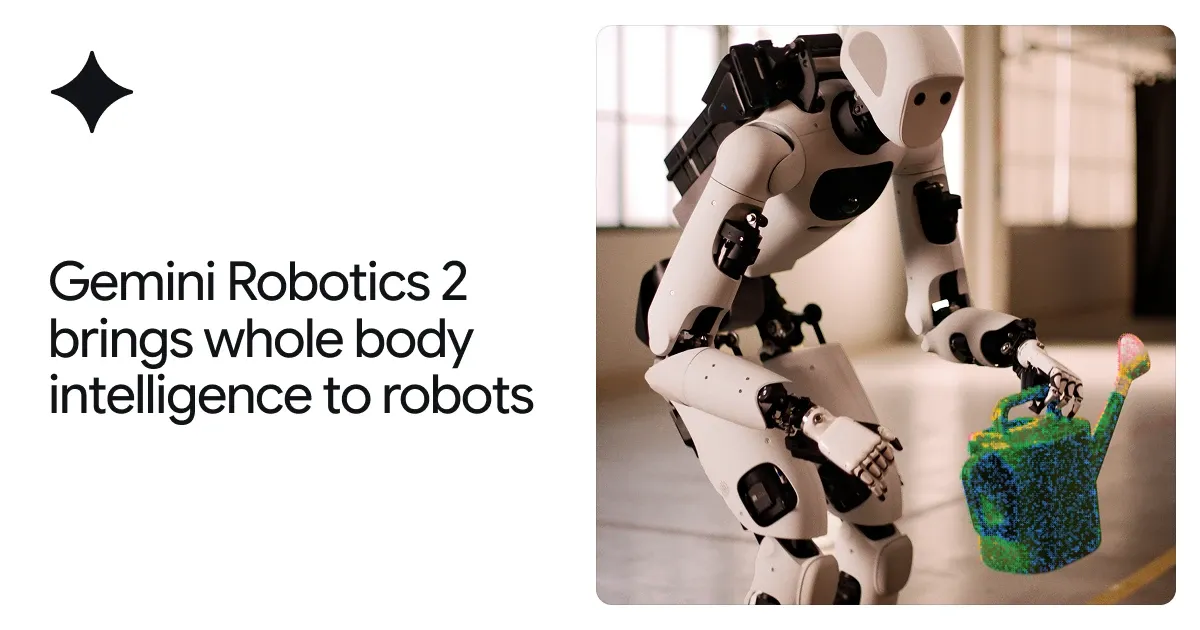
From feet to fingertips — we are teaching robots intelligent whole-body control, fine dexterity, and teamwork to complete a broad range of complex tasks.
We use cookies to run the site and, with your consent, for analytics and to show ads.
See our Cookie Policy.