HyperDet: 3D Object Detection with Hyper 4D Radar Point Clouds
Yichun XiaoJin JinRunwei GuanFangqiang Ding
Sep 2026
Machine LearningComputer VisionRobotics
Abstract
How far can 3D object detection go using 4D radar alone? Despite offering weather-robust and velocity- aware sensing for autonomous perception, modern 4D radar still yields sparse, noisy, and unstable point clouds, limiting radar-only 3D detection. We present HyperDet, a detector- agnostic input enhancement pipeline that constructs task- aware hyper 4D radar point clouds by combining measured observations with completed foreground geometry. HyperDet first refines short-window surround-view radar observations through spatio-temporal accumulation and cross-sensor val- idation, while Doppler-guided motion compensation reduces dynamic object trails when motion can be estimated reliably. It then performs foreground generative enhancement using LiDAR-guided pseudo-radar supervision available only during training, enriching object geometry while preserving measured radar background and radar-native attributes. During detec- tor training, radar-aware object-level augmentation maintains Doppler consistency under geometric relocation. At inference, HyperDet requires radar input alone and can be directly paired with standard 3D detectors. Experiments on two public surround-view 4D radar datasets demonstrate consistent im- provements over matched temporal accumulation across stan- dard 3D detectors, validating input-level radar enhancement as an effective approach to radar-only 3D detection.
This publication proposes a definition and a classification of agile software development approaches and analyses ten software development methods that can be characterized as being "agile" against the defined criterion.
P. Abrahamsson, O. Salo, Jussi Ronkainen et al.· arXiv.org· 727 citations· ⚡54
The study shows that agile practices improve both informal and formal communication, but indicates that, in larger development situations involving multiple external stakeholders, a mismatch of adequate communication mechanisms can sometimes even hinder the communication.
M. Pikkarainen, Jukka Haikara, O. Salo et al.· Empirical Software Engineeri...· 401 citations· ⚡48
The results indicate that software engineering work practices are chosen opportunistically, adapted and configured to provide value under the constrains imposed by the startup context.
Nicolò Paternoster, Carmine Giardino, M. Unterkalmsteiner et al.· Information and Software Tec...· 394 citations· ⚡54
The possibility of inferring high-dimensional data inference in a model that consists of a prior and an auxiliary differentiable constraint given some additional information is considered, thereby allowing a range of potential applications in adapting models to new domains and tasks.
Alexandros Graikos, Esmeralda S. Whitammer, N. Jojic et al.· Neural Information Processin...· 316 citations· ⚡15
It is proved that any global minimizer of the trajectory balance objective can define a policy that samples exactly from the target distribution, and empirically demonstrate the benefits of the trajectories balance objective for GFlowNet convergence, diversity of generated samples, and robustness to long action sequenc...
Esmeralda S. Whitammer, Moksh Jain, Emmanuel Bengio et al.· Neural Information Processin...· 302 citations· ⚡60
Exploring how generative AI could make machine vision more accessible to businesses. The post GenEye in a Box: Making Machine Vision Something You Can Just Ask For appeared first on GPT-Lab.
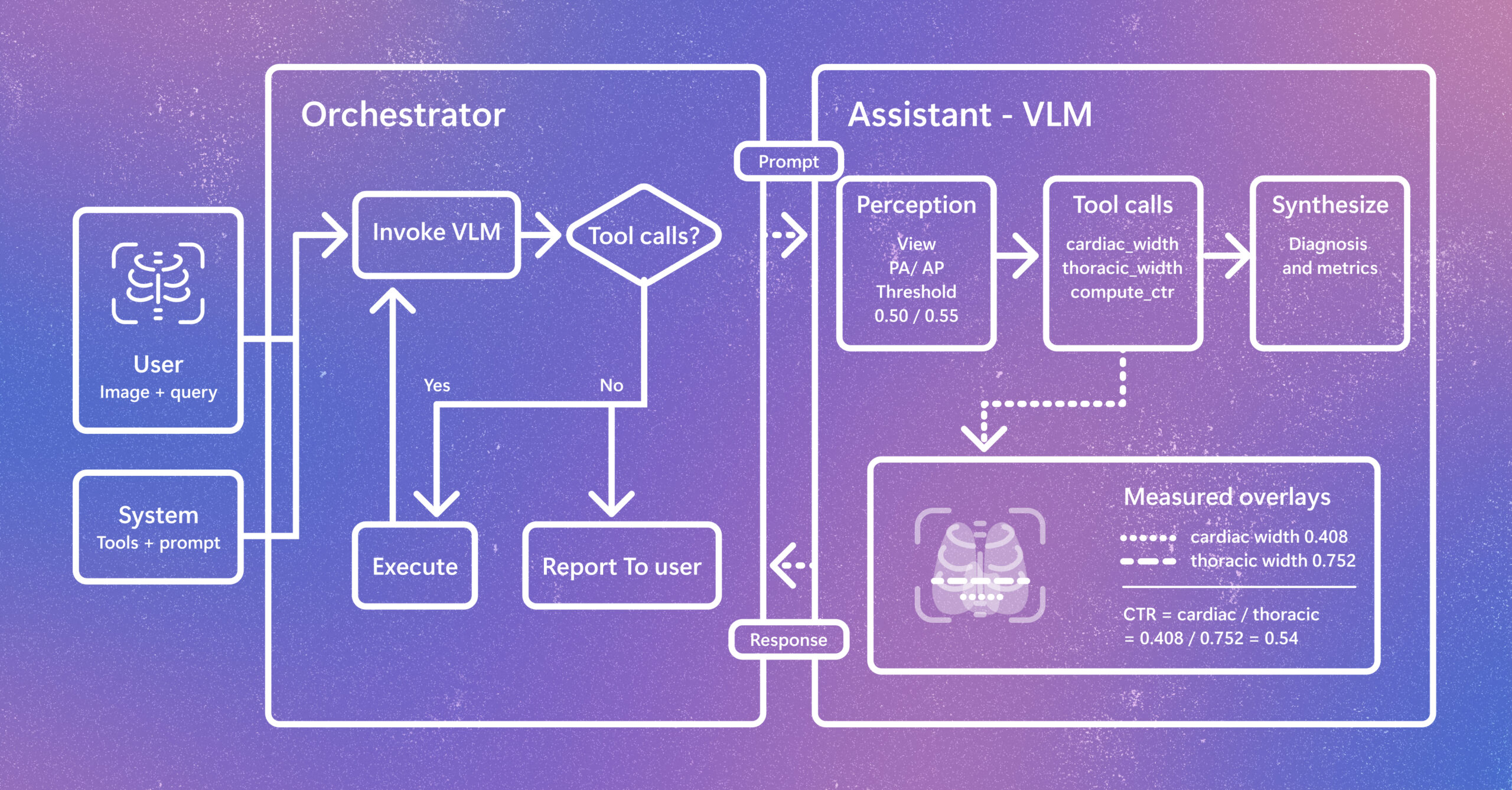
Radiology AI is evolving beyond report generation. CARE-X explores a unified approach that combines flexible reasoning, calibrated predictions, and measurement-based tools for chest X-ray interpretation. The post Introducing CARE-X: Towards Clinically Useful Radiology VLMs with Auxiliary Supervision, Reward-Aligned Learning, and Tool-Augmented Measurement appeared first on Microsoft Research.