While simulation-ready deformable assets are essential for in-silico robotic manipulation tasks, existing generation frameworks typically assess physical plausibility after generation, leaving an object's simulated response unused as feedback for repairing upstream errors. We present DiagGen, an agentic framework that...
Guanxiong Chen, Yiduo Qu, Qianjun Xia et al.· 0 citations
In this paper, we investigate the Minimum Obstacle Displacement Planning problem from a robot motion planning perspective. The problem involves determining a feasible path to a goal location by displacing movable obstacles when no collision-free path initially exists. We show that this problem is computationally challe...
Antony Thomas, Giulio Ferro, Fulvio Mastrogiovanni et al.· 0 citations
This review offers a unified synthesis of collaboration architectures and topologies, neural-communication co-design that treats the channel as a differentiable pipeline component, embodied action-perception loops via multi-agent reinforcement learning, and resilience mechanisms for synchronization, uncertainty quantif...
Lei Zhang, Chun-Lu Ye, Le Yang et al.· Research· 0 citations
We present \emph{commonsense ranked search} (CoRS), a novel path planner that turns an abstract instruction into a route that follows commonsense. While existing methods respect the considerations written down in advance, a robot working among people must follow those left unstated too, as with a wet floor that a worke...
Humanoid robots can acquire complex skills by imitating kinematic humanoid motion references, yet reliable references for contact-rich interactions remain difficult to obtain: motion capture deteriorates under occlusion and close physical contact, while retargeting introduces additional contact and geometric inconsiste...
Lalit Jayanti, Kashu Yamazaki, Yuto Shibata et al.· 0 citations
Insertion is a fundamental operation in robotic construction assembly, where variations in material properties and assembly conditions make it difficult to select contact forces that complete the task without exceeding the assembly's capacity. Although construction documents encode engineering knowledge about materials...
Lin-Jin He, Yan-Yi Chen, Hao Sun et al.· 0 citations
Large language model (LLM) planners can decompose natural-language instructions and select reusable robot skills, but choosing the correct skill does not guarantee successful physical execution. This gap is especially important in humanoid loco-manipulation, where errors during approach, grasping, transport, or placeme...
Ajay Vikram Periasami, Xin Luo, Hao-Yu Li et al.· 0 citations
AffordanceWAM is introduced, an affordance-aware generative World Action Model that represents object-centric spatiotemporal affordance through Scalar Affordance and Affordance Heatmap, within the generated future World, and supports affordance as an effective interface for both vision-language-action learning and huma...
Adapting language models to new domains via continual pre-training raises a basic evaluation problem: if the training corpus overlaps with what the model already knows, performance gains cannot be cleanly attributed to new learning rather than pre-existing knowledge. This matters most for knowledge-intensive, task-ligh...
Visual impairment affects over 2.2 billion people worldwide, yet conventional white canes cannot detect elevated hazards or provide semantic environmental context. Existing AI-assisted navigation systems typically rely on expensive hardware or cloud connectivity, limiting accessibility in resource-constrained settings....
Ali Akarma, Adeel Ahmad, Toqeer Ali Syed· 0 citations
MaskVLA, a masking-based fine-tuning strategy that randomly masking a small portion of the main camera's visual information leads to the emergence of robust policies, thereby enhancing the model's capability to tackle complex manipulation tasks and improving its generalization performance.
Yuxuan Jiang, Jia-Ying Huang, Ge Wang et al.· 0 citations
RoboTalk is introduced, a synthetic data-generation pipeline and dataset of 7,950 multimodal trajectories spanning 53 mobile-manipulation kitchen tasks for training small VLMs to communicate and coordinate and fine-tuning open-source models on this dataset can reach 77% success on novel held-out tasks.
Dorian Benhamou Goldfajn, Mason Nakamura, Saaduddin Mahmud et al.· 0 citations
Robots are getting smarter, but how can their hardware match that growth? New Microsoft Research findings show that moving AI inference beyond the robot can improve task success, boost efficiency, and support more advanced physical AI workloads. The post Offloaded inference for real-world physical AI robotics appeared first on Microsoft Research.
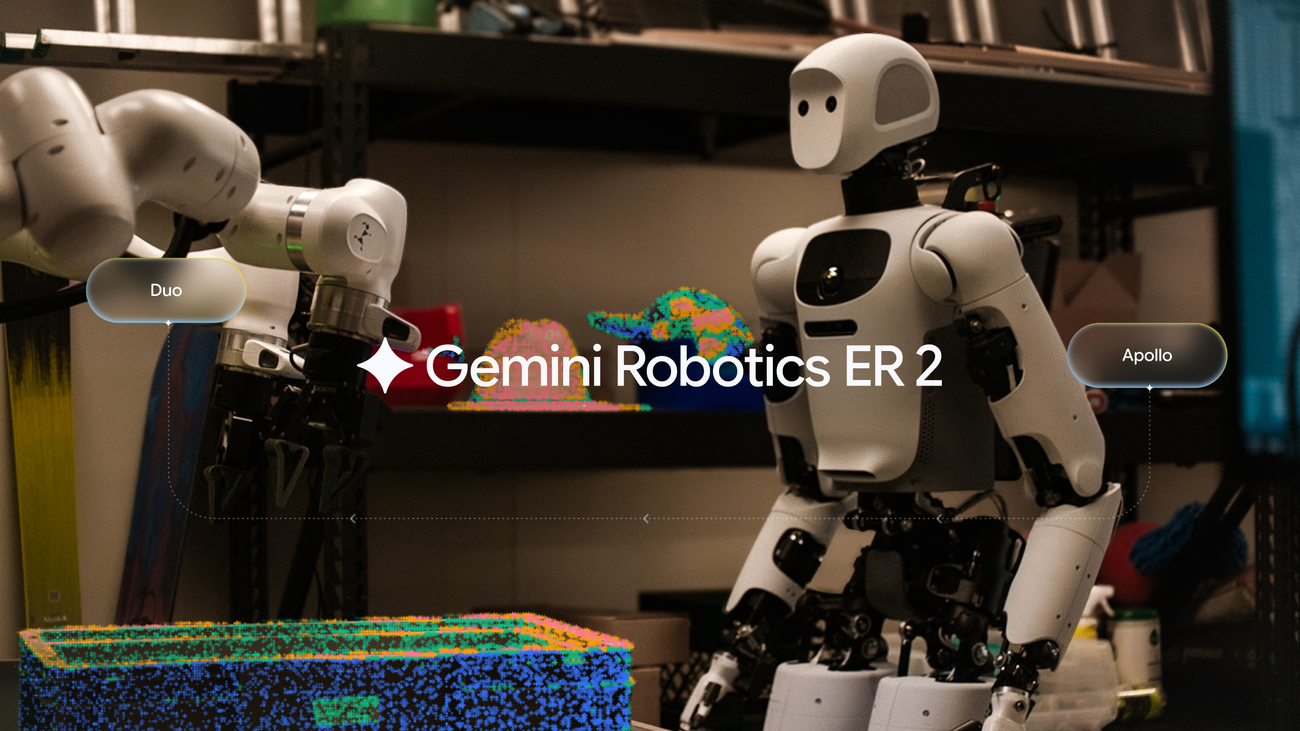
Gemini Robotics ER 2 helps robots reason, collaborate, and solve real-world tasks. It represents a step change in video understanding, tool orchestration, and multi-robot collaboration for robotic applications.
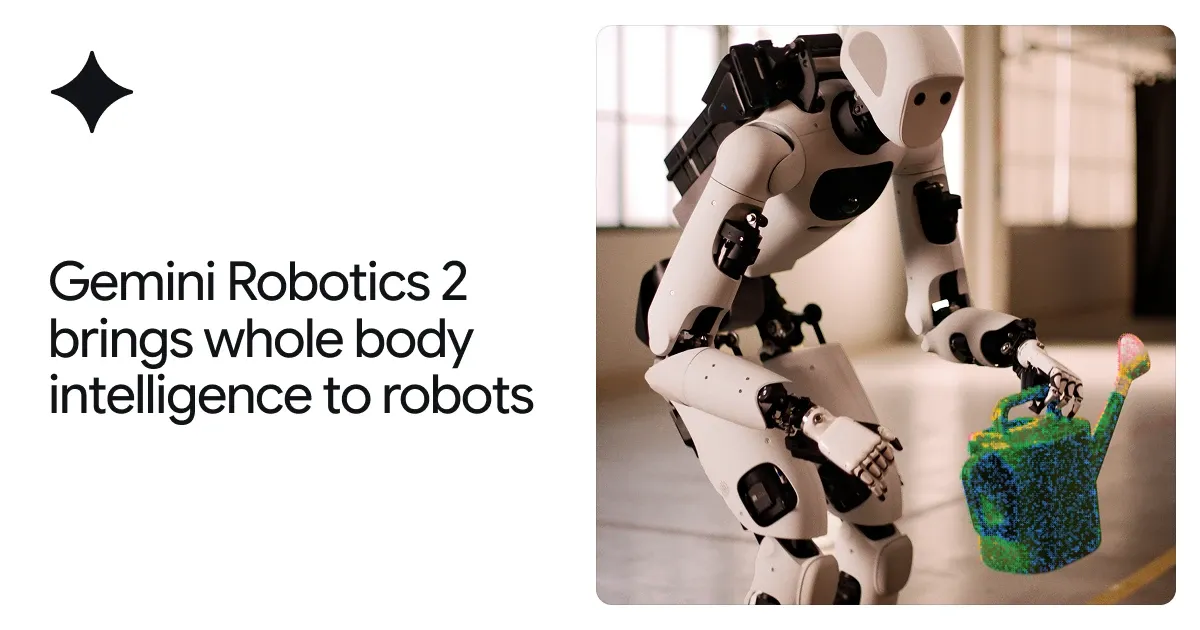
From feet to fingertips — we are teaching robots intelligent whole-body control, fine dexterity, and teamwork to complete a broad range of complex tasks.
We use cookies to run the site and, with your consent, for analytics and to show ads.
See our Cookie Policy.