This v2 revision reports measured results on the completed implementation of DroneShield-AI, a unified open framework integrating six processing layers: RF signal classification, acoustic motor-signature detection, YOLOv8-based visual detection, evidence-weighted sensor fusion, a Behavioral Intent Classification Engine...
Experiments show that COVER improves the coverage-conflict trade-off, making CM-EVS a sparse, compact, and auditable RGB-D-pose resource for geometry-consistent panoramic 3D learning.
Long-horizon robotic manipulation requires dense feedback that reflects how a task advances through its procedural stages, not merely whether the final outcome is successful. Existing reward models often rely on trajectory-level success labels or time-based interpolation, which can conflate elapsed time with true task...
Youhe Feng, Hansen Shi, Haoyang Li et al.· 0 citations
Pose-VLA is proposed, a decoupled paradigm that separates VLA training into a pre-training phase for extracting universal 3D spatial priors in a unified camera-centric space, and a post-training phase for efficient embodiment alignment within robot-specific action space.
Coral reefs are on the brink of collapse, with climate change, ocean acidification, and pollution leading to a projected 70-90% loss of coral species within the next decade. Reef restoration is crucial, but its success hinges on introducing automation to upscale efforts. In this work, we present a highly configurable A...
Scarlett Raine, Emilio Olivastri, Benjamin Moshirian et al.· arXiv.org· 3 citations
Simultaneous localization and mapping (SLAM) allows a mobile robot or autonomous vehicle to build a map of an unknown environment while estimating its own pose within that map. Reinforcement learning (RL), in which an agent learns a decision policy from interaction and reward, has been applied to decide how such system...
Mohammad Dehghani Tezerjani, Mohammad Khoshnazar, Mohammadhamed Tangestanizadeh et al.· 0 citations
The results distinguish cross-sensor consistency, multimodal fusion, and generalization to new action orders as separate questions as separate questions in evaluating multimodal physical representations.
Kai-Zhen Tan, Xin Xu, Si-Ru Tao et al.· 0 citations
Joint-Embedding Predictive Architectures (JEPAs), including recent LeWorldModel (LeWM), have become a promising foundation for reconstruction-free visual world models. For visual planning, however, LeWM evaluates candidate action sequences by repeatedly applying a local one-step latent transition model. This autoregres...
Long-horizon, sparse-reward tasks pose a fundamental challenge for reinforcement learning, since single-step TD learning suffers from bootstrapping error accumulation across successive Bellman updates. Actor-critic methods with action chunking address this by operating over temporally extended actions, which reduce the...
Qian Chen, Junqiao Zhao, Hongtu Zhou et al.· 0 citations
A statistically principled hard expectation-maximization procedure is introduced, with a Kalman smoother in the hard E-step, to identify dynamical representations of disturbance whose latent evolution is uniformly contractive, which yields a composite adaptive tracking controller with predictive capability and provable...
Min Kim, José Leonardo Brenes, Fred Y. Hadaegh et al.· 0 citations
Accurately decoding object states from the internal representations of vision-language-action (VLA) models does not establish that the predictions respond faithfully to changes in the target physical state. In natural observations, object state, robot configuration, occlusion, and task progress vary together, allowing...
Hyungjoon Kim, Wonbin Son, Mi Young Lee et al.· 0 citations
Differentiable physics is increasingly used in robotic material manipulation for system identification, trajectory or skill optimization, demonstration generation, and robot or end-effector design. These applications depend on gradients propagated through long, contact-rich simulation rollouts. We study the numerical r...
Xin-Tong Yang, Ming-Lun Wei, Yu-Kun Lai et al.· 0 citations
Robots are getting smarter, but how can their hardware match that growth? New Microsoft Research findings show that moving AI inference beyond the robot can improve task success, boost efficiency, and support more advanced physical AI workloads. The post Offloaded inference for real-world physical AI robotics appeared first on Microsoft Research.
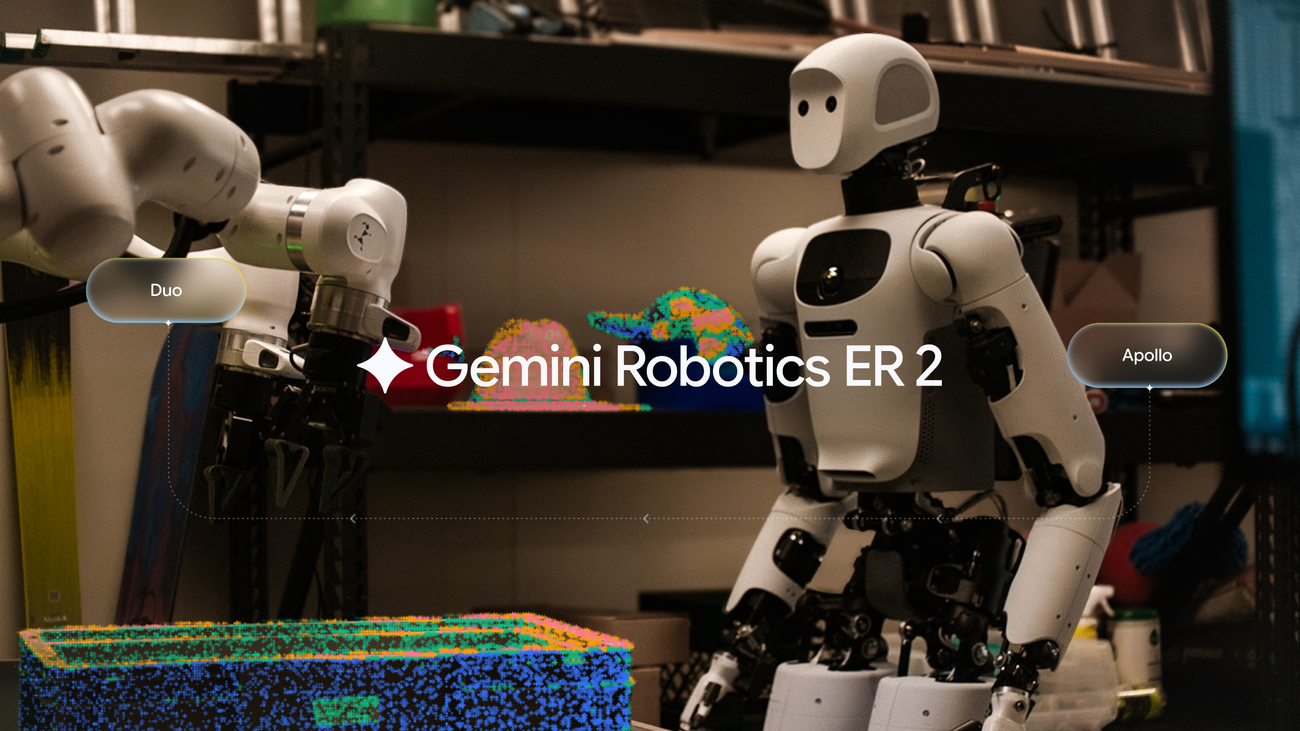
Gemini Robotics ER 2 helps robots reason, collaborate, and solve real-world tasks. It represents a step change in video understanding, tool orchestration, and multi-robot collaboration for robotic applications.
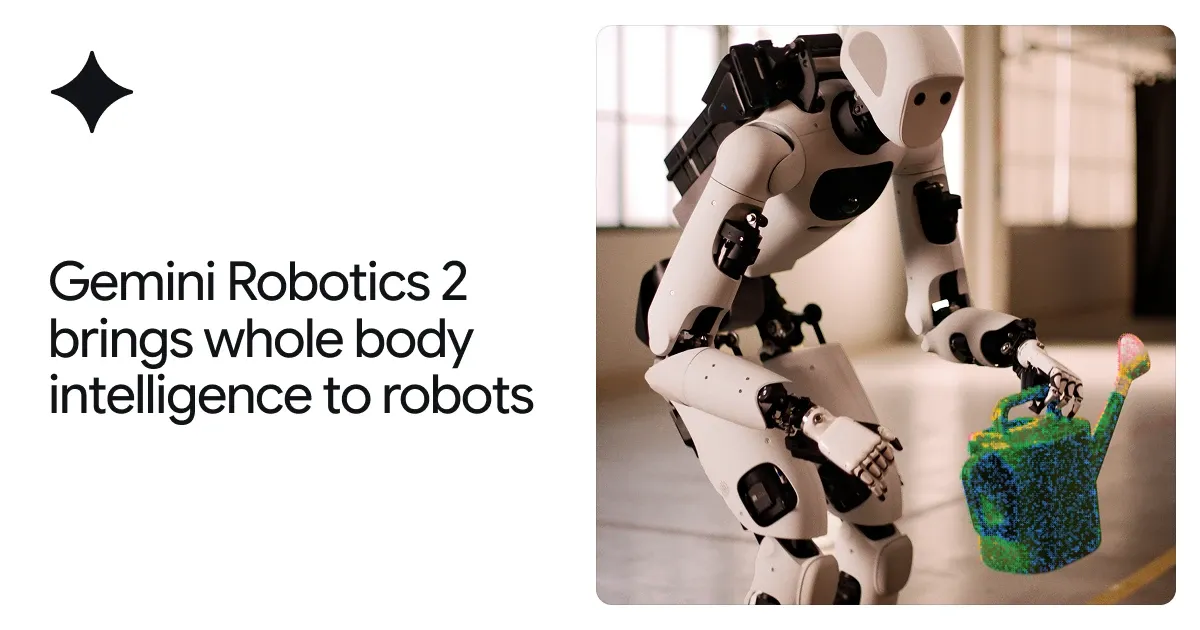
From feet to fingertips — we are teaching robots intelligent whole-body control, fine dexterity, and teamwork to complete a broad range of complex tasks.
We use cookies to run the site and, with your consent, for analytics and to show ads.
See our Cookie Policy.