Jun 2026· arXiv.org· Vol abs/2606.11687· 0 citations· 48 references
Computer Science
TL;DR
This v2 revision reports measured results on the completed implementation of DroneShield-AI, a unified open framework integrating six processing layers: RF signal classification, acoustic motor-signature detection, YOLOv8-based visual detection, evidence-weighted sensor fusion, a Behavioral Intent Classification Engine (BICE), and a Graph Neural Network Swarm Intelligence Module (GNN-SIM).
Abstract
Unmanned Aerial Vehicle (UAV) threats have emerged as a defining security challenge of the 21st century. This paper presents DroneShield-AI, a unified open framework integrating six processing layers: RF signal classification, acoustic motor-signature detection, YOLOv8-based visual detection, evidence-weighted sensor fusion, a Behavioral Intent Classification Engine (BICE), and a Graph Neural Network Swarm Intelligence Module (GNN-SIM). This v2 revision reports measured results on the completed implementation (495 automated tests), superseding the v1 simulation-only preprint. On real public data: RF presence detection reaches F1 0.9924; acoustic detection reaches 98.12% accuracy, though a 4-feature statistical baseline reaches 93.25% on the same split, so the model's drone-specific contribution is approximately 4.9 points, a property of dataset provenance rather than a leakage bug; visual detection (YOLOv8) reaches AP50 0.8782 on a held-out test split, from a model still improving when training stopped. No fused-accuracy figure is reportable, since the three real-data layers use independently collected, unsynchronized datasets with no shared ground truth. BICE and GNN-SIM remain evaluated on physics-calibrated simulation data pending real adversarial and swarm field data: BICE shows a consistent robustness advantage over a trivial baseline under distribution shift; GNN-SIM underperforms its own trivial baseline in-distribution but independently replicates BICE's noise-robustness advantage, regarded as this work's most durable finding. All code, trained checkpoints, and the full test suite are publicly released.
This publication proposes a definition and a classification of agile software development approaches and analyses ten software development methods that can be characterized as being "agile" against the defined criterion.
P. Abrahamsson, O. Salo, Jussi Ronkainen et al.· arXiv.org· 727 citations· ⚡54
The study shows that agile practices improve both informal and formal communication, but indicates that, in larger development situations involving multiple external stakeholders, a mismatch of adequate communication mechanisms can sometimes even hinder the communication.
M. Pikkarainen, Jukka Haikara, O. Salo et al.· Empirical Software Engineeri...· 401 citations· ⚡48
The results indicate that software engineering work practices are chosen opportunistically, adapted and configured to provide value under the constrains imposed by the startup context.
Nicolò Paternoster, Carmine Giardino, M. Unterkalmsteiner et al.· Information and Software Tec...· 394 citations· ⚡54
The possibility of inferring high-dimensional data inference in a model that consists of a prior and an auxiliary differentiable constraint given some additional information is considered, thereby allowing a range of potential applications in adapting models to new domains and tasks.
Alexandros Graikos, Esmeralda S. Whitammer, N. Jojic et al.· Neural Information Processin...· 316 citations· ⚡15
It is proved that any global minimizer of the trajectory balance objective can define a policy that samples exactly from the target distribution, and empirically demonstrate the benefits of the trajectories balance objective for GFlowNet convergence, diversity of generated samples, and robustness to long action sequenc...
Esmeralda S. Whitammer, Moksh Jain, Emmanuel Bengio et al.· Neural Information Processin...· 302 citations· ⚡60
Exploring how generative AI could make machine vision more accessible to businesses. The post GenEye in a Box: Making Machine Vision Something You Can Just Ask For appeared first on GPT-Lab.
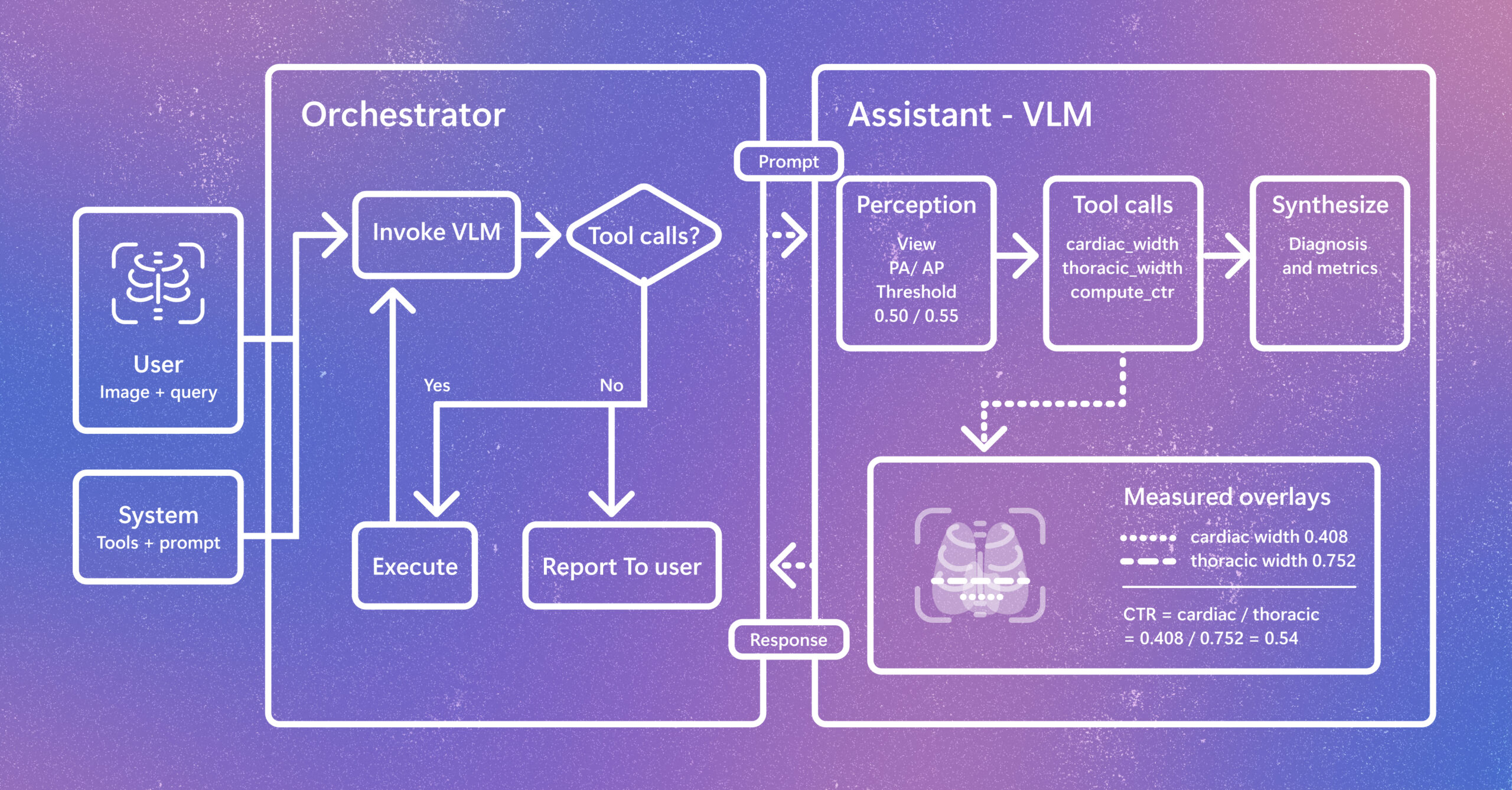
Radiology AI is evolving beyond report generation. CARE-X explores a unified approach that combines flexible reasoning, calibrated predictions, and measurement-based tools for chest X-ray interpretation. The post Introducing CARE-X: Towards Clinically Useful Radiology VLMs with Auxiliary Supervision, Reward-Aligned Learning, and Tool-Augmented Measurement appeared first on Microsoft Research.