Natural State-Prediction Accuracy can Hide Weak Controlled Responsiveness in VLA Readouts
Hyungjoon KimWonbin SonMi Young LeeJun Young LeeSeungmin Rho
Sep 2026
Machine LearningComputer VisionRobotics
Abstract
Accurately decoding object states from the internal representations of vision-language-action (VLA) models does not establish that the predictions respond faithfully to changes in the target physical state. In natural observations, object state, robot configuration, occlusion, and task progress vary together, allowing contextual cues to contribute to prediction. In this paper, we introduce an evaluation framework that separates prediction accuracy, target-state responsiveness, and context stability using physically validated observations that cross target coordinates with robot contexts. We demonstrate that high natural-trajectory accuracy can coexist with weak controlled target-state responsiveness in fixed representation-readout pairs. Comparisons and interventions involving representations, readouts, and training data show that the three properties provide distinct diagnostic information. Furthermore, adding responsiveness and context sensitivity to a failure predictor based on initial state error and physical variables reduces policy-failure prediction error on new initializations relative to the specified baseline while same-observation controlled MAE is also informative. These findings motivate evaluating target-state responsiveness and context stability alongside natural prediction accuracy, and examining their relationship to actual policy behavior and task outcomes.
This publication proposes a definition and a classification of agile software development approaches and analyses ten software development methods that can be characterized as being "agile" against the defined criterion.
P. Abrahamsson, O. Salo, Jussi Ronkainen et al.· arXiv.org· 727 citations· ⚡54
The study shows that agile practices improve both informal and formal communication, but indicates that, in larger development situations involving multiple external stakeholders, a mismatch of adequate communication mechanisms can sometimes even hinder the communication.
M. Pikkarainen, Jukka Haikara, O. Salo et al.· Empirical Software Engineeri...· 401 citations· ⚡48
The results indicate that software engineering work practices are chosen opportunistically, adapted and configured to provide value under the constrains imposed by the startup context.
Nicolò Paternoster, Carmine Giardino, M. Unterkalmsteiner et al.· Information and Software Tec...· 394 citations· ⚡54
The possibility of inferring high-dimensional data inference in a model that consists of a prior and an auxiliary differentiable constraint given some additional information is considered, thereby allowing a range of potential applications in adapting models to new domains and tasks.
Alexandros Graikos, Esmeralda S. Whitammer, N. Jojic et al.· Neural Information Processin...· 316 citations· ⚡15
It is proved that any global minimizer of the trajectory balance objective can define a policy that samples exactly from the target distribution, and empirically demonstrate the benefits of the trajectories balance objective for GFlowNet convergence, diversity of generated samples, and robustness to long action sequenc...
Esmeralda S. Whitammer, Moksh Jain, Emmanuel Bengio et al.· Neural Information Processin...· 302 citations· ⚡60
Exploring how generative AI could make machine vision more accessible to businesses. The post GenEye in a Box: Making Machine Vision Something You Can Just Ask For appeared first on GPT-Lab.
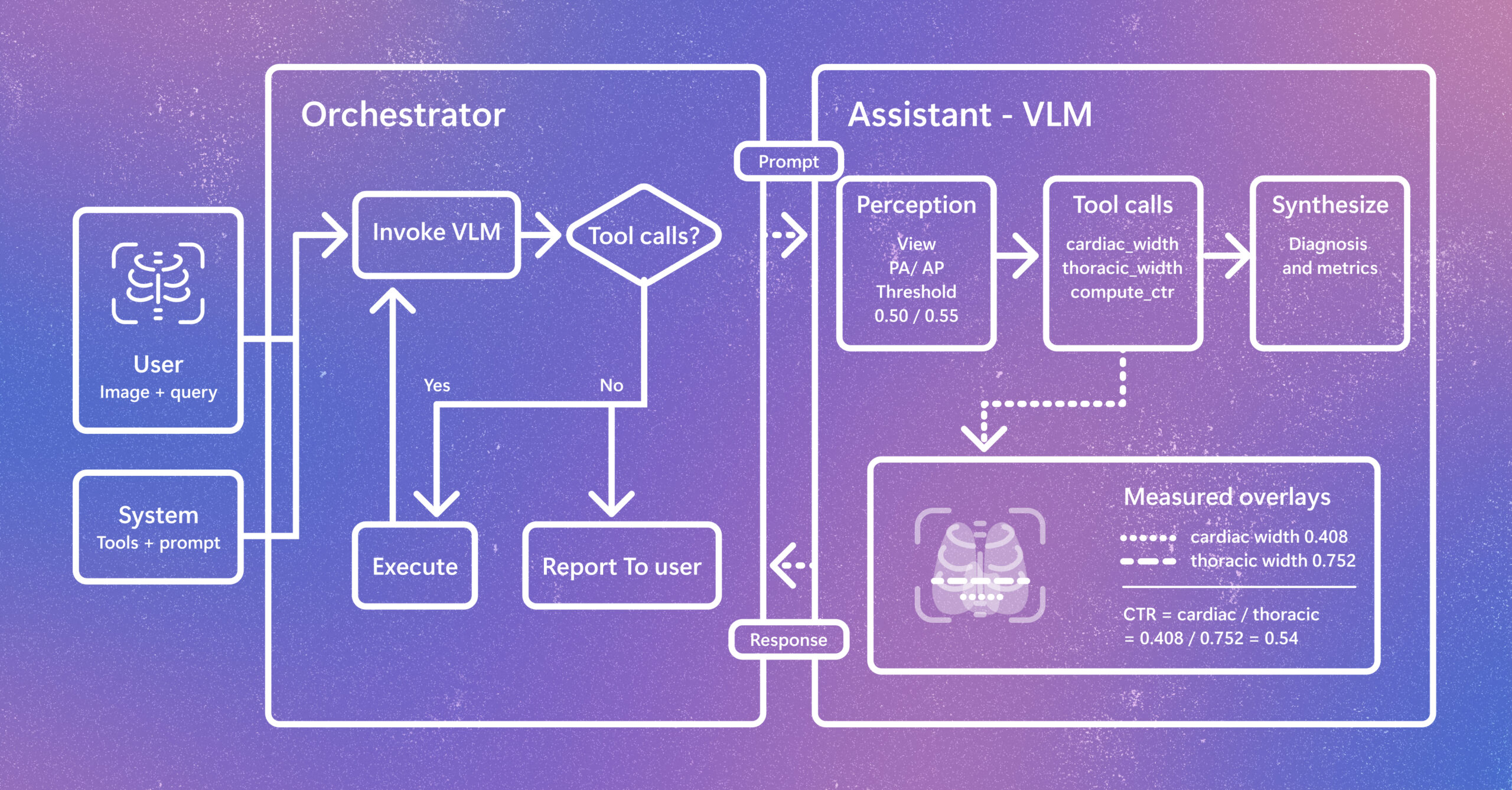
Radiology AI is evolving beyond report generation. CARE-X explores a unified approach that combines flexible reasoning, calibrated predictions, and measurement-based tools for chest X-ray interpretation. The post Introducing CARE-X: Towards Clinically Useful Radiology VLMs with Auxiliary Supervision, Reward-Aligned Learning, and Tool-Augmented Measurement appeared first on Microsoft Research.