We introduce a PAC framework in which the learner can access sampling oracles both before and at decision time. Sample complexity is measured by a pair $(n,m)$, where $n$ is the learning budget spent before a query is known and $m$ is the additional sampling budget per query. We demonstrate its relevance in discounted...
Corentin Pla, Hugo Richard, Marc Abeille et al.· 0 citations
Real-world user behavior rarely consists of isolated actions; instead, it often forms intent flows governed by spatiotemporal dependencies. To provide integrated service recommendations, we focus on the task of Generative Spatiotemporal Intent Sequence Recommendation (GSISR), which aims to generate intent sequences tha...
Sicong Wang, Ruiting Dong, Yue Liu et al.· 0 citations
Drone-view geo-localization aims to match a query drone image, often captured under adverse weather conditions (e.g., rain, snow, fog), against a gallery of geo-tagged satellite images. Weather-induced degradations in the drone view, such as noise, reduced visibility, and partial occlusions, severely exacerbate the int...
Neural likelihood surrogates (e.g., Neural Ratio Estimation) for stochastic process models are commonly trained via probabilistic classification on simulated data, which forces a tradeoff between surrogate quality and training costs. For structured models where the exact score $\nabla_\theta \log p(x \mid \theta)$ is a...
Alexander Shen, Mikael Kuusela· 0 citations
Reach audiences
Advertise in front of researchers, engineers, and readers.
Chaos arises in many complex dynamical systems, from weather to power grids, but is difficult to accurately model with data-driven methods such as machine learning emulators. While emulators are promising tools for accelerating simulations and solving inverse problems, they still struggle to learn chaotic dynamics, whe...
Gabriel Melo, Leonardo Santiago, Peter Y. Lu· 0 citations
Most repository-level code translation and validation techniques have been evaluated on a single source-target programming language (PL) pair, owing to the complex engineering effort required to adapt new PL pairs. Programming agents can enable PL-agnosticism in repository-level code translation and validation: they ca...
Ali Reza Ibrahimzada, Brandon Paulsen, Daniel Kroening et al.· 0 citations
This paper incorporated neurotransmitter populations into the modeling and establish the limit network model when the number of neurotransmitters at all synaptic connections go to infinity, and sufficient conditions for stability and contraction properties of the limit network model are established.
Shuang Gao, Peter E. Caines· arXiv.org· 0 citations
In probabilistic classification, calibration error (CE) measures the average divergence of predicted probabilities $f(X)$ from $\mathbb{P}(Y|f(X))$, the true class distribution for that predicted probability. While being a useful diagnostic tool, it is hard to estimate: popular binning-based estimators are often incons...
Eug\`ene Berta, Sacha Braun, Francis Bach et al.· 0 citations
Visually-guided acoustic highlighting seeks to rebalance audio in alignment with the accompanying video, creating a coherent audio-visual experience. While visual saliency and enhancement have been widely studied, acoustic highlighting remains underexplored, often leading to misalignment between visual and auditory foc...
Hugo Malard, Gael Le Lan, Daniel Wong et al.· 0 citations
Cu NPs have a broad applicability, yet their synthesis is sensitive to subtle changes in reaction parameters. This sensitivity, combined with the time- and resource-intensive nature of experimental optimization, poses a major challenge in achieving reproducible and size-controlled synthesis. While ML shows promise in m...
Brent Motmans, Digvijay Ghogare, Thijs G. I. van Wijk et al.· 0 citations
We study the problem of learning disentangled signals from data using non-linear Independent Component Analysis (ICA). Motivated by advances in self-supervised learning, we propose to learn self-sufficient signals: Given the remaining values of a recovered signal, observing other signals should not change the condition...
Scaling large recommendation systems requires advancing three major frontiers: processing longer user histories, expanding candidate sets, and increasing model capacity. While promising, transformers' computational cost scales quadratically with the user sequence length and linearly with the number of candidates. This...
Yang Liu, Yunjiang Jiang, Ayush Agarwal et al.· 0 citations
Learn how Google DeepMind and GovTech Singapore uses lightweight on-device Gemma models to intercept conversational scams in private chats with zero cloud data egress.
MIT News · Artificial Intelligence· news.mit.eduOct 13, 2026
Machine-learning networks can learn without detailed instructions from a designer. Those that do may offer insight into how the brain reorganizes itself during learning.
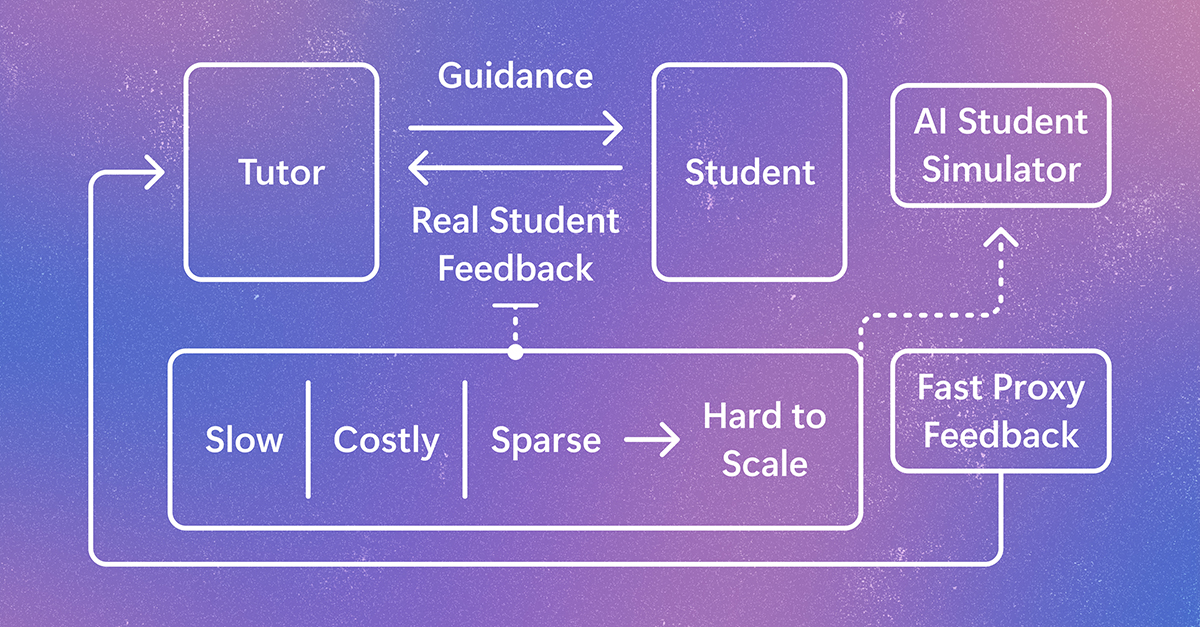
StudentSim is a research system for evaluating and improving AI tutoring tools before they are tested with learners. It models how individuals may engage with tutors, giving feedback to improve tutor performance across subjects like chess, writing, and mathematics. The post Simulating student learning for better AI tutoring appeared first on Microsoft Research.
Exploring how generative AI could make machine vision more accessible to businesses. The post GenEye in a Box: Making Machine Vision Something You Can Just Ask For appeared first on GPT-Lab.
We use cookies to run the site and, with your consent, for analytics and to show ads.
See our Cookie Policy.