Multi-turn tool-use agents must reason, call tools, and adapt to observations across several interaction turns. Post-training such agents is challenging, as reinforcement learning often suffers from sparse rewards and weak credit assignment despite matching the prompt-only inference setting, while supervised fine-tunin...
Zhenbang Du, Jun Luo, Zhiwei Zheng et al.· 0 citations
Modern video diffusion models generate increasingly realistic and temporally coherent videos, motivating their use as candidate world simulators. Yet it remains unclear whether these models internally encode physical structure, or merely reproduce motion patterns seen during training. We study this question by probing...
Parsa Esmati, Somjit Nath, Katja Hofmann et al.· 0 citations
Self on-policy distillation trains a student policy against a teacher derived from its own parameter history, yet the teacher's update schedule -- which governs the \emph{temporal coupling} between teacher and student -- has not been systematically studied as a stability variable. Through a controlled schedule sweep on...
Haowei Guo, Baolong Bi, Ruicheng Zhang et al.· 0 citations
Safe exploration remains a fundamental challenge in reinforcement learning (RL), limiting the deployment of RL agents in the real world. We propose Sampling-Based Safe Reinforcement Learning (SBSRL), a model-based RL algorithm that maintains safety throughout the learning process by enforcing constraints jointly across...
Luca Vignola, Bruce D. Lee, Manish Prajapat et al.· 0 citations
Industrial machines are actuated systems, yet most open time-series corpora record sensor outcomes alone; the few that do log commanded signals expose them in vendor-specific forms that differ from machine to machine, so commanded intent and measured response cannot be compared across embodiments. We introduce FactoryN...
Jonas Petersen, Pratik Jawahar, Riccardo Maggioni et al.· 0 citations
Direct Preference Optimization (DPO) aligns language models using pairwise preference comparisons, offering a simple and effective alternative to Reinforcement Learning (RL) from human feedback. However, in many practical settings, training data consists of multiple rollouts per prompt, inducing rich preference structu...
Ning Liu, Chuanneng Sun, Kristina Klinkner et al.· 0 citations
Spiking neural networks (SNNs) have been proposed as energy-efficient alternatives to deep neural networks. Their training is non-convex and involves a non-differentiable spike function, so existing methods offer no guarantee of reaching a global optimum. We address this issue by formulating SNN optimization as an equi...
Himanshu Udupi, Calvin Ang, Sungyoon Kim et al.· 0 citations
We study the convergence dynamics of Gradient Descent (GD) in a minimal binary classification setting, consisting of a two-neuron ReLU network and two training instances. We prove that even under these strong simplifying assumptions, while GD successfully converges to an optimal robustness margin, effectively maximizin...
Guy Smorodinsky, Sveta Gimpleson, Itay Safran· 0 citations
We investigate the theoretical aspects of offline reinforcement learning (RL) under general function approximation. While prior works (e.g., Xie et al., 2021) have established the theoretical foundations of learning a good policy from offline data via pessimism, existing algorithms that are computationally tractable (o...
Training large language models (LLMs) for multi-turn code generation typically relies on online reinforcement learning (RL), in which models learn from repeatedly generated online rollouts. Although effective, online RL can be costly and unstable. In this paper, we present contextual bandit learning with offline trajec...
Ziru Chen, Dongdong Chen, Ruinan Jin et al.· 0 citations
A central difficulty in applying reinforcement learning to real-world applications such as autonomous driving is that conventional scalar reward formulations obtained by aggregating multiple often competing objectives may obscure the structure of their trade-offs. These challenges are particularly relevant to decision-...
Deepthi Pathare, Leo Laine, Morteza Haghir Chehreghani· 0 citations
Learn how Google DeepMind and GovTech Singapore uses lightweight on-device Gemma models to intercept conversational scams in private chats with zero cloud data egress.
MIT News · Artificial Intelligence· news.mit.eduOct 13, 2026
Machine-learning networks can learn without detailed instructions from a designer. Those that do may offer insight into how the brain reorganizes itself during learning.
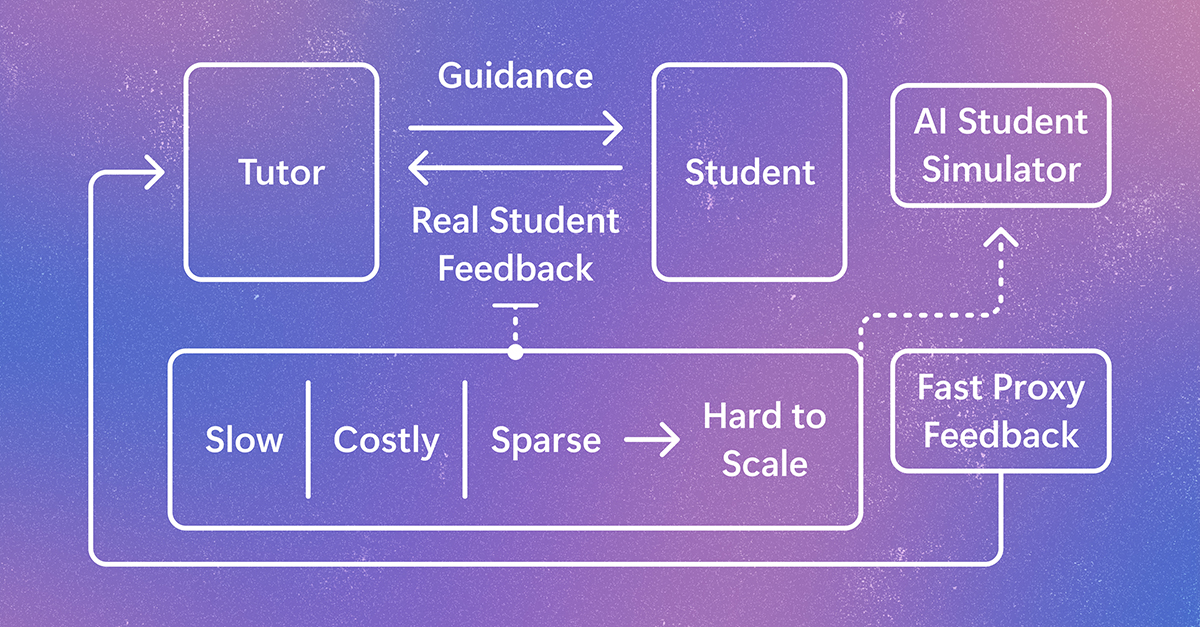
StudentSim is a research system for evaluating and improving AI tutoring tools before they are tested with learners. It models how individuals may engage with tutors, giving feedback to improve tutor performance across subjects like chess, writing, and mathematics. The post Simulating student learning for better AI tutoring appeared first on Microsoft Research.
Exploring how generative AI could make machine vision more accessible to businesses. The post GenEye in a Box: Making Machine Vision Something You Can Just Ask For appeared first on GPT-Lab.
We use cookies to run the site and, with your consent, for analytics and to show ads.
See our Cookie Policy.