When a trader executes a large order, the relevant question is not \emph{what will the price be?} but \emph{what would the price have been had I not traded?} Market impact is thus a causal quantity, yet classical models (Almgren--Chriss, propagators) regress price on flow, which is biased whenever informed flow moves p...
Training-free feature reuse accelerates diffusion transformer inference by replacing full denoising computation at selected steps with cached approximations. Existing methods mainly improve the reconstruction of skipped features, but we find that once a stable first-order reconstructor is used, increasing reconstructio...
Qinhan Lyu, Jusheng Zhang, Zhixing Zhang et al.· 0 citations
Continuous glucose monitoring (CGM) foundation models encode each day as one vector that mixes who the person is, what happened that day and how the sensor measured it, so measurement differences travel with the representation into new cohorts. We ask whether pretraining can place the measurement component that harms t...
Adinath Madhavrao Dukre, Abdullah Mohammad, Yifan Lu et al.· 0 citations
Distribution operators need visibility of behind-the-meter photovoltaic (PV) generation, yet most residential customers are observed only through net smart meters. Deep-learning-based PV disaggregation can restore this visibility, but its operational value depends on whether the model serves known customers, new custom...
Jack Zheng, Hao Wang· 0 citations
Reach audiences
Advertise in front of researchers, engineers, and readers.
Sequence models with a fixed-size state avoid the quadratic cost of attention, but face a design choice. An input-dependent state transition gives content-dependent memory at the cost of FFT-based training, while a fixed transition keeps the O(T log T) convolutional path but reads memory the same way for every input. R...
In this article, we propose algebraic integer number formats (AINF) as a framework for highly configurable and accurate compressed computation. A key property of AINF is its straightforward reduction to purely integer arithmetic, enabling error-free multiply-accumulate operations. We develop a matrix multiplication eng...
Anthony Kostal-Vazquez, Vassil Dimitrov, Branden Butler· 0 citations
Certified training aims to produce models whose predictions can be formally verified against adversarial perturbations, typically by optimising upper bounds on the worst-case loss over an allowed perturbation set. For neural networks, certified training methods based purely on tight relaxation bounds produce networks t...
Matteo Melis, Jesus Martinez Del Rincon, Vishal Sharma· 0 citations
Machine unlearning (MU) is commonly judged by output forgetting, such as low forget-set accuracy or reduced membership inference. But if output-level success can coexist with retraining-inconsistent residuals in representation space, what kind of forgetting are current evaluations actually certifying? We study this que...
Teresa Pui Yee Yong, Win Kent Ong, Chee Seng Chan· 0 citations
Robots deployed in realistic settings will accumulate experience across many sessions and tasks over their deployment. The robot's tasks may often require it to remember information from multiple sessions ago, making long-context robot memory important for real-world deployments. However, most robot-memory benchmarks t...
Deploying generalist robotic agents in the real world requires transferable skills. Specifically, a policy trained to clone a behavior from object-specific demonstrations must generalize beyond that object, otherwise data collection requirements become intractable. Recently, fine-tuning of pre-trained billion-parameter...
Nikolaos Tsagkas, Andreas Sochopoulos, Chris Xiaoxuan Lu et al.· 0 citations
Runtime monitors for autonomous agents commonly threshold an accumulated internal state - a behavioural baseline, a drift statistic, or, in our prior work, a modelled affective state. We previously reported a State Saturation Trap: threshold-on-state triggers over a continuous affect engine become near-constant alarms...
A prominent research direction in mechanistic interpretability is learning sparse circuits over LLM components to reveal how they jointly produce model behavior. However, raw neurons are polysemantic, making learned circuits hard to interpret. Sparse autoencoder (SAE) features alleviate this, but their high dimensional...
Naiyu Yin, Dennis Wei, Tian Gao et al.· 0 citations
Learn how Google DeepMind and GovTech Singapore uses lightweight on-device Gemma models to intercept conversational scams in private chats with zero cloud data egress.
MIT News · Artificial Intelligence· news.mit.eduOct 13, 2026
Machine-learning networks can learn without detailed instructions from a designer. Those that do may offer insight into how the brain reorganizes itself during learning.
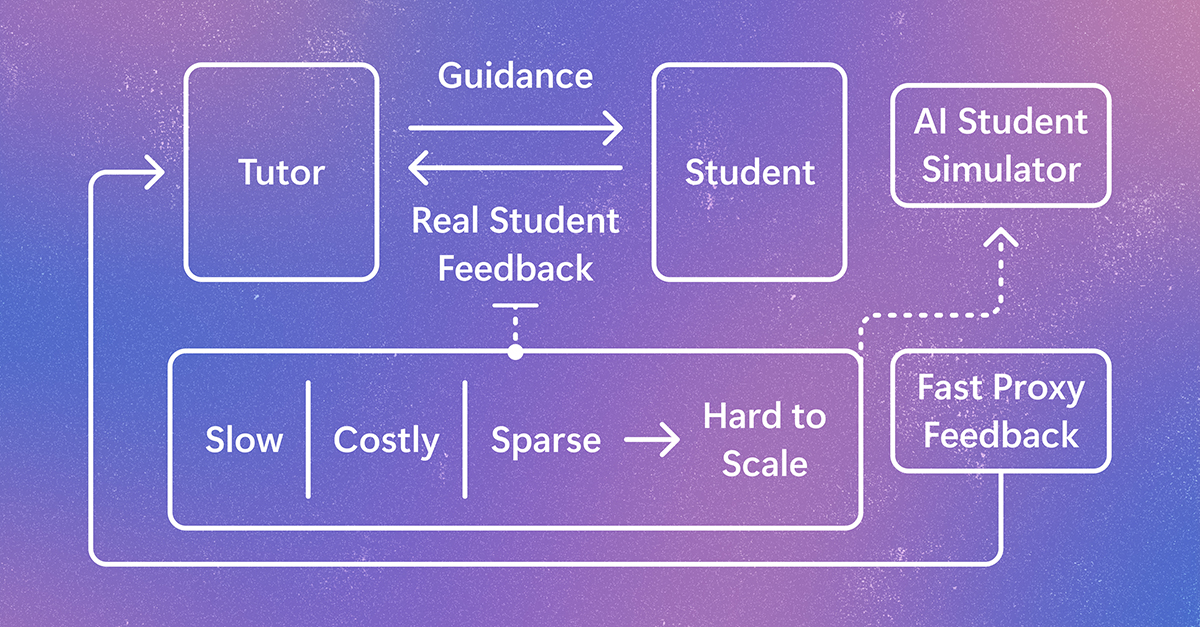
StudentSim is a research system for evaluating and improving AI tutoring tools before they are tested with learners. It models how individuals may engage with tutors, giving feedback to improve tutor performance across subjects like chess, writing, and mathematics. The post Simulating student learning for better AI tutoring appeared first on Microsoft Research.
Exploring how generative AI could make machine vision more accessible to businesses. The post GenEye in a Box: Making Machine Vision Something You Can Just Ask For appeared first on GPT-Lab.
We use cookies to run the site and, with your consent, for analytics and to show ads.
See our Cookie Policy.