Digital Health Technologies (DHTs) including telemedicine, electronic health records (EHRs), mobile health (mHealth) applications, and Artificial Intelligence (AI)-enabled tools have emerged as central instruments for strengthening health systems and improving patient care, particularly in resource-constrained settings...
Ejuchegahi A. Angwaomaodoko, Ph.D Edime Yunusa, Julius Olugbenga Owoyemi· Zenodo (CERN European Organi...· 0 citations
This paper presents a formal mathematical model for simulating information diffusion within social networks utilizing an agent-based simulation (ABS) approach. The core aim is to provide a rigorous framework for understanding the complex dynamics of how information spreads through interconnected social groups. The mode...
Jincheng Zhang· Zenodo (CERN European Organi...· 0 citations
Dieses theoretische Hypothesenpapier entwickelt einen falsifizierbaren Rahmen für Quality-Driven Propagation, Epistemic–Propagation Coupling und Adaptive Reopening in vernetzten Informationssystemen. Ausgangspunkt ist die Beobachtung, dass sich Informationen nicht ausschließlich aufgrund ihrer epistemischen Qualität ve...
Bernd von Mallinckrodt· Zenodo (CERN European Organi...· 0 citations
This paper introduces Counterfactual Diffusion Networks (CDN), a novel approach to causal representation learning. Traditional representation learning methods often fail to accurately capture underlying causal relationships within data, leading to issues in downstream tasks that rely on understanding these relationship...
Jincheng Zhang· Zenodo (CERN European Organi...· 0 citations
Reach audiences
Advertise in front of researchers, engineers, and readers.
This paper presents a formal mathematical model for simulating information diffusion within social networks utilizing an agent-based simulation (ABS) approach. The core aim is to provide a rigorous framework for understanding the complex dynamics of how information spreads through interconnected social groups. The mode...
Jincheng Zhang· Zenodo (CERN European Organi...· 0 citations
The present study aimed to develop and evaluate a flucytosine-loaded invasomal gel for improved topical antifungal drug delivery. Nine invasomal formulations (F1–F9) were prepared by varying terpene and phosphatidylcholine concentrations while maintaining flucytosine concentration at 1% w/v. The prepared invasomes were...
Manu Kumar Singh*, Dr. Sandesh Asati, Dr. Brijesh Sirohi, Dr. Vishnu Raj· Zenodo (CERN European Organi...· 0 citations
This paper explores the potential of non-Euclidean diffusion processes to revolutionize material science. Traditional approaches often assume uniform material properties, limiting our ability to precisely tailor material structures. We propose a novel mathematical framework based on a non-Euclidean diffusion equation,...
Jincheng Zhang· Zenodo (CERN European Organi...· 0 citations
ABSTRACT Digital transformation has encouraged Open and Distance Higher Education (ODHE) institutions to develop innovation communication strategies capable of effectively engaging diverse stakeholders. However, a communication model that specifically reflects the characteristics of Indonesian ODHE institutions remains...
Mochamad Priono, Gunawan Wiradharma, Hasanuddin et al.· ACADEMIA Jurnal Inovasi Rise...· 0 citations
spectraMR is a research framework for MRI reconstruction, super-resolution and generative modelling. It spans GAN, diffusion (including cold and latent diffusion), VAE/VQ-VAE, masked-autoencoder and self-supervised pretraining, reconstruction-only, domain-adaptation, physics-driven, disentangled, sensitivity-estimation...
Adnane Gdihi· Zenodo (CERN European Organi...· 0 citations
Artificial intelligence is dismantling the long‑standing computational bottlenecks of Earth system modeling. Traditional numerical weather prediction (NWP)—rooted in Navier‑Stokes discretization and dependent on exascale supercomputers—faces scaling limits that make sub‑kilometer global resolution prohibitively expensi...
Hunter Hughes· Zenodo (CERN European Organi...· 0 citations
This work addresses limitations of diffusion MRI sequence design, lengthy acquisition protocols, and the challenges associated with robust estimation of high-dimensional microstructural model parameters by combining optimised diffusion encoding with state-of-the-art simulation-based inference, establishing a clinically...
A. Leibovici, E. Soler, D. Mesika et al.· medRxiv· 0 citations
Quantum computing promises revolutionary advancements across various fields, yet its practical realization is severely hampered by errors arising from various sources. Traditional approaches to error correction in quantum computing often treat decoherence and other error mechanisms as isolated processes. This paper pro...
Jincheng Zhang· Zenodo (CERN European Organi...· 0 citations
A new computational approach reveals how cells communicate to assemble into tissues. This could accelerate stem cell engineering, improve disease models, and inform therapies.
Learn how Google DeepMind and GovTech Singapore uses lightweight on-device Gemma models to intercept conversational scams in private chats with zero cloud data egress.
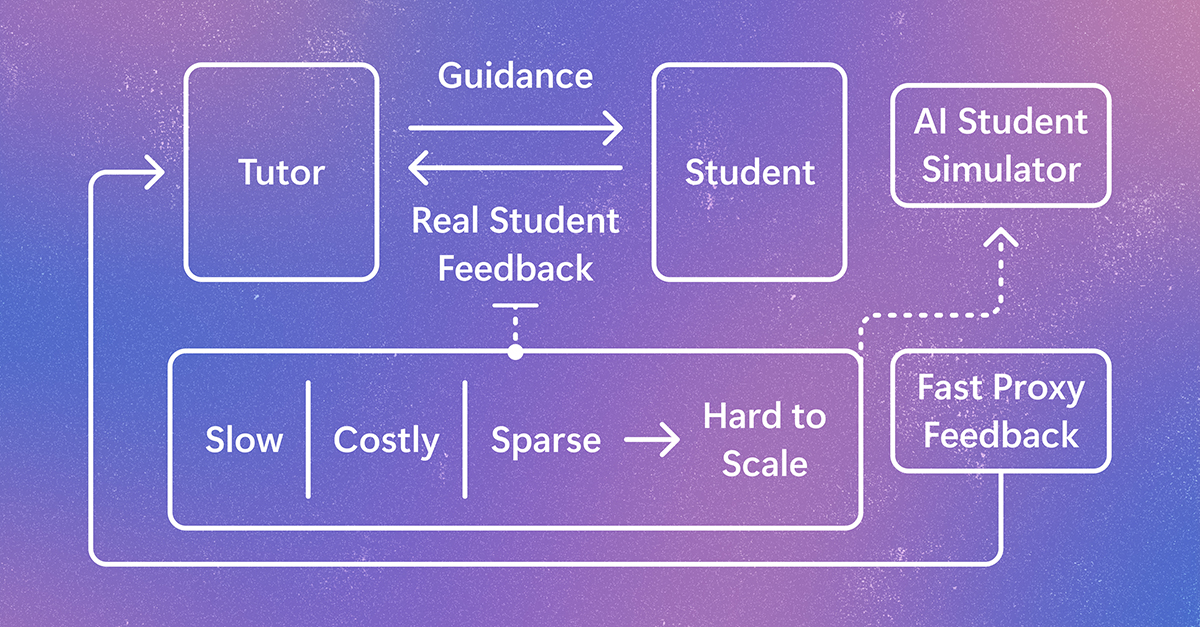
StudentSim is a research system for evaluating and improving AI tutoring tools before they are tested with learners. It models how individuals may engage with tutors, giving feedback to improve tutor performance across subjects like chess, writing, and mathematics. The post Simulating student learning for better AI tutoring appeared first on Microsoft Research.
We use cookies to run the site and, with your consent, for analytics and to show ads.
See our Cookie Policy.