DiffCold: A Diffusion-Based Generative Model for Cold-Start Item Recommendation
Kangning Zhang, Yingjie Qin, Yingjie Qin et al.
· Lecture notes in computer sc... · 0 citations
 AI Networking Cookbook: Practical recipes for AI-assisted network automation and development
Category
2,370 papers
Abstract Diffusion decision models (DDMs) offer the potential to go beyond standard accuracy and response-time indices to better understand perceptual decision-making in autism. One unanswered question is whether autistic participants can flexibly adjust the speed and accuracy of their decision-making according to task...
The rapid diffusion of generative artificial intelligence (GenAI) in higher education is transforming academic teaching, research, and administrative practices while simultaneously challenging institutional structures for governance, professional development, and academic integrity. Despite the growing use of GenAI too...
Reach audiences
Advertise in front of researchers, engineers, and readers.
The rapid diffusion of generative artificial intelligence (GenAI) in higher education is transforming academic teaching, research, and administrative practices while simultaneously challenging institutional structures for governance, professional development, and academic integrity. Despite the growing use of GenAI too...
Large language models lose coherence over long reasoning chains and long contexts: accuracy degrades with input length well inside the nominal context window, per-step errors compound, and the end state is often a fluent contradiction of the model's own earlier statements. This note draws a structural analogy between t...
This work proposes 3D Morphological Perturbations as an optimization-free regularizer that preserves spatial consistency in 3D scene representations and treats each Gaussian as a fundamental building block and applies perturbations across its morphological parameter space via scale, rotation, and pruning.
Resumen La noción de brecha digital nació para describir una diferencia binaria de acceso físico a computadoras e internet. La investigación posterior la reformuló como una desigualdad estratificada en niveles (acceso, habilidades y usos, resultados), pero la difusión de la inteligencia algorítmica, es decir, de los si...
This paper explores the potential of non-Euclidean diffusion processes to revolutionize material science. Traditional approaches often assume uniform material properties, limiting our ability to precisely tailor material structures. We propose a novel mathematical framework based on a non-Euclidean diffusion equation,...
Abstract The cognitive-motivational repercussions of social exclusion have been extensively studied, particularly its adverse effects on cognitive functions such as decision-making. However, its influence on moral decision-making remains underexplored. In an era where a significant portion of social interaction takes p...
We’re on a journey to advance and democratize artificial intelligence through open source and open science.
A new computational approach reveals how cells communicate to assemble into tissues. This could accelerate stem cell engineering, improve disease models, and inform therapies.
We’re on a journey to advance and democratize artificial intelligence through open source and open science.
Learn how Google DeepMind and GovTech Singapore uses lightweight on-device Gemma models to intercept conversational scams in private chats with zero cloud data egress.
We’re giving developers, enterprises, scientists, and consumers access to Gemini 4 Argon, our latest frontier model.
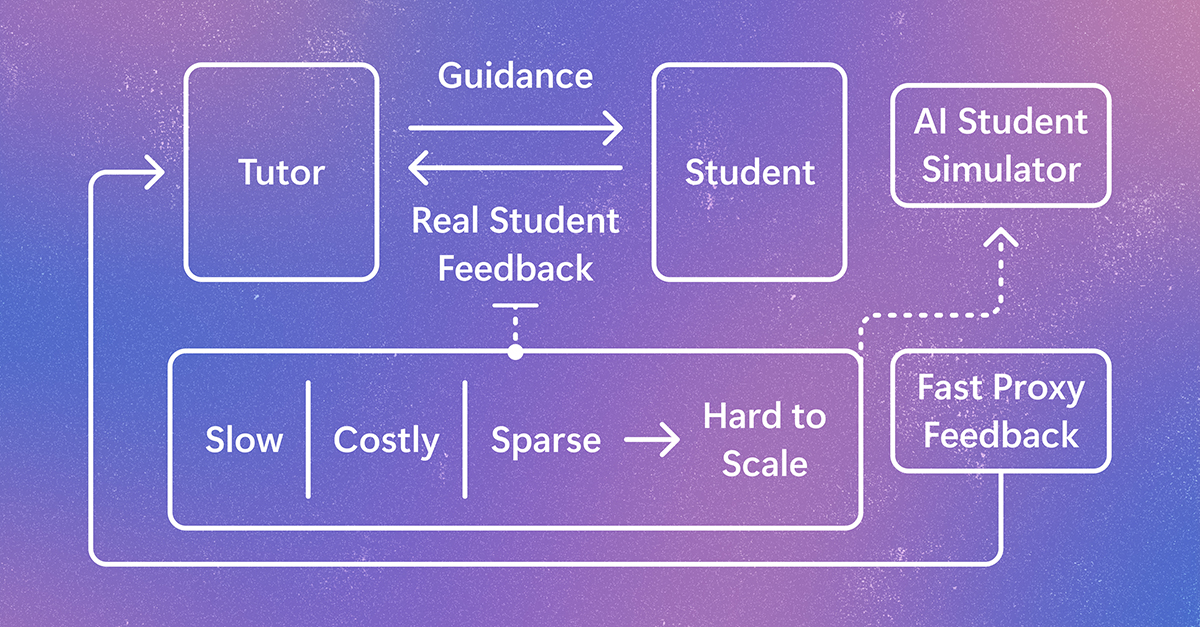
StudentSim is a research system for evaluating and improving AI tutoring tools before they are tested with learners. It models how individuals may engage with tutors, giving feedback to improve tutor performance across subjects like chess, writing, and mathematics. The post Simulating student learning for better AI tutoring appeared first on Microsoft Research.
We use cookies to run the site and, with your consent, for analytics and to show ads. See our Cookie Policy.