Humans can grasp everyday objects with almost perfect success rates using fingertip tactile feedback, yet much of the robotic grasping literature emphasizes vision-based grasp selection with parallel grippers. In this work, we systematically investigate how high-resolution, dynamic tactile sensing contributes to grasp...
Ken Nakahara, Aleksei Buvailik, Prokhor Kotov et al.· 0 citations
Standard information retrieval metrics, such as mean Average Precision (mAP), assess performance one query at a time, based on how the similarities between a query and its positives compare against those with its negatives. The same holds for common representation learning losses, such as InfoNCE and per-query AP surro...
Bill Psomas, Mohammad Mahdi, Michalis Thomas et al.· 0 citations
4D point clouds acquired by permanent laser scanning (PLS) enable accurate high-frequency monitoring of surface change in dynamic topographic environments. However, existing methods remain limited in organizing detected surface activities into meaningful process types. We propose DeepTopoClustering (DTC), an unsupervis...
Jiapan Wang, Daan Hulskemper, Mathilde Letard et al.· 0 citations
Self-supervised anomaly detection is a promising paradigm for medical ultrasound, as normal images are often easier to obtain than exhaustive annotations of all possible pathologies. However, most existing evaluations are limited to a single anatomy or task, making it unclear whether models learn a robust notion of nor...
Marco Riedenauer, Daniel Kienzle, Pratik Mayekar et al.· 0 citations
Frozen vision-language models increasingly provide safety signals for reinforcement learning. Their use assumes that similarity to language describing danger indicates the hazard itself. Yet policy return and collision rate cannot reveal whether a score detects hazards or responds to correlated features of the scene. V...
Latent actions supervise robot policies with action-like codes inferred from visual transitions, and their usefulness hinges on two questions: what a code keeps from a transition, and whether it still means the same thing when reused in a different initial state. The first is a tension in time: an endpoint difference d...
This paper addresses the prediction of adjacency between pairs of 2D fragments based on their contours. We improved the two-stage architecture proposed in Beaulac's thesis, in which a rotation-equivariant Siamese convolutional neural network scores pairs of local image windows along the two contours of two fragments. T...
Guillaume Brouillette (Universit\'e du Qu\'ebec \`a Trois-Rivi\`eres, Trois-Rivi\`eres, Canada) et al.· 0 citations
Contrails are the thin ice clouds that aircraft leave behind. They cause a large share of aviation's warming, and rerouting the few flights that produce them could avoid much of it. However, an avoided contrail only counts if a satellite can confirm that it never formed, and this check is hard: contrails are one to two...
Facial movements convey subtle and important information that is critical for human social communication. Optical methods for face capture are difficult or impossible to use when the face is occluded by head-mounted devices (HMDs), such as VR headsets. Even with a clear line of sight, such methods raise privacy concern...
Ganidhu Abey, Wendy Greening, Ashika Kamboj et al.· 0 citations
The Visual Geometry Grounded Transformer (VGGT) marks a significant leap forward in 3D scene reconstruction, as it is the first model that directly infers all key 3D attributes (camera poses, depths, and dense geometry) jointly in one pass. However, this joint inference mechanism requires global attention layers with e...
Weitian Wang, Shubham Rai, Cecilia De La Parra et al.· 0 citations
Medical imaging models often operate as black boxes, limiting interpretability and systematic debugging. We introduce an easy-to-use, plug-and-play framework for concept-based interpretation and model refinement. By aligning a single-modality encoder to BioMedCLIP, we construct a Concept Bottleneck Model (CBM) that ena...
Samrajya Thapa, Daniel J. Quest, Timothy L. Kline et al.· 0 citations
Exploring how generative AI could make machine vision more accessible to businesses. The post GenEye in a Box: Making Machine Vision Something You Can Just Ask For appeared first on GPT-Lab.
Jennifer Neville did not want to go into computer science—but that’s exactly where she landed. Neville discusses the starts and stops that led to her professional sweet spot and her work identifying “surprising failures” making it hard for AI to handle complexity. The post What AI gets wrong and what failure teaches us appeared first on Microsoft Research.
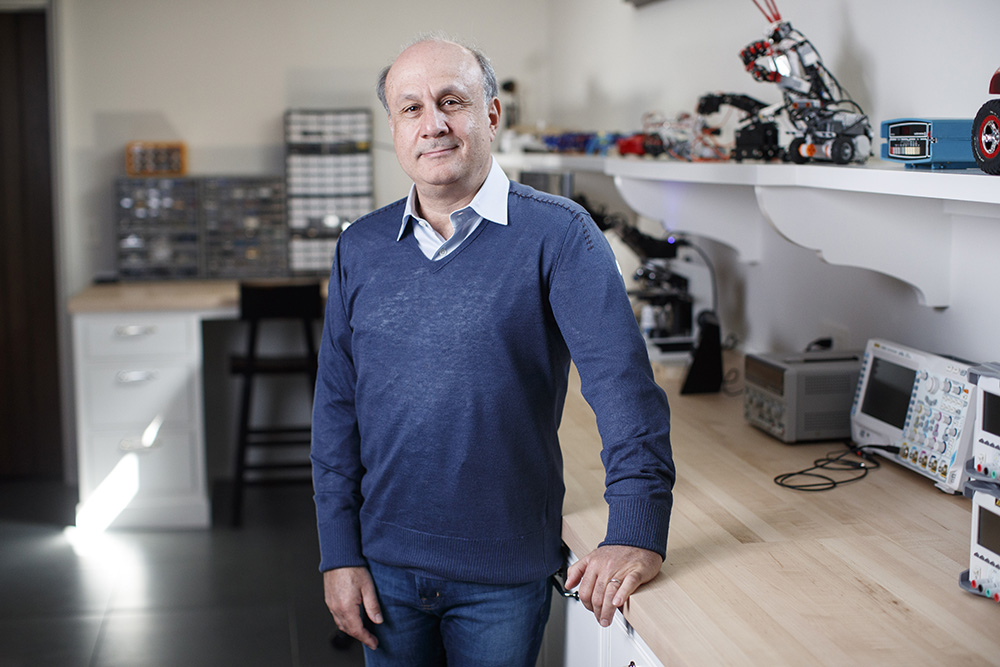
Computer scientist, entrepreneur, and philanthropist will collaborate with the MIT Schwarzman College of Computing to advance AI and scientific discovery.