Skip to content

Can People Distinguish Human and AI Agency in Humanoid Teleoperation? A Preliminary Study of Agency Perception

Sep 2026 · 0 citations · 13 references
Computer Science

TL;DR

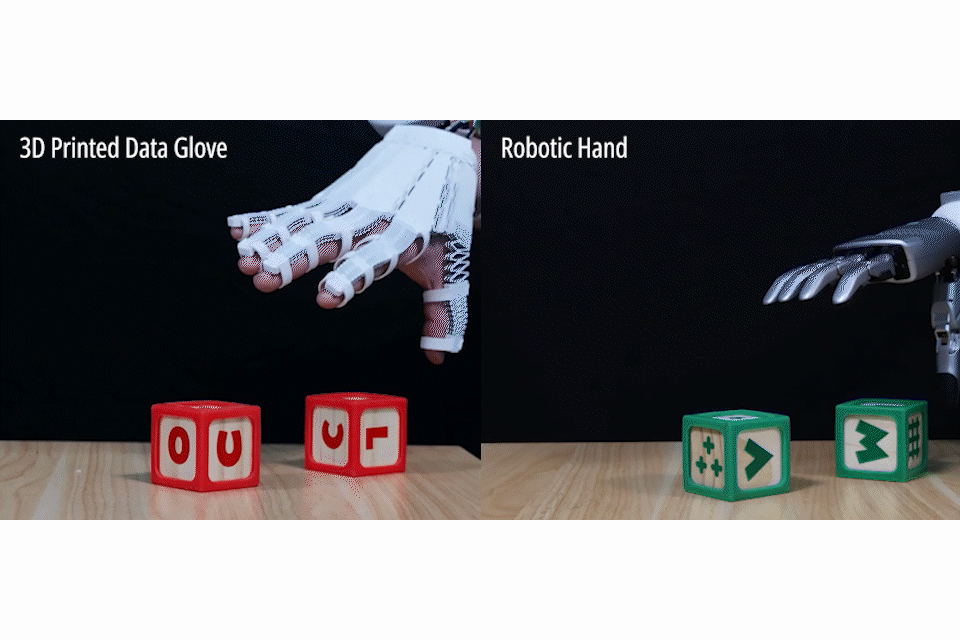
Ghost-in-the-Loop, a teleoperation framework that supports both human-operated and AI-generated control of a robot's voice, facial expressions, and gestures while maintaining a consistent embodiment, provides initial insights into agency perception in embodied human--AI communication.

Abstract

Can people distinguish between human and AI agency in humanoid teleoperation? To explore this question, we developed \textit{Ghost-in-the-Loop}, a teleoperation framework that supports both human-operated and AI-generated control of a robot's voice, facial expressions, and gestures while maintaining a consistent embodiment. We conducted a preliminary online study ($N=50$) in which participants viewed short interaction clips generated by either a Human Operator or an AI Control and judged the perceived source of control. Results suggest that participants often struggled to distinguish between the two conditions in brief interactions. Qualitative responses indicate that judgments were primarily influenced by perceived naturalness, temporal coordination, and consistency across speech, facial expression, and gesture. These findings provide initial insights into agency perception in embodied human--AI communication and motivate future investigations of blended human--AI telepresence systems.

View source

Similar papers

#artificial intelligence Conference Open access Jun 2018

Gibson Env: Real-World Perception for Embodied Agents

This paper investigates developing real-world perception for active agents, proposes Gibson Environment for this purpose, and showcases a set of perceptual tasks learned therein.

F. Xia, Amir Zamir, Zhi-Yang He et al. · 1,069 citations · ⚡112
#computer vision Review Sep 2017

Agile Software Development Methods: Review and Analysis

This publication proposes a definition and a classification of agile software development approaches and analyses ten software development methods that can be characterized as being "agile" against the defined criterion.

P. Abrahamsson, O. Salo, Jussi Ronkainen et al. · 727 citations · ⚡54
#computer vision Jun 2008

The impact of agile practices on communication in software development

The study shows that agile practices improve both informal and formal communication, but indicates that, in larger development situations involving multiple external stakeholders, a mismatch of adequate communication mechanisms can sometimes even hinder the communication.

M. Pikkarainen, Jukka Haikara, O. Salo et al. · 401 citations · ⚡48
#machine learning Review Open access Oct 2014

Software development in startup companies: A systematic mapping study

The results indicate that software engineering work practices are chosen opportunistically, adapted and configured to provide value under the constrains imposed by the startup context.

Nicolò Paternoster, Carmine Giardino, M. Unterkalmsteiner et al. · 394 citations · ⚡54

Related blog posts

MIT News · Artificial Intelligence Oct 28, 2026

Making machines that can listen

Professor Paris Smaragdis develops computers with superhuman hearing for applications like speech recognition, music understanding, and environmental monitoring.

MIT News · Artificial Intelligence Oct 23, 2026

Reinforcing the value of human understanding at MIT

During the School of Humanities, Arts, and Social Sciences’ 75th Anniversary Symposium, President Sally Kornbluth said “MIT has never needed your particular insight and guidance more than we do now.”

MIT News · Artificial Intelligence Oct 23, 2026

Q&A: How AI came to model the “messy” human mind

Assistant Professor Benjamin Lindquist studies how engineers deliberately injected randomness into early AI, giving rise to deep-learning models that sometimes hallucinate.

We use cookies to run the site and, with your consent, for analytics and to show ads. See our Cookie Policy.