UniMate is presented, a unified foundation model that synthesizes articulated motion for arbitrary skeletons from a rigged 3D asset and a text prompt, with no test-time optimization or per-skeleton retraining, and outperforms state-of-the-art baselines in quality, generalization, and efficiency.
Abstract
Recent advances in automatic rigging now deliver animation-ready 3D assets at scale, yet generating the motion to drive them remains a bottleneck. Existing learned animators are topology-constrained: they rely on category-specific templates or require per-skeleton fine-tuning and reference motions at inference. We present UniMate, a unified foundation model that synthesizes articulated motion for arbitrary skeletons from a rigged 3D asset and a text prompt, with no test-time optimization or per-skeleton retraining. UniMate introduces a topology-aware diffusion transformer, which integrates skeletal topology into attention via three mechanisms: (1) a graph-aware attention bias from pairwise joint relations and geodesic distances; (2) a spectral rotary position embedding generalizing RoPE to arbitrary kinematic trees via the graph Laplacian; and (3) a global topological conditioner attention-pooled from the rest-pose skeleton. We also curate UniML3D, 13,006 motion sequences spanning bipedal, quadrupedal, avian, marine, insectoid, serpentine, and articulated rigid objects with unified canonicalization and text pairing. Trained on this dataset, UniMate outperforms state-of-the-art baselines in quality, generalization, and efficiency, and supports zero-shot cross-topology transfer, in-betweening, expansion, and text-guided editing. Our project page is available at https://linzhanmou.com/unimate/.

UniMo is proposed, a unified point cloud-based motion generation framework that bypasses topological discrepancies by converting parametric skeletons into unparametric representations, further enhanced by dynamic sampling that allocates more points to active joints.
Ze-Yu Zhang, Zhi-Yuan Zhang, Si-Heng Wang et al.· 0 citations
This work introduces a framework for cross-morphology motion transfer with semantic style alignment that uses morphology-agnostic control signals (e.g., velocity, angular velocity, relative height) to align behaviors across species.
Alexios Mylordos, J. L. Pontón, Nuria Pelechano et al.· IEEE Transactions on Visuali...· 0 citations
ArtiMo, a novel agent-driven framework for text-guided articulated mesh animation, develops an agentic pipeline powered by Large Language and Vision-Language Models (LLMs/VLMs) to orchestrate motion generation without requiring model fine-tuning.
Chun-Yu Zou, Peng Dai, Yi-Hua Huang et al.· 0 citations
This work introduces BLARM, a feed-forward method for video-driven 3D mesh animation that produces accurate and temporally stable animations while recovering compact, interpretable motion structure from monocular video.
Pradyumn Goyal, Yizhak Ben-Shabat, Hsueh-Ti Derek Liu et al.· 0 citations
RididBench is introduced, a simulator-grounded benchmark that compares a generated continuation with a reference rollout from the same initial frame and motion description, with per-frame masks, depth, 6-DoF trajectories, and contacts available for scoring.
ArticulateArena is proposed, a representation-invariant counterpart of Chamfer distance for articulation that compares the motions one-DOF joints induce rather than the parameters that encode them, and it is proved that the resulting quotient distance is a metric.
Yu-Meng He, Yong-Fei She, Huan-Yu Chen et al.· 0 citations
Related blog posts
MIT News · Artificial Intelligence· news.mit.eduOct 28, 2026
Professor Paris Smaragdis develops computers with superhuman hearing for applications like speech recognition, music understanding, and environmental monitoring.
Exploring how generative AI could make machine vision more accessible to businesses. The post GenEye in a Box: Making Machine Vision Something You Can Just Ask For appeared first on GPT-Lab.
Microsoft Research Blog· microsoft.comAug 11, 2026
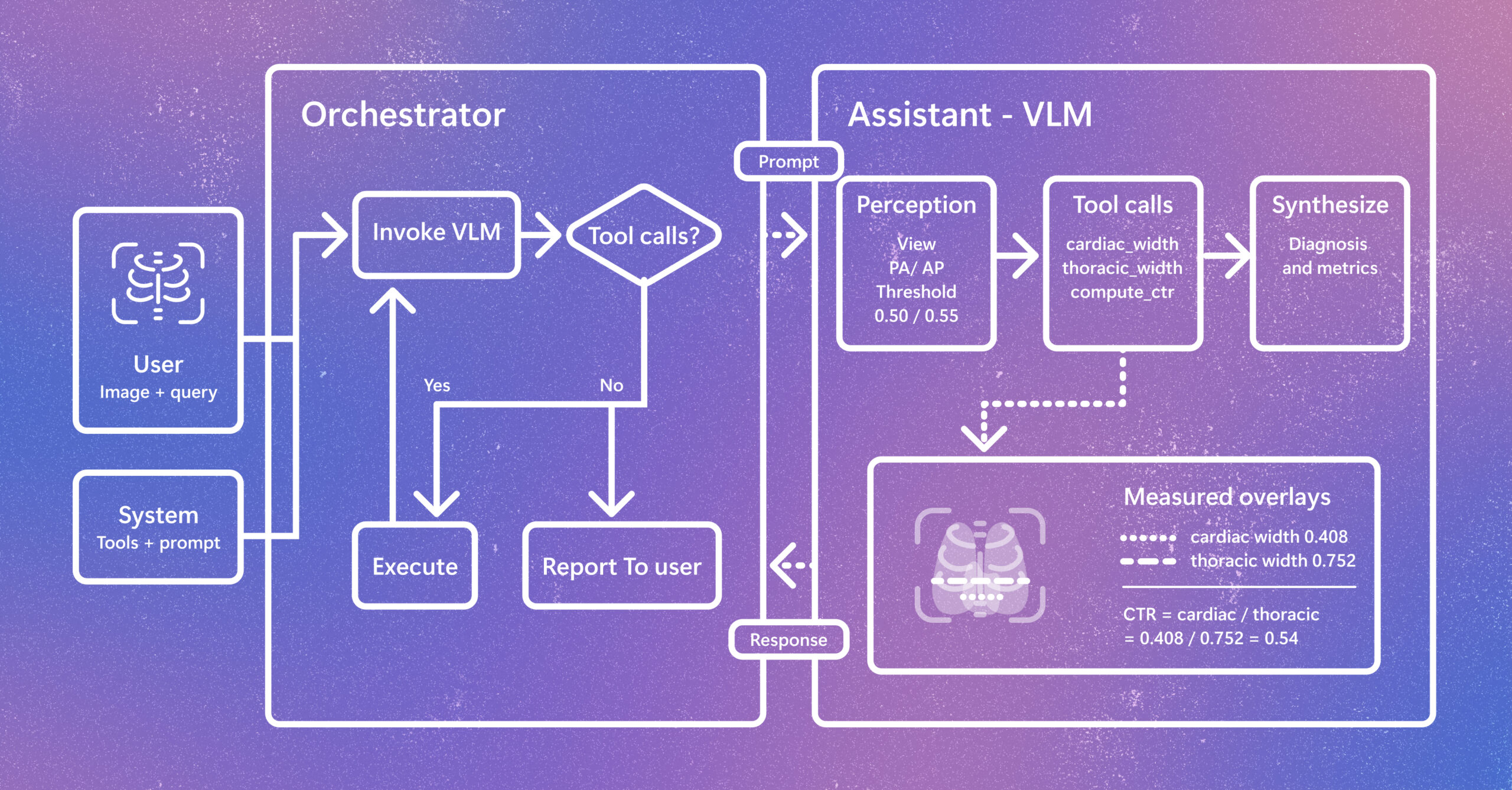
Radiology AI is evolving beyond report generation. CARE-X explores a unified approach that combines flexible reasoning, calibrated predictions, and measurement-based tools for chest X-ray interpretation. The post Introducing CARE-X: Towards Clinically Useful Radiology VLMs with Auxiliary Supervision, Reward-Aligned Learning, and Tool-Augmented Measurement appeared first on Microsoft Research.