Jul 2026· International Journal of Progressive Research in Engineering Management and Science· 2 citations· 19 references
Adversarial Robustness in Machine Learning
Abstract
Machine learning systems can retain high average accuracy while becoming overconfident under distribution shift, making a fixed confidence threshold unsafe.This study introduces a Shift-Responsive Conformal Ensemble (SRCE) for selective tabular classification.SRCE temperature-calibrates four heterogeneous learners, weights them by calibration reliability and estimated perturbation sensitivity, computes a robust input-shift score, widens conformal prediction sets as shift increases, and defers decisions that fail singleton-set and adaptive-confidence conditions.The framework was evaluated on the Wisconsin Breast Cancer, Wine, and Digits datasets using twelve repeated stratified train-calibration-test splits and controlled clean, moderate, and severe feature shifts.Across 36 dataset-repetition pairs, SRCE achieved 97.6% mean clean accuracy and 91.8% under severe shift.Under severe shift, it reduced selective risk to 1.08%, compared with 2.90% for the best single model and 1.34% for a static conformal ensemble, while covering 53.6% of cases.With normalized error cost 15 and deferral cost 0.2, SRCE produced the lowest mean cost, 0.195, compared with 0.365 and 0.211.SRCE is therefore best understood as a safety-oriented controller that converts detected shift into explicit abstention and auditable risk-coverage trade-offs.

It is found that Llama 3 delivers comparable quality to leading language models such as GPT-4 on a plethora of tasks, and performs competitively with the state-of-the-art on image, video, and speech recognition tasks.
This paper investigates developing real-world perception for active agents, proposes Gibson Environment for this purpose, and showcases a set of perceptual tasks learned therein.
F. Xia, Amir Zamir, Zhi-Yang He et al.· 2018 IEEE/CVF Conference on...· 1,069 citations· ⚡112
This publication proposes a definition and a classification of agile software development approaches and analyses ten software development methods that can be characterized as being "agile" against the defined criterion.
P. Abrahamsson, O. Salo, Jussi Ronkainen et al.· arXiv.org· 727 citations· ⚡54
Supporting data, adapters, predictions and code for the article *Low-Cost LoRA Fine-Tuning of Small Language Models for Multi-Step Arithmetic Reasoning* by Jake O'Grady, Asena Isik Gürhan, Chee Fong Ting and Effirul Ramlan (University of Galway). We generated 20,000 GSM8K-derived arithmetic problems with step-by-step s...
O'Grady, Jake, Gürhan, Asena Isik, Chee, Fong Ting et al.· Zenodo (CERN European Organi...· 465 citations
The study shows that agile practices improve both informal and formal communication, but indicates that, in larger development situations involving multiple external stakeholders, a mismatch of adequate communication mechanisms can sometimes even hinder the communication.
M. Pikkarainen, Jukka Haikara, O. Salo et al.· Empirical Software Engineeri...· 401 citations· ⚡48
Related blog posts
MIT News · Artificial Intelligence· news.mit.eduAug 18, 2026
A new method for surgically removing training examples from a model reveals that as datasets grow, the link between what a model learns and what it produces dissolves.
MIT News · Artificial Intelligence· news.mit.eduNov 17, 2026
By studying the computational foundations of language learning, Associate Professor Jacob Andreas builds intelligent systems that can communicate effectively with humans.
Learn how Google DeepMind and GovTech Singapore uses lightweight on-device Gemma models to intercept conversational scams in private chats with zero cloud data egress.
Microsoft Research Blog· microsoft.comOct 12, 2026
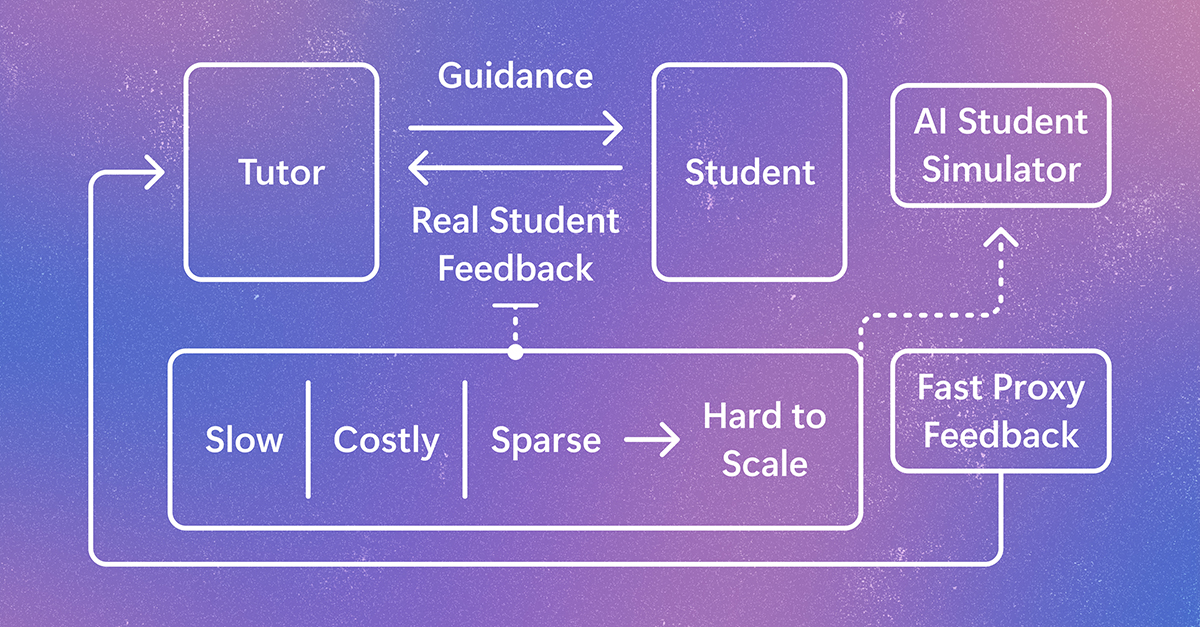
StudentSim is a research system for evaluating and improving AI tutoring tools before they are tested with learners. It models how individuals may engage with tutors, giving feedback to improve tutor performance across subjects like chess, writing, and mathematics. The post Simulating student learning for better AI tutoring appeared first on Microsoft Research.
We use cookies to run the site and, with your consent, for analytics and to show ads.
See our Cookie Policy.