Skip to content

Trust-Aware Federated Learning for Privacy-Preserving IoT Intrusion Detection

Oct 2026 · Electronics · 0 citations · 39 references
Privacy-Preserving Technologies in Data Network Security and Intrusion Detection

TL;DR

FLZT-IDS (Federated Learning with Zero-Trust for Intrusion Detection in IoT) employs gradient-deviation monitoring to mitigate the effects of heterogeneous client updates, while Graph Neural Networks and an Attention-based BiLSTM capture relational and temporal attack patterns.

Abstract

The rapid growth of Internet of Things (IoT) networks has increased the need for intrusion detection mechanisms that provide accurate threat detection while preserving privacy, resisting malicious clients, and limiting communication overhead. Existing Federated Learning (FL)-based intrusion detection systems (IDS) remain challenged by heterogeneous non-IID client data, exposure of model updates, adversarial client participation, and frequent model transmission. To address these limitations, this paper proposes FLZT-IDS (Federated Learning with Zero-Trust for Intrusion Detection in IoT). The framework employs gradient-deviation monitoring to mitigate the effects of heterogeneous client updates, while Graph Neural Networks (GNN) and an Attention-based BiLSTM capture relational and temporal attack patterns, respectively. Secure Aggregation with Local Differential Privacy (SALDP) protects transmitted model updates, whereas dynamic trust-based client filtering limits the contribution of potentially malicious participants. An adaptive communication mechanism transmits local updates only when the model change exceeds a predefined threshold, thereby reducing unnecessary communication. Experiments on CICIDS2017 and Edge-IIoTset show that FLZT-IDS achieves 97.8% and 96.2% accuracy, respectively. Compared with FL-IDS, the adaptive communication and trust-filtering mechanisms reduce cumulative communication overhead by more than 30% after 100 communication rounds. Under model-poisoning experiments with 30% malicious clients, FLZT-IDS maintains accuracies of 89.3% on CICIDS2017 and 87.1% on Edge-IIoTset, demonstrating improved robustness under the evaluated adversarial setting.

Read PDF

Similar papers

#federated learning Open access Oct 2026

Dynamic weighted federated learning with client level differential privacy for DDoS detection in IoT networks

A client-level differential privacy-dynamic weighted federated learning (DWFL) framework that applies Gaussian-mechanism noise with Renyi differential privacy (DP) composition and privacy amplification by subsampling, combined with a quality-score-driven weighted aggregation mechanism, within a single unified architect...

Laiba Maryam, Bilal Shabbir Qaisar, Mubashar Raza et al. · 0 citations
Sep 2026

Federated Learning Based Anamoly Detection for Secure and Resilient Internet of Things Communication Network

The rapid proliferation of Internet of Things (IoT) devices has created highly distributed communication environments that are increasingly exposed to anomalous traffic, botnet activity, denial-of-service attacks, spoofing, malware propagation, and other cyber threats. Conventional centralized intrusion detection appro...

Salman Arafath Mohammed · 0 citations

Privacy-Preserving Intrusion Detection Using Federated Learning in Distributed Networks

Evaluated on standard intrusion detection datasets, including NSL-KDD and CICIDS2017, indicates that the proposed model can maintain competitive detection performance while improving privacy protection and supporting deployment across distributed network environments.

Ram Chouhan, Kirti Jain, M. Bagwani · 0 citations
Open access Sep 2026

A Privacy-Preserving Intrusion Detection System for IoT Networks Using Federated Learning

The experimental results demonstrate that the proposed framework not only maintains competitive detection performance and data privacy but also reduces computational and memory requirements, supporting its suitability as an effective and lightweight IDS for resource-constrained IoT environments.

Ali Abd Alraheem, Ali Obeid, Bassam Noori Shaker · 0 citations
Open access 2026

Federated Learning for Privacy-preserving Internet of Things (IoT) Security: A Decentralized Intrusion Detection Framework

The proposed framework introduces several innovative features, such as federated learning with momentum-based optimization, adaptive differential privacy, trust verification via blockchain, and Byzantine-resilient aggregation, to enhance the security, scalability, and robustness of the system compared with traditional...

M. Ramzan · 0 citations
Sep 2026

SHFL-EI: Secure Hierarchical Federated Learning with Edge Intelligence for Robust IoT Security

The rapid proliferation of Internet of Things (IoT) systems has significantly increased the attack surface of modern cyber-physical infrastructures, creating the need for scalable, intelligent, and privacy-preserving security solutions. Traditional centralized intrusion detection approaches are limited by high communic...

Afef Slimani, K. Karoui · 0 citations

Related blog posts

Microsoft Research Blog Jul 13, 2026

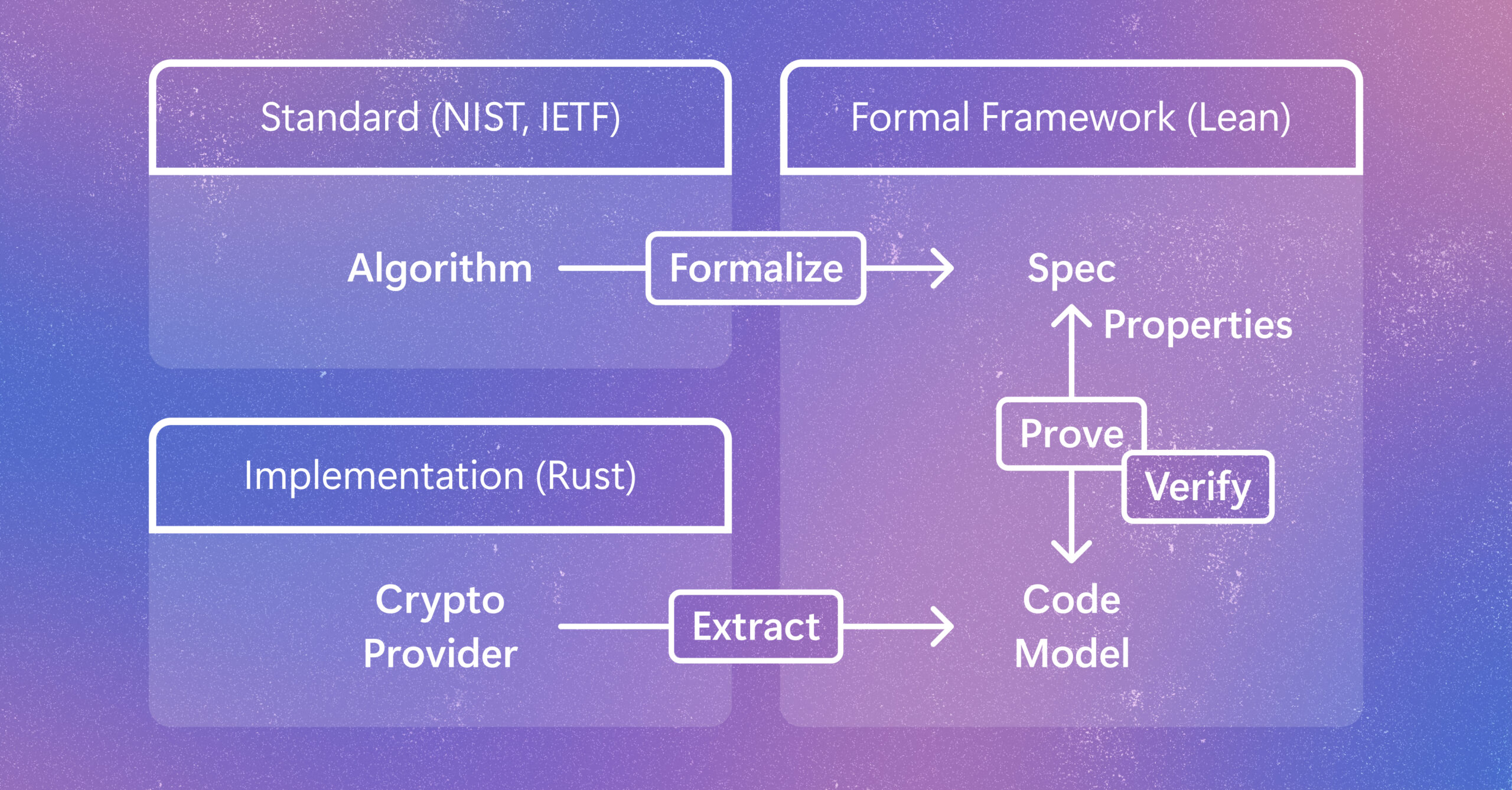
Verifying Rust cryptography in SymCrypt, from standards to code

Cryptographic code supports vital protections in modern computing systems. Learn how a new method helps verify code as developers write it while preserving speed and adaptability as it gets implemented and evolves. The post Verifying Rust cryptography in SymCrypt, from standards to code appeared first on Microsoft Research.

We use cookies to run the site and, with your consent, for analytics and to show ads. See our Cookie Policy.
