Skip to content
#graph neural networks Dataset Open access

NORMAN Kow model v0.1: QMRF, model card and SusDat predictions

Oct 2026 · Zenodo (CERN European Organization for Nuclear Research)
Computational Drug Discovery Methods

Abstract

Regression model for the n-octanol/water partition coefficient (log Kow) of the neutral form of organic chemicals, developed for the NORMAN network: the mean of gradient-boosted trees (XGBoost and LightGBM) and a graph neural network (Chemprop D-MPNN). It was trained on 14 836 structures with measured values, 13 530 from the LogP_QR data set of OPERA and 1 306 from curated REACH study results. On a locked external set of REACH structures that neither OPERA 2.9 nor the EPI Suite data hold, the model reached RMSE 0.64 log units against 0.95 for KOWWIN and 0.92 for OPERA 2.9 on the 287 structures with a value from all three models, after an outlier rule fixed in advance (all 292 labels: 0.96, 1.33 and 1.03). Every prediction comes with an applicability-domain level, a calibrated reliability (R10, R3) and a 90 % prediction interval. The model serves the screening of hazard properties, in particular bioaccumulation, fills data gaps in the NORMAN Substance Database (SusDat) and supplies log Kow as an input for other NORMAN models. This record contains the QMRF (OECD QMRF v2.1), the model card, the public part of the training and validation set, the predictions for 95 792 SusDat structures, also as an upload file for the NORMAN Database System, the figures of the QMRF with their data, the rule files fixed before the runs, the validation statistics and the scripts. Start with the QMRF and README.md. Not included: the 15 model files and the measured values from the REACH study results. Both are available on request from Dr. Peter C. von der Ohe, peter.vonderohe@uba.de, under the terms of use of the ECHA REACH Study Results.

View source

Similar papers

#computer vision Conference Aug 2008

Scrum in a Multiproject Environment: An Ethnographically-Inspired Case Study on the Adoption Challenges

Agile methods continue to gain popularity. In particular, the Scrum method appears to be on the verge of becoming a de-facto standard in the industry, leading the so called Agile movement. While there are success stories and recommendations, there is little scientifically valid evidence of the challenges in the adoptio...

A. Marchenko, P. Abrahamsson · 59 citations · ⚡11
#computer vision Open access Sep 2012

Making the leap to a software platform strategy: Issues and challenges

A comprehensive taxonomy of the challenges faced when a medium-scale organization decided to adopt software platforms is provided, namely: business challenges, organizational challenges, technical challenges, and people challenges.

Yaser Ghanam, F. Maurer, P. Abrahamsson · 41 citations · ⚡3
#machine learning Open access Mar 2024

Integration of molecular coarse-grained model into geometric representation learning framework for protein-protein complex property prediction

MCGLPPI, a novel geometric representation learning framework that combines graph neural networks (GNNs) with the MARTINI molecular coarse-grained (CG) model to predict overall PPI properties accurately and efficiently, offers an effective and efficient solution for PPI overall property predictions.

Yang Yue, Shu Li, Yihua Cheng et al. · 15 citations

PepPCBench is a Comprehensive Benchmarking Framework for Protein-Peptide Complex Structure Prediction

PepPCBench enables a robust evaluation of PFNN-based methods and supports their continued development for peptide-protein structure prediction, and highlights the influence of peptide length, conformational flexibility, and training set similarity on prediction accuracy.

Si-Long Zhai, Huifeng Zhao, Ji-Ke Wang et al. · 13 citations · ⚡1
#data science Open access Oct 2026

Less can be more for predicting properties with large language models

Abstract Predicting properties from coordinate–category data—sets of vectors paired with categorical information—is fundamental to computational science, manifesting in materials science as predicting formation energies or elastic moduli from crystal structures. While large language models (LLMs) have increasingly been...

Nawaf Alampara, Santiago Miret, Kevin Maik Jablonka · 13 citations

Related blog posts

Microsoft Research Blog Jul 13, 2026

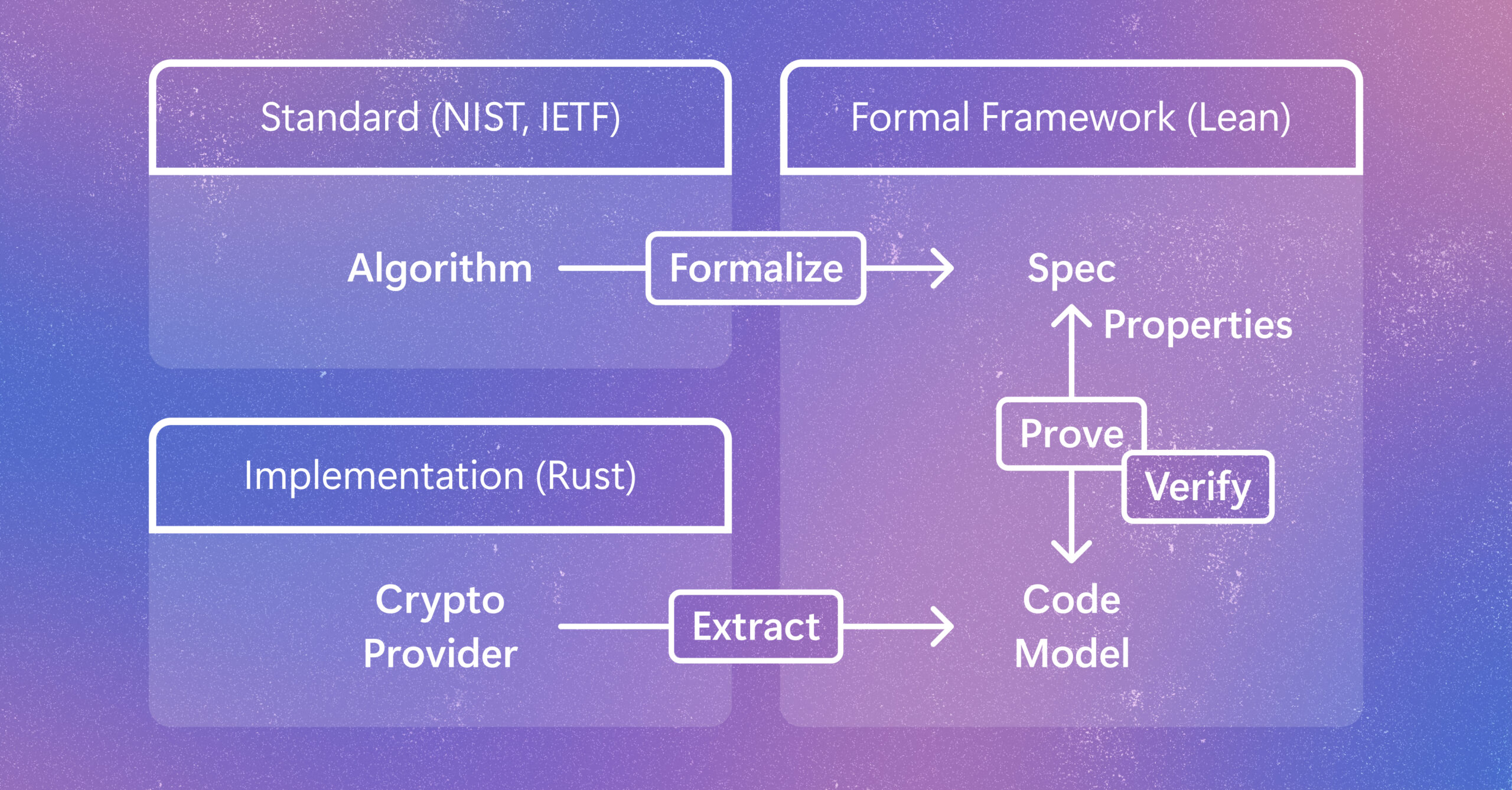
Verifying Rust cryptography in SymCrypt, from standards to code

Cryptographic code supports vital protections in modern computing systems. Learn how a new method helps verify code as developers write it while preserving speed and adaptability as it gets implemented and evolves. The post Verifying Rust cryptography in SymCrypt, from standards to code appeared first on Microsoft Research.

We use cookies to run the site and, with your consent, for analytics and to show ads. See our Cookie Policy.