Skip to content

Upstream and Downstream Credit Exposure Modeling Around Core Industrial Enterprises

Dec 2026 · The Journal of Applied Engineering and Technologies · 0 citations · 30 references

Abstract

Core industrial enterprises often anchor large supplier and distributor networks, and their operational or financial changes may affect upstream procurement, downstream sales, trade credit, receivable turnover, and bank credit exposure. Credit risk assessment focused only on a single borrower may miss hidden risk accumulated through dependence on a core enterprise. This study proposes an upstream and downstream credit exposure modeling method around core industrial enterprises. The model constructs a multi-relational graph linking core firms, suppliers, distributors, receivables, purchase orders, bank credit lines, guarantee contracts, logistics records, ownership ties, and payment outcomes. A graph neural inference module captures credit exposure transmission across upstream and downstream relations, while knowledge rules identify dependency risks from delayed payment, customer concentration, order contraction, shared guarantors, and regional industry shocks. Experiments are conducted on a core-enterprise credit dataset containing 8,240 core industrial firms, 162,000 upstream suppliers, 96,000 downstream distributors, 2.18 million purchase-order records, 1.34 million receivable entries, 74,000 bank credit contracts, and 9,860 confirmed credit-risk cases over 40 months. The proposed method shortens median early-warning time from 76 days to 28 days compared with a borrower-only credit model. It identifies 10,420 upstream exposure chains and 6,780 downstream repayment-risk paths linked to core-enterprise financial stress. Graph aggregation reduces 21,600 borrower-level alerts to 4,950 supply-chain exposure review cases. Portfolio simulation shows that graph-informed monitoring reduces expected overdue credit exposure by 156 million RMB during the validation period. The results demonstrate that upstream and downstream graph reasoning can improve credit risk management around core industrial enterprises by revealing dependency-based financial risk transmission.
View source

Similar papers

#computer vision Conference Aug 2008

Scrum in a Multiproject Environment: An Ethnographically-Inspired Case Study on the Adoption Challenges

Agile methods continue to gain popularity. In particular, the Scrum method appears to be on the verge of becoming a de-facto standard in the industry, leading the so called Agile movement. While there are success stories and recommendations, there is little scientifically valid evidence of the challenges in the adoptio...

A. Marchenko, P. Abrahamsson · 59 citations · ⚡11
#computer vision Open access Sep 2012

Making the leap to a software platform strategy: Issues and challenges

A comprehensive taxonomy of the challenges faced when a medium-scale organization decided to adopt software platforms is provided, namely: business challenges, organizational challenges, technical challenges, and people challenges.

Yaser Ghanam, F. Maurer, P. Abrahamsson · 41 citations · ⚡3
#machine learning Open access Mar 2024

Integration of molecular coarse-grained model into geometric representation learning framework for protein-protein complex property prediction

MCGLPPI, a novel geometric representation learning framework that combines graph neural networks (GNNs) with the MARTINI molecular coarse-grained (CG) model to predict overall PPI properties accurately and efficiently, offers an effective and efficient solution for PPI overall property predictions.

Yang Yue, Shu Li, Yihua Cheng et al. · 15 citations

PepPCBench is a Comprehensive Benchmarking Framework for Protein-Peptide Complex Structure Prediction

PepPCBench enables a robust evaluation of PFNN-based methods and supports their continued development for peptide-protein structure prediction, and highlights the influence of peptide length, conformational flexibility, and training set similarity on prediction accuracy.

Si-Long Zhai, Huifeng Zhao, Ji-Ke Wang et al. · 13 citations · ⚡1
#machine learning Open access Sep 2025

Unified and explainable molecular representation learning for imperfectly annotated data from the hypergraph view

OmniMol is presented, a framework using hypergraphs to improve predictions of molecular properties, addressing challenges of imperfect data annotation and enhancing model explainability, and achieves state-of-the-art performance in properties prediction.

Bowen Wang, Junyou Li, Donghao Zhou et al. · 11 citations

Related blog posts

Microsoft Research Blog Jul 13, 2026

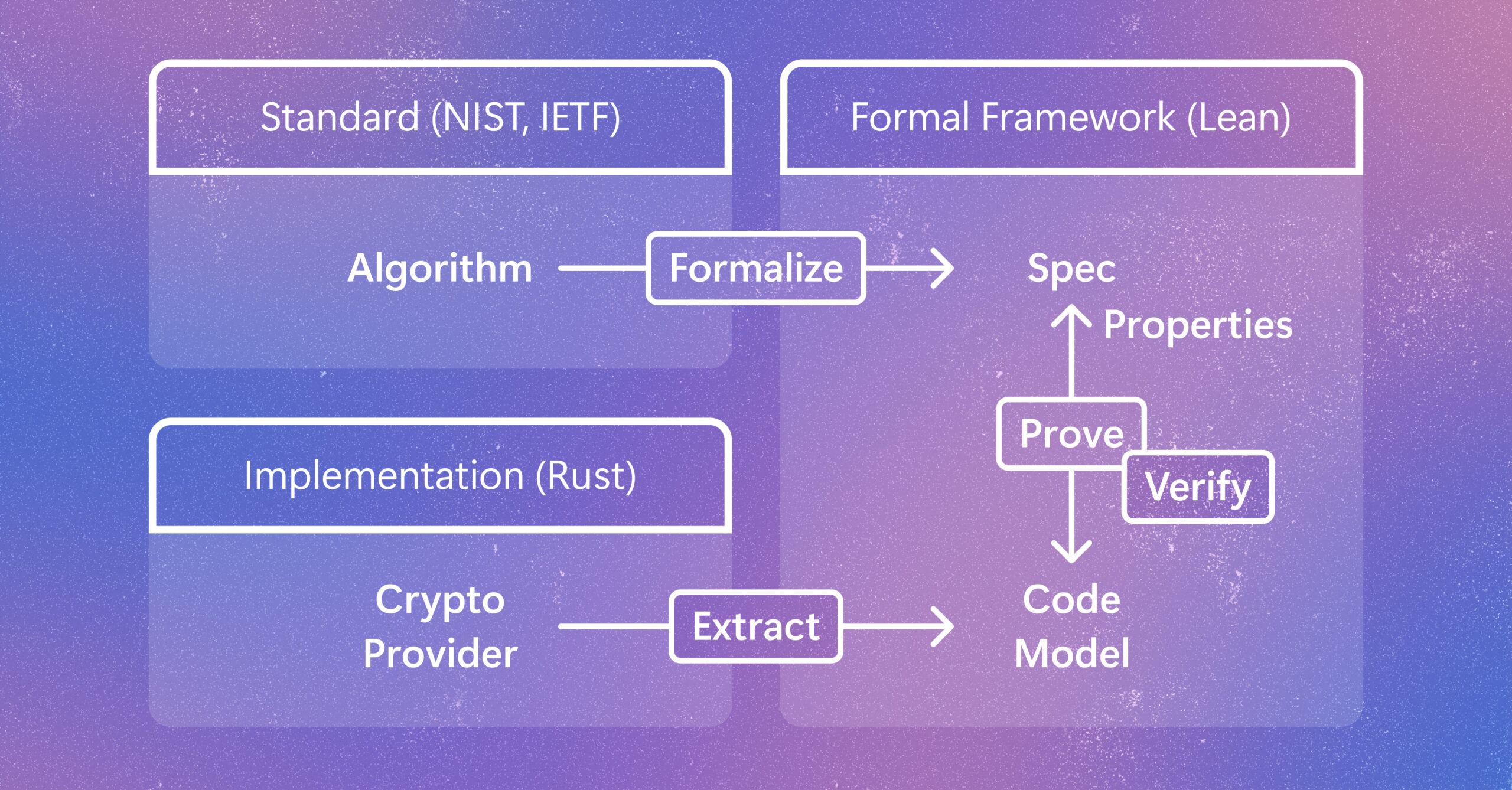
Verifying Rust cryptography in SymCrypt, from standards to code

Cryptographic code supports vital protections in modern computing systems. Learn how a new method helps verify code as developers write it while preserving speed and adaptability as it gets implemented and evolves. The post Verifying Rust cryptography in SymCrypt, from standards to code appeared first on Microsoft Research.

We use cookies to run the site and, with your consent, for analytics and to show ads. See our Cookie Policy.