Skip to content

River ST-GNN Forecast: code and trained weights for river-stage forecasting in Ascension Parish, Louisiana

Oct 2026 · Zenodo (CERN European Organization for Nuclear Research)

Abstract

River ST-GNN Forecast provides research code and trained weights for the manuscript "An operational river-stage forecasting system using spatiotemporal graph neural network (ST-GNN) in Ascension Parish, Louisiana", prepared for submission to Hydrology and Earth System Sciences (HESS). The software compares a spatiotemporal graph neural network (ST-GNN), a GRU with identity adjacency, and a nodewise LSTM in a managed, low-gradient drainage network. The models use 72 hours of historical observations to forecast river stage over the next 24 hours at 15-minute intervals across 68 gauges, including 51 scored in-parish gauges and 17 supporting boundary gauges. This GitHub-synced v1.0.0 release contains data preparation and feature construction, graph construction, chronological training, inference, rainfall-forcing preparation, operational postprocessing, evaluation, and the original figure and table recipes. It also includes trained checkpoints, node order, normalization statistics, training histories, model lineage and checksums; configuration files; environment requirements; reproduction instructions; and development scripts retained for provenance. The code and weights are distributed under the Apache License 2.0. The study selects training duration and graph configuration using 2023-2024 training data and chronological validation in 2025. Final models are reinitialized and fitted to eligible pre-2026 data, then held fixed for evaluation at 5,832 hourly forecast origins from January to August 2026. The three training seeds are 101, 202 and 303. The 927 event-only origins are defined by parish pump operation at issue time. Hindcasts use observed future rainfall with postprocessing off; simulated operational forecasts use archived issue-time HRRR rainfall with continuity blending, stale-data handling, and rainfall-dependent rise caps. A standalone Python script reproduces the paired uncertainty analysis from the companion evaluation data using NumPy, with 10,000 paired resampling replicates over gauges and 72-hour blocks. The original training and inference workflow requires the documented input-data layout and dependencies. The complete raw training matrix, private Parish HEC-RAS terrain and mesh files, operational credentials, server addresses, and the Parish operational rainfall downloader are not distributed. The supplied checkpoints depend on Ascension Parish gauge order, graphs and normalization statistics; application to another watershed requires its own inputs and model fitting. Source repository: https://github.com/awesomemfg/River_ST_GNN_Forecast. Release snapshot: https://github.com/awesomemfg/River_ST_GNN_Forecast/tree/v1.0.0. Companion evaluation data and derived graphs: https://doi.org/10.5281/zenodo.23086107. The companion data support scoring and uncertainty calculations; retraining requires additional original telemetry and meteorological inputs.
View source

Similar papers

#computer vision Conference Aug 2008

Scrum in a Multiproject Environment: An Ethnographically-Inspired Case Study on the Adoption Challenges

Agile methods continue to gain popularity. In particular, the Scrum method appears to be on the verge of becoming a de-facto standard in the industry, leading the so called Agile movement. While there are success stories and recommendations, there is little scientifically valid evidence of the challenges in the adoptio...

A. Marchenko, P. Abrahamsson · 59 citations · ⚡11
#computer vision Open access Sep 2012

Making the leap to a software platform strategy: Issues and challenges

A comprehensive taxonomy of the challenges faced when a medium-scale organization decided to adopt software platforms is provided, namely: business challenges, organizational challenges, technical challenges, and people challenges.

Yaser Ghanam, F. Maurer, P. Abrahamsson · 41 citations · ⚡3
#machine learning Open access Mar 2024

Integration of molecular coarse-grained model into geometric representation learning framework for protein-protein complex property prediction

MCGLPPI, a novel geometric representation learning framework that combines graph neural networks (GNNs) with the MARTINI molecular coarse-grained (CG) model to predict overall PPI properties accurately and efficiently, offers an effective and efficient solution for PPI overall property predictions.

Yang Yue, Shu Li, Yihua Cheng et al. · 15 citations

PepPCBench is a Comprehensive Benchmarking Framework for Protein-Peptide Complex Structure Prediction

PepPCBench enables a robust evaluation of PFNN-based methods and supports their continued development for peptide-protein structure prediction, and highlights the influence of peptide length, conformational flexibility, and training set similarity on prediction accuracy.

Si-Long Zhai, Huifeng Zhao, Ji-Ke Wang et al. · 13 citations · ⚡1
#machine learning Open access Sep 2025

Unified and explainable molecular representation learning for imperfectly annotated data from the hypergraph view

OmniMol is presented, a framework using hypergraphs to improve predictions of molecular properties, addressing challenges of imperfect data annotation and enhancing model explainability, and achieves state-of-the-art performance in properties prediction.

Bowen Wang, Junyou Li, Donghao Zhou et al. · 11 citations

Related blog posts

Microsoft Research Blog Jul 13, 2026

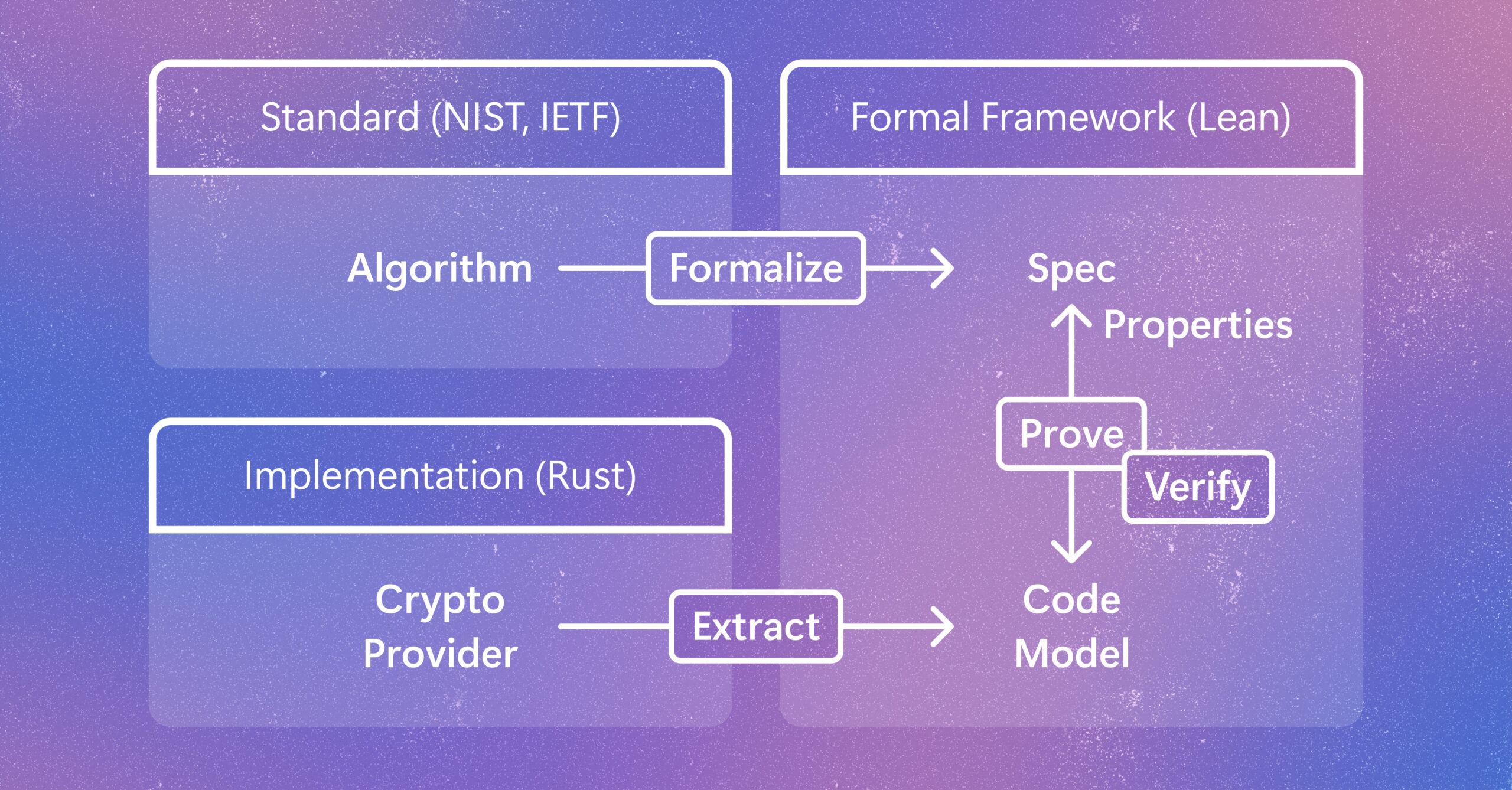
Verifying Rust cryptography in SymCrypt, from standards to code

Cryptographic code supports vital protections in modern computing systems. Learn how a new method helps verify code as developers write it while preserving speed and adaptability as it gets implemented and evolves. The post Verifying Rust cryptography in SymCrypt, from standards to code appeared first on Microsoft Research.

We use cookies to run the site and, with your consent, for analytics and to show ads. See our Cookie Policy.