Skip to content
#graph neural networks Book Open access

Neuroeconometrics and Neuroconnectometrics: Mathematical Foundations, Causal Identification, and Topological Manifolds

Oct 2026 · Zenodo (CERN European Organization for Nuclear Research)
Functional Brain Connectivity Studies

Abstract

Neuroeconometrics and Neuroconnectometrics: Mathematical Foundations, Causal Identification, and Topological Manifolds presents an axiomatic, measure-theoretic, and differential-topological foundation unifying decision neurobiology, high-dimensional econometrics, and structural connectomics. The monograph resolves the fundamental inverse and measurement problems inherent in neuroimaging modalities (fMRI, MEG, EEG, two-photon calcium imaging) by formulating neural latent utility inversion through regularized Fredholm and weakly singular Volterra integral operators, stochastic jump-diffusion processes, and Hamilton-Jacobi-Bellman viscosity solutions. The treatise introduces rigorous causal identification regimes for transcranial magnetic stimulation (TMS) and optogenetic interventions via non-local Maxwell resolvents and Rubin-Angrist local average treatment effect (LATE) boundaries. On structural and dynamic network architectures, the work establishes exact spectral Hodge Laplacians on simplicial complexes, geodesic regression on the Riemannian manifold of positive-definite covariance matrices, and network control theory under port-Hamiltonian dissipative energy bounds. Subgraph communicability and matrix exponentials are proven to govern risk-preference curvature, while graphon mean field games (G-MFG) model multi-agent strategic equilibrium. High-dimensional graph Elastic Net estimators and continuum spatial autoregressive (C-SAR) field equations on 2D Riemannian manifolds are accompanied by non-asymptotic oracle inequalities, minimax rate bounds, and dynamic Schrödinger bridge optimal transport solvers. Package Contents: Complete 12-chapter research monograph, 10-part scholarly front matter, 8-part back matter (chronological timeline 1850–2026, technical glossary, substantive endnotes, comprehensive bibliography, conceptual index), open-science benchmarking protocols (HCP S1200 / UK Biobank), and verified reference algorithms implemented in pyneuroconnect.
View source

Similar papers

#computer vision Conference Aug 2008

Scrum in a Multiproject Environment: An Ethnographically-Inspired Case Study on the Adoption Challenges

Agile methods continue to gain popularity. In particular, the Scrum method appears to be on the verge of becoming a de-facto standard in the industry, leading the so called Agile movement. While there are success stories and recommendations, there is little scientifically valid evidence of the challenges in the adoptio...

A. Marchenko, P. Abrahamsson · 59 citations · ⚡11
#computer vision Open access Sep 2012

Making the leap to a software platform strategy: Issues and challenges

A comprehensive taxonomy of the challenges faced when a medium-scale organization decided to adopt software platforms is provided, namely: business challenges, organizational challenges, technical challenges, and people challenges.

Yaser Ghanam, F. Maurer, P. Abrahamsson · 41 citations · ⚡3
#machine learning Open access Mar 2024

Integration of molecular coarse-grained model into geometric representation learning framework for protein-protein complex property prediction

MCGLPPI, a novel geometric representation learning framework that combines graph neural networks (GNNs) with the MARTINI molecular coarse-grained (CG) model to predict overall PPI properties accurately and efficiently, offers an effective and efficient solution for PPI overall property predictions.

Yang Yue, Shu Li, Yihua Cheng et al. · 15 citations

PepPCBench is a Comprehensive Benchmarking Framework for Protein-Peptide Complex Structure Prediction

PepPCBench enables a robust evaluation of PFNN-based methods and supports their continued development for peptide-protein structure prediction, and highlights the influence of peptide length, conformational flexibility, and training set similarity on prediction accuracy.

Si-Long Zhai, Huifeng Zhao, Ji-Ke Wang et al. · 13 citations · ⚡1
#machine learning Open access Sep 2025

Unified and explainable molecular representation learning for imperfectly annotated data from the hypergraph view

OmniMol is presented, a framework using hypergraphs to improve predictions of molecular properties, addressing challenges of imperfect data annotation and enhancing model explainability, and achieves state-of-the-art performance in properties prediction.

Bowen Wang, Junyou Li, Donghao Zhou et al. · 11 citations

Related blog posts

Microsoft Research Blog Jul 13, 2026

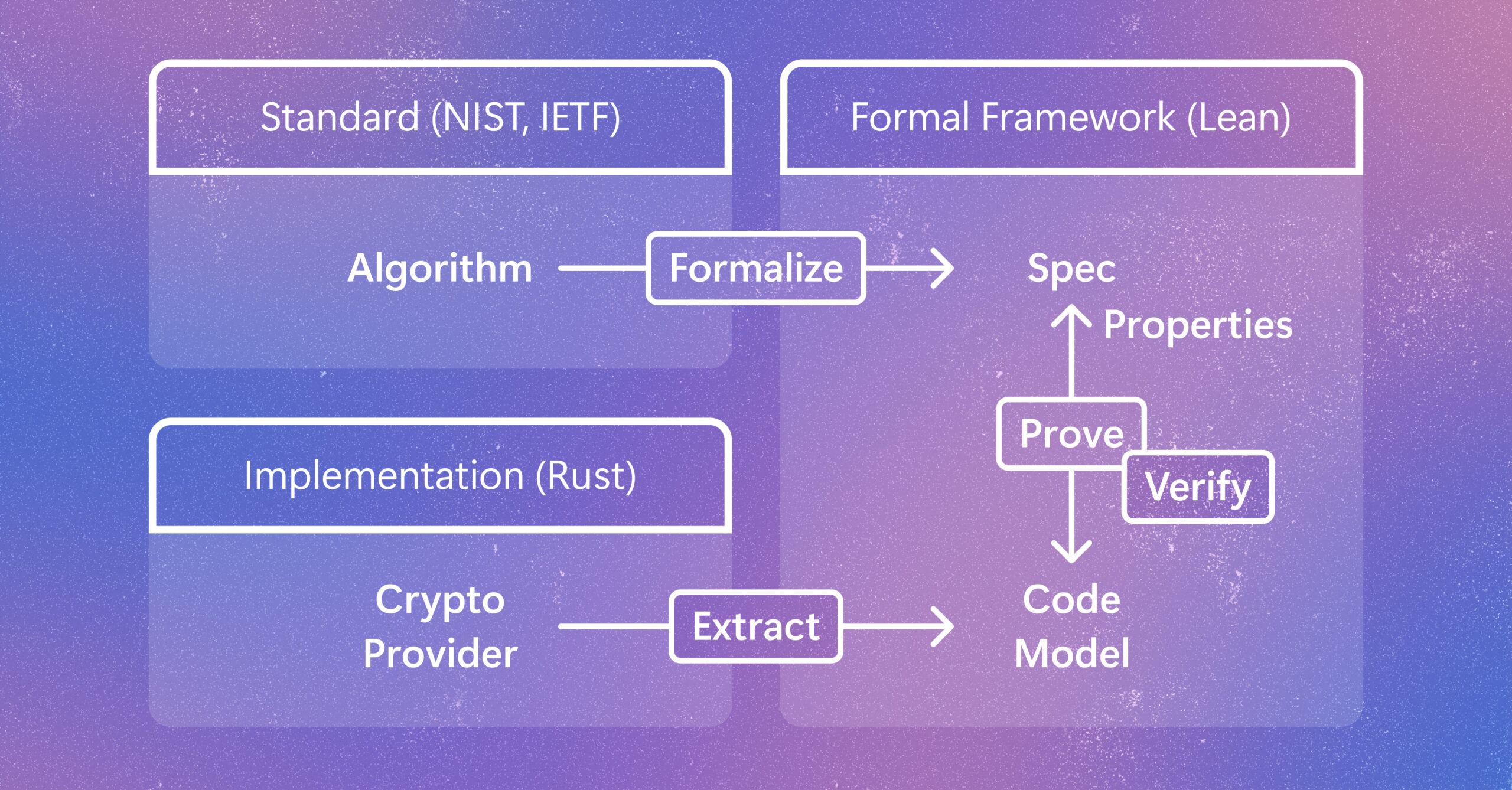
Verifying Rust cryptography in SymCrypt, from standards to code

Cryptographic code supports vital protections in modern computing systems. Learn how a new method helps verify code as developers write it while preserving speed and adaptability as it gets implemented and evolves. The post Verifying Rust cryptography in SymCrypt, from standards to code appeared first on Microsoft Research.

We use cookies to run the site and, with your consent, for analytics and to show ads. See our Cookie Policy.