Skip to content

Longitudinal Artificial Intelligence for Parkinson’s Disease: Modern Modelling, Feature Selection, and Imputation – A Technical Review and Clinical Roadmap

Sep 2026 · AI Computer Science and Robotics Technology · 35 references
Parkinson's Disease Mechanisms and Treatments

Abstract

Parkinson’s disease (PD) research has been reshaped by large-scale multi-modal longitudinal datasets and advances in artificial intelligence (AI) and machine learning (ML). This review synthesises the current state of longitudinal modelling, feature selection, and missing-data imputation for PD, drawing on 154 studies identified through a documented search strategy covering January 2011 to July 2025, with a focus on technical rigour and clinical translation. Classical and modern approaches for modelling disease progression are critically examined, including linear and latent-class mixed-effects models, latent-growth and event-based frameworks, and ML methods such as Subtype and Stage Inference (SuStaIn), graph-based neural networks, and neural ordinary differential equations. Feature-selection paradigms are discussed from statistical and AI-driven perspectives, with attention to cost-aware, fairness-aware, and multi-omics strategies. Imputation methods, from simple techniques to deep generative models, are then reviewed, together with an analysis of how imputation choices cascade through downstream modelling, feature selection, and clinical inference. Reported developments include latent-class mixed-effects models reaching an of 0.92 for cognitive-decline prediction in single-cohort Parkinson’s Progression Markers Initiative (PPMI) analyses, multimodal SuStaIn-based subtyping refined with deep learning and multi-omics integration, graph-based personalised progression models achieving area under the receiver operating characteristic curve (AUCs) of 0.71–0.74 on PPMI/PDBP test sets, and multi-objective feature-selection frameworks jointly optimising cost, equity, and interpretability. Recurring gaps include limited external validation across diverse populations, inconsistent leakage prevention, and weak characterisation of how imputation choices propagate to downstream inference. Priority directions include causal-probabilistic models, uncertainty-driven feature acquisition, federated validation, and transparent imputation protocols with routine fairness auditing, aligned with current reporting standards for systematic reviews and clinical prediction models.
View source

Similar papers

#computer vision Conference Aug 2008

Scrum in a Multiproject Environment: An Ethnographically-Inspired Case Study on the Adoption Challenges

Agile methods continue to gain popularity. In particular, the Scrum method appears to be on the verge of becoming a de-facto standard in the industry, leading the so called Agile movement. While there are success stories and recommendations, there is little scientifically valid evidence of the challenges in the adoptio...

A. Marchenko, P. Abrahamsson · 59 citations · ⚡11
#computer vision Open access Sep 2012

Making the leap to a software platform strategy: Issues and challenges

A comprehensive taxonomy of the challenges faced when a medium-scale organization decided to adopt software platforms is provided, namely: business challenges, organizational challenges, technical challenges, and people challenges.

Yaser Ghanam, F. Maurer, P. Abrahamsson · 41 citations · ⚡3
#machine learning Open access Mar 2024

Integration of molecular coarse-grained model into geometric representation learning framework for protein-protein complex property prediction

MCGLPPI, a novel geometric representation learning framework that combines graph neural networks (GNNs) with the MARTINI molecular coarse-grained (CG) model to predict overall PPI properties accurately and efficiently, offers an effective and efficient solution for PPI overall property predictions.

Yang Yue, Shu Li, Yihua Cheng et al. · 15 citations

PepPCBench is a Comprehensive Benchmarking Framework for Protein-Peptide Complex Structure Prediction

PepPCBench enables a robust evaluation of PFNN-based methods and supports their continued development for peptide-protein structure prediction, and highlights the influence of peptide length, conformational flexibility, and training set similarity on prediction accuracy.

Si-Long Zhai, Huifeng Zhao, Ji-Ke Wang et al. · 13 citations · ⚡1
#machine learning Open access Sep 2025

Unified and explainable molecular representation learning for imperfectly annotated data from the hypergraph view

OmniMol is presented, a framework using hypergraphs to improve predictions of molecular properties, addressing challenges of imperfect data annotation and enhancing model explainability, and achieves state-of-the-art performance in properties prediction.

Bowen Wang, Junyou Li, Donghao Zhou et al. · 11 citations

Related blog posts

Microsoft Research Blog Jul 13, 2026

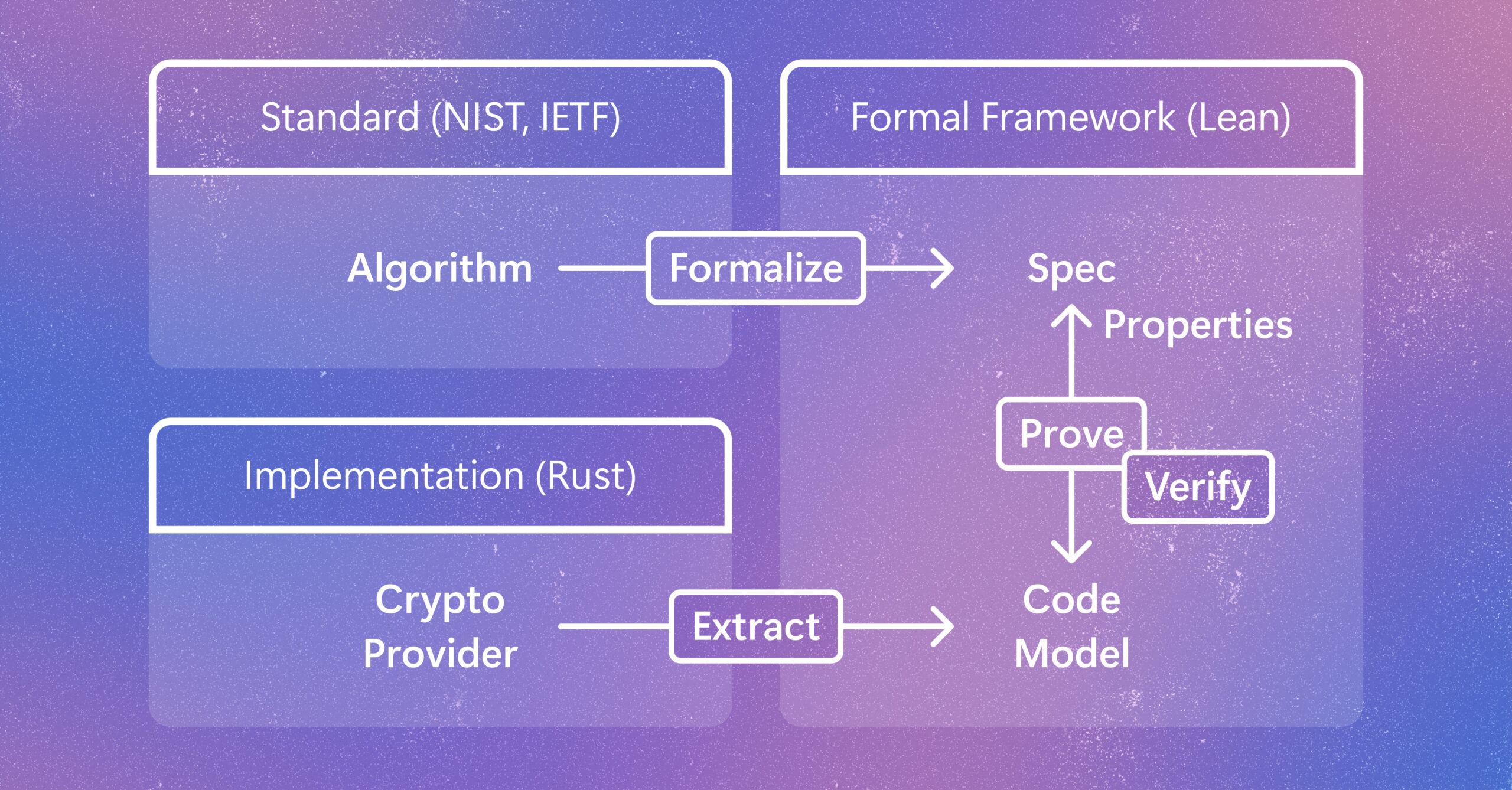
Verifying Rust cryptography in SymCrypt, from standards to code

Cryptographic code supports vital protections in modern computing systems. Learn how a new method helps verify code as developers write it while preserving speed and adaptability as it gets implemented and evolves. The post Verifying Rust cryptography in SymCrypt, from standards to code appeared first on Microsoft Research.

We use cookies to run the site and, with your consent, for analytics and to show ads. See our Cookie Policy.